
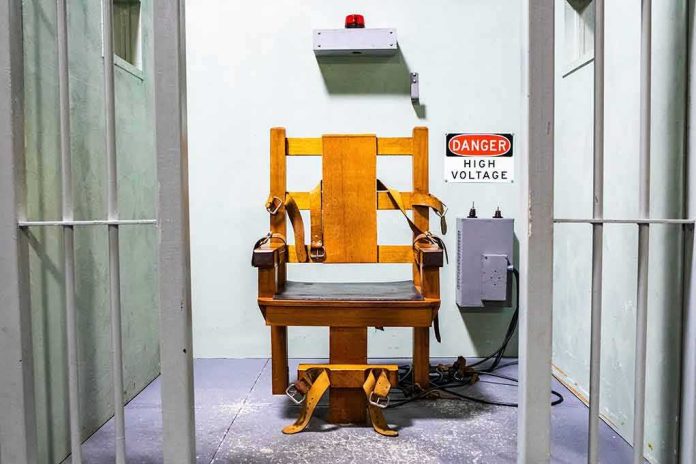
The modern American firing squad is sold as a precise, clinical mechanism for instant death, yet the evidence now on the record—especially from South Carolina—shows how much still depends on human judgment, fallible marksmanship, and the uneasy possibility of executioners intentionally botching their shots.
Key Points
- Idaho has made the firing squad its primary execution method, with an unusually detailed protocol designed to produce a quick, certain death.
- Supporters argue that trained law enforcement shooters, standardized rifles, and cardiac targeting make the firing squad more reliable than lethal injection.
- South Carolina’s recent firing squad execution produced forensic evidence of missed shots, prolonged dying, and judicial findings of “torture,” undermining claims of foolproof precision.
- The combination of secret shooter identities, limited oversight, and historical examples raises a hard question: is there a real risk of executioners deliberately botching shots—by ideology, bias, or psychological avoidance?
From “Humane and Certain” to a Humanly Executed Procedure
When Idaho lawmakers moved the firing squad from backup option to primary execution method, they did so in the shadow of a failed lethal injection attempt: the team assigned to kill Thomas Creech simply could not establish IV access despite repeated tries. The episode crystallized a broader national frustration; lethal injection, once embraced as medicalized and painless, has proved technically fragile and legally fraught. In that context, the firing squad is marketed as a return to reliable mechanics: rifles, bullets, a heart, a team of professionals.
Idaho’s 36‑page protocol, publicly released as IDOC Form 283090, is a deliberate exercise in control. It specifies three POST‑certified law enforcement shooters with at least three years’ experience and clean disciplinary records; they must pass a marksmanship test hitting a target that mirrors the execution setup at close range. Each uses a.308 rifle loaded with dedicated magazines carrying single live rounds, firing simultaneously from a fixed distance at a clearly marked cardiac target. The condemned is restrained, offered a mild sedative before execution, and monitored by a medical team that confirms death. On paper, every variable that can be standardized—from weapon type to shooter training—is standardized.
Proponents read that protocol as a moral improvement. They point to data suggesting firing squad executions, historically, have been less frequently botched than lethal injection, particularly when compared to the wave of visible failures in recent decades. They also emphasize that firing squads rely on skills a subset of American professionals already possess: law enforcement officers and military shooters trained to deliver accurate fire under pressure. The implicit claim is not just that the firing squad is more “certain,” but that it is less vulnerable to the messy uncertainties of pharmacology and supply chains.
South Carolina’s Botched Execution: Precision Meets Practice
The counter‑case stops being theoretical once you examine South Carolina’s recent use of the firing squad. In 2025, the state carried out firing squad executions after authorizing the method as an alternative to lethal injection. The execution of Mikal Mahdi, in particular, has become a test case for how firing squads can go wrong.
An autopsy by Dr. Marcus Bradley for the South Carolina Department of Corrections found only two gunshot wounds despite a protocol calling for three bullets. Neither bullet hit the heart; instead, they passed through the ventricle, diaphragm, liver, and pancreas. A pathologist retained by Mahdi’s attorneys, Dr. Jonathan Arden, concluded that the shooters missed the intended target zone and that Mahdi likely remained conscious and in extreme pain for 30 to 60 seconds before death. The execution that was predicted to produce near‑instantaneous cardiac failure became, in forensic reconstruction, a prolonged, agonizing bleed‑out.
South Carolina’s Supreme Court brought the legal consequences into sharp focus. In a 2024 decision, the court found that firing squad executions in that state amounted to “torture, a possibly lingering death, and pain beyond that necessary for the mere extinguishment of life,” and held the method unconstitutional under the state’s ban on corporal punishments that mutilate the body. Importantly, the ruling did not rest on abstract fears; it was rooted in specific evidence about how the execution had actually been carried out.
Practice failures weren’t limited to the execution itself. A prison official reportedly acknowledged that in training runs, targets occasionally showed only one or two bullet holes where three live rounds were expected, indicating inconsistent accuracy among the volunteer shooters. That pattern undermines the core promise of firing squads: that trained marksmen will unfailingly place bullets through a small, lethal target under stress.
Idaho’s Attempt at Engineering Certainty
Idaho’s protocol can be read as, among other things, an attempt to avoid South Carolina’s mistakes. Where South Carolina used three shooters with live rounds but disclosed little about their training or rifle specifications, Idaho’s document is explicit:.308 caliber rifles with 110‑grain TAP rounds, three magazines per shooter, a fixed 10‑yard distance, and a cardiac target placed by medical staff. Shooter selection is limited to POST‑certified law enforcement officers, and their qualification includes a test in conditions mimicking the execution setup.
The state has invested heavily in infrastructure built to those specifications. Reports place the cost of retrofitting the execution chamber at over $1 million, with additional spending on rifles and related equipment. This level of investment is framed politically as both a response to lethal injection failures and a commitment to a “quick, certain” method. Representative Bruce Skaug has been explicit: in his view, the firing squad is “humane because it is sudden, it is quick, and it is certain.”[ABC 33/40 summary]
At the same time, Idaho has layered in measures aimed at the psychological burden on executioners. Participation is voluntary for Department of Correction staff and law enforcement shooters; volunteers may withdraw at any time, and alternates are on standby. In public commentary, some supporters have invoked the traditional mechanism of issuing at least one blank round so that each shooter can plausibly believe he did not fire a fatal shot, though Idaho’s written protocol, as released, specifies only live rounds in the operational magazines.[Valuetainment summary] These features underscore how much the system depends on human beings willing to fire accurately at a restrained person’s heart, repeatedly, as part of their employment.
Secrecy, Oversight, and the Possibility of Intentional Botching
That dependence on human judgment is where the question of intentionally botched shots arises. Idaho law protects the identities of firing squad members; they are known only to a narrow group of prison leadership and shielded from public disclosure. Access to information about the procedure itself—training records, shooter performance data, detailed after‑action reports—is similarly constrained by statutory and policy limits. Critics, including Robin Maher of the Death Penalty Information Center, have argued that such secrecy makes it “very troubling” for citizens, who are asked to trust that elected officials are making ethical decisions about life and death that the public is not allowed to understand in detail.
Historically, secrecy and discretion have not always produced humane outcomes. Accounts from Utah’s long experience with firing squads include at least one case where shooters allegedly aimed away from the heart in order to prolong suffering. More broadly, the sociological record of executions in various countries includes “ghastly stories,” as one researcher put it, of marksmen missing targets, prisoners initially surviving, and follow‑up shots being required. These instances do not prove that executioners regularly choose to botch their shots, but they demonstrate that the possibility is more than hypothetical.
What would intentional botching look like in the modern Idaho system? It could be as overt as a shooter consciously offsetting his aim from the cardiac target, or as subtle as a team culture that tolerates or even encourages “symbolic” participation—a willingness to fire but with half‑hearted precision. The state’s reliance on volunteer law enforcement officers raises further questions about ideological bias, given longstanding debates about racial and class disparities in death sentencing. Experts cited in public commentary have worried that some executioners might see their role less as carrying out a neutral sentence and more as personally enacting retribution.[PBS summary]
Legally, Idaho has strong incentives to insist on accurate shots. A pattern of missed hearts and prolonged deaths would invite litigation under the Eighth Amendment’s ban on cruel and unusual punishment and could, as in South Carolina, trigger state constitutional challenges. In practice, however, ensuring accuracy requires data: shot placement records from training, ballistic analyses after executions, and independent medical review of time to unconsciousness and death. None of that is meaningfully available to the public today. Without it, the risk that some shootings will be intentionally or carelessly off‑target cannot be quantified or effectively overseen.
Comparative Reliability: Firing Squad Versus Lethal Injection
Many of the arguments for firing squads rest on comparison to lethal injection’s well‑documented failures. Research spanning more than a century has found that a significant minority of lethal injections deviate from protocol—failed IV access, drug precipitation, prolonged gasping, or apparent awareness under paralysis. Idaho’s own Creech attempt is a textbook example of procedural breakdown at the very first step.
Firing squads avoid those particular mechanisms of failure. There is no need to secure a vein, calculate drug dosages, or rely on reluctant pharmaceutical suppliers. The physics of a high‑velocity rifle round aimed through the heart are well understood; if the shot lands where it is supposed to, the probability of instantaneous loss of consciousness is high. Some physicians who have testified in favor of firing squads emphasize precisely this point: the method works when protocol is followed.
Yet the South Carolina evidence shows the hinge of that “if”: when protocol is not followed, the failure mode is gruesome and rapid. A missed heart does not produce a non‑execution; it produces a slower execution, with substantial pain until blood loss or organ damage reaches a critical threshold. In this sense, firing squad reliability is bimodal. Accurate shots can be quick and arguably less chaotic than some lethal injections; inaccurate shots are not simply delays—they transform the execution into a form of mutilating violence that courts have already found constitutionally intolerable.
What Would Real Accountability Look Like?
The tension between engineered precision and human fallibility suggests three practical tests for any jurisdiction using firing squads and hoping to avoid both botched executions and the specter of intentional mis‑aiming.
First, independent ballistic and medical analysis. Idaho’s choice of.308 110‑grain TAP rounds at 10 yards is technically plausible as a means to ensure catastrophic cardiac destruction, but there is no publicly cited cadaver or simulation study verifying time to unconsciousness and death under those specific conditions. Commissioned, peer‑reviewed work could either support or challenge the state’s claims about “sudden, quick, certain” death.
Second, transparent shooter performance data. Anonymity for individual executioners can coexist with aggregate reporting on qualification scores, training shot placement, and post‑execution forensic findings. That kind of data would allow courts, legislators, and the public to assess whether the shooters are consistently hitting their intended targets, or whether South Carolina‑style discrepancies are emerging behind closed doors.
Third, genuine external oversight of execution protocols. Shield laws that prevent meaningful review of procedures and outcomes may protect individual staff from harassment, but they simultaneously weaken institutional accountability. Independent inspectors general, civilian review boards, or court‑appointed experts could examine firing squad operations without exposing shooter identities, striking a balance between safety and transparency.
Absent those measures, the ethical risk remains real. An execution method that depends on human aim, conducted in a sealed chamber by anonymous volunteers, and insulated from detailed public scrutiny is structurally vulnerable to both unintentional error and, in the worst case, intentional deviation. Idaho’s insistence on technical detail is a step toward reliability; whether it is enough to rule out botched shots—especially botched shots by design—will depend less on the rifles and more on the systems built to watch the people holding them.
Idaho is making a major change to how it carries out executions.
The state is now the first in the nation to designate the firing squad as its primary method, following years of challenges with other approaches.
The move has reignited conversations about capital punishment…
— 1080 KRLD (@KRLD) July 2, 2026
Where the Debate Goes Next
The controversy over firing squads is not an isolated Idaho story; it sits within a broader national pattern of states and the federal government cycling through execution methods in search of a politically acceptable blend of effectiveness and perceived humanity. Nitrogen gas in Alabama, the return of electrocution in several jurisdictions, and the Justice Department’s own embrace of firing squads for federal executions all reflect a common impulse: when one method’s failures become too visible, officials reach for another.
In that cycle, the hardest question may be the one this article began with: when we build systems that rely on human shooters, behind closed doors, aiming at living people restrained to chairs, how confident can we be—not just that the shots will hit—but that they are meant to? The answer, at least so far, is mixed. Some jurisdictions have executions that appear technically smooth; others have produced autopsies and court opinions describing pain and torture. The future of the firing squad as an American institution will turn less on rhetorical claims about “certainty” and more on whether states like Idaho are willing to submit their engineered procedures to rigorous, independent scrutiny in practice.
Sources:
feedpress.me, idahostatesman.com, police1.com, youtube.com, deathpenaltyinfo.org, facebook.com, prisonlegalnews.org, southcarolinapublicradio.org, nbcnews.com, cbsnews.com, pbs.org