Economic warfare is policy by other means; used skillfully, it can throttle a state’s revenue, finance, and trade without firing a shot—yet history shows it rarely delivers fast political capitulation. President Trump’s declared pivot to “the most crushing” economic operation against Iran squarely fits that paradox: maximum financial pressure as the preferred instrument, calibrated to outlast a shooting war while tightening the vise on Tehran’s access to money, markets, and maritime routes.
At a Glance
- President Trump has shifted emphasis from fresh military strikes to intensified economic pressure on Iran, pairing sanctions escalation with maritime interdiction.
- Treasury’s toolset ranges from primary and secondary sanctions to designations targeting oil, shipping, banking, and—more recently—digital-asset conduits.
- Sanctions reliably inflict macroeconomic pain; their track record at forcing strategic policy reversals in Iran is mixed and time-limited.
- This campaign echoes prior “maximum pressure” phases, but with broader financial plumbing in scope and a blockade posture constraining oil exports.
What Washington is doing: sanctions first, force held in reserve
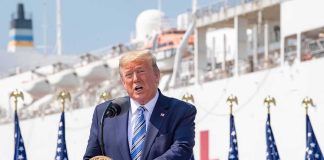
The administration’s center of gravity has moved to finance. President Trump has been explicit that he is “low-keying it,” emphasizing Iran’s inflation, cash squeeze, and deteriorating credit access over immediate renewed strikes, while promising an unprecedented expansion in sanctions reach and intensity. Treasury officials have previewed measures “never been seen” before, telegraphing steps that go beyond traditional oil and banking designations into insurance, maritime services, and alternative payment rails. The logic is straightforward: accelerate a liquidity crisis by constricting export earnings, confiscating or freezing reachable sovereign funds, and raising the costs and legal risks for any foreign entity that enables Tehran’s trade.
Institutionally, this runs through the Office of Foreign Assets Control (OFAC), which implements multiple legal authorities spanning executive orders and statutes under the Iran program. OFAC’s toolkit includes primary sanctions (barring U.S. persons from most dealings), secondary sanctions (threatening non-U.S. entities with loss of U.S. market access if they transact with sanctioned Iranian sectors), and targeted designations against individuals, front companies, vessels, and financial intermediaries. These levers were extensively used during earlier rounds, including the 2018 reimposition that swept hundreds of names in one day—an operation Treasury then called the most expansive single-day Iran action to date.
How it bites: revenue denial, transaction friction, and maritime choke points
Sanctions campaigns work through three channels. First, revenue denial: choking oil exports deprives the state of hard currency, squeezing budgets for imports, military procurement, and patronage. Second, transaction friction: banks, insurers, and logistics providers raise compliance thresholds or exit Iran-linked business altogether to avoid U.S. penalties, multiplying costs even for lawful trade. Third, visibility and interdiction: designating ships, ports, and facilitators—and, when paired with a blockade posture, inspecting or turning back cargoes—impedes physical flows.
Washington has increasingly targeted the financial plumbing Tehran uses to evade sanctions, including networks that move value via shell companies, third-country brokers, and, more recently, digital-asset venues. State Department announcements have described designations against exchanges and intermediaries that help the regime maintain offshore connectivity, signaling a campaign that follows the money wherever it migrates. This complements maritime measures aimed at suppressing oil liftings from Iranian ports and deterring ship-to-ship transfers used to obscure provenance.
Continuity and escalation: today’s squeeze in the arc of four decades
Although the rhetoric of an unprecedented operation is new, the playbook is not. Since 1979, U.S. administrations of both parties have layered authorities on Iran, from President Reagan’s 1987 import embargo to successive expansions that incorporated terrorism, proliferation, human-rights, and regional-activity rationales. The 2018 “maximum financial pressure” phase reimposed nuclear-related sanctions lifted under the JCPOA and pledged aggressive enforcement—framing a high baseline that subsequent rounds are now surpassing in breadth and enforcement tempo.
What distinguishes the current moment is coupling that pressure with an overt blockade posture around the Strait of Hormuz—an attempt to translate legal prohibitions into physical scarcity. Reporting across major outlets has captured the administration’s preference to wait out Iran economically, asserting that Tehran is “a mess” financially, cannot borrow, and faces swelling inflation, while Treasury promises additional tranches designed to close remaining escape valves.
Effectiveness, with an asterisk: what the research says sanctions can and cannot do
Scholarly and policy literature converge on a sober conclusion: sanctions are dependable at inflicting macroeconomic damage—on oil output, exchange rates, inflation, and growth—but far less reliable at compelling capitulations on core security policies. Meta-analyses and institutional surveys find no conclusive evidence that sanctions, in isolation, consistently deliver intended political outcomes; their impact tends to decay over time as targets adapt by diversifying trade partners, innovating around payment systems, or deepening autarky.
Iran exemplifies this pattern. Studies reviewing decades of pressure—including periods widely judged “toughest ever”—argue that Tehran absorbed the pain and adjusted its behavior at the margins rather than abandoning strategic objectives. Brookings, WTO workpapers, and multiple academic theses cite both early-phase impact and longer-run erosion in effectiveness; sanctions narrow fiscal space and raise domestic costs but do not, on their own, settle questions of nuclear capability, regional posture, or regime durability.
Secondary sanctions and global compliance: the real force multiplier
The single greatest innovation of the past decade is not a new blacklist but the extraterritorial bite of secondary sanctions. By threatening access to the U.S. market and dollar clearing, Washington induces European, Asian, and Middle Eastern firms to police their own exposure; risk officers become enforcers-by-proxy. That leverage explains why relatively small formal changes—say, designating a shipping insurer or a bunker supplier—can cascade into wholesale exit from Iran-facing business. Yet it also introduces political costs, straining allies that bridle at U.S. reach and spawning parallel financial channels designed to blunt American jurisdiction over time.
The administration’s willingness to press this advantage—especially against Chinese, Turkish, Emirati, or Indian intermediaries—often determines whether Iran’s exports fall sharply or merely shift to discounted gray-market flows. Announced intentions to unveil measures “never been seen” suggest a focus on these third-country nodes, including commodity traders, maritime services, and crypto-enabled value transfer, where incremental enforcement yields outsized disruption.
Endgames and risks: why “economic victory” is not the same as strategic success
Financial strangulation can set conditions, but it does not, by itself, create a settlement. Iran retains levers: asymmetric attacks across the region, calibrated maritime harassment, and a nuclear program that can be advanced or paused to shape bargaining. Sanctions also create humanitarian spillovers and political optics—fuel prices, alliance friction, sanctions fatigue—that adversaries exploit. The research consensus is blunt: coercive success tends to require a credible pathway to relief tied to verifiable steps, plus enforcement staying power measured in years, not weeks.
The current U.S. approach—pressure first, force in reserve—keeps escalation options open while betting that compounded scarcity will force choices in Tehran it has long avoided. That wager may be prudent compared with large-scale war, and it will almost certainly deepen Iran’s economic distress. Whether it compels the strategic concessions Washington seeks is a different question—one history suggests will be answered not by sanctions alone, but by the clarity of the off-ramps and the credibility of the sticks.
Trump has just made his harshest announcement yet: “the most crushing economic operation in history” against Iran. ECONOMIC D-DAY. Total isolation. Any country that gives it financial relief will suffer the consequences.
The tone is pure Trump: all caps, drama, “maniacs on the…
— Miguel (@m1guelsv) August 20, 2026
The sober benchmark for judging results
Judge this operation on concrete financial outcomes—sustained oil export suppression, verified loss of access to global financial pipes, and the drying up of maritime workarounds—and on diplomatic architecture that translates leverage into enforceable commitments. Past campaigns that maximized pain without mapping relief rarely produced durable change. The administration says it is “watching economic pressure mount”; if the endgame is more than pressure for pressure’s sake, the proof will be a negotiated instrument that swaps measurable rollback for calibrated sanctions relief, backstopped by enforcement that allies can own and adversaries cannot easily route around.
Sources:
redstate.com, aljazeera.com, cnn.com, cnbc.com, reuters.com, fortune.com, npr.org, finance.yahoo.com, state.gov, wsj.com