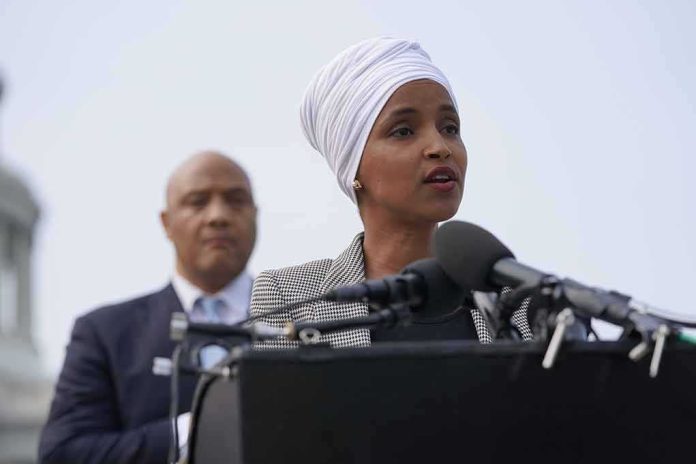
When federal agents obtain a warrant to search a sitting lawmaker’s home and a grand jury issues subpoenas to relatives, the conversation moves from rumor to process: whatever anyone suspects or denies, the government has secured judicial authority to investigate. That distinction—investigative authority versus adjudicated proof—frames what is actually known and what still isn’t in the Ilhan Omar matter.
At a Glance
- Federal investigators executed a judicially authorized search of Rep. Ilhan Omar’s Washington, D.C., residence and seized her phone as part of a criminal probe.
- Reporting points to an active grand jury and multiple subpoenas, including to relatives, focused in part on potential fraud in immigration paperwork.
- A federal judge described a sealed, 67-page affidavit underlying the search and partially unsealed related filings that addressed congressional-privilege safeguards.
- No charges have been filed; public records document investigative steps, not proof of any immigration offense or personal culpability.
What Has Been Established: Investigative Steps With Judicial Oversight
The most concrete facts are procedural. Federal agents searched Omar’s D.C. residence pursuant to a warrant and seized her phone, confirming an ongoing criminal investigation anchored in judicial process rather than informal inquiry. Separately, accounts from multiple outlets describe grand-jury activity, including subpoenas to relatives, regarding possible fraud in immigration paperwork. The court docket surrounding the search is particularly instructive: Chief U.S. District Judge James Boasberg referenced a 67-page probable-cause affidavit—substantial by any measure—and ruled that public release would be premature given the sensitivity of the investigation.
Boasberg also ordered a partial unsealing of filings that illuminate the constitutional guardrails used when searching a member of Congress, including procedures to allow identification and shielding of legislative material before execution of the warrant. That aligns with established Speech or Debate Clause practice, which protects core legislative activity even as non-legislative evidence may be seized with appropriate safeguards.
What Remains Unclear: Allegations, Scope, and Individual Culpability
Despite the rigor of these investigative steps, the public record leaves major questions unanswered. The sealed affidavit means the precise alleged false statements, forms, dates, and witnesses are not visible to the public. Reporting indicates a focus on immigration history and related family documentation, but does not delineate who allegedly made what statement or received which benefit—critical distinctions in any immigration-fraud theory. Moreover, while some accounts describe both Washington and Minnesota grand-jury activity, it is not yet clear whether these are parallel strands of one investigation or separate inquiries.
Equally important, warrants and subpoenas are evidence of probable cause and investigatory need; they are not findings of guilt. No indictment has been reported, and there is no adjudication of the underlying allegations. In practical terms, the investigation has crossed a significant threshold—judicial authorization to search and compel evidence—without crossing the threshold that matters most for culpability: a charge supported by admissible proof tested in court.
How Searches of Lawmakers Work: Speech or Debate Protections and Process
Searching a member of Congress implicates the Speech or Debate Clause, which shields legislative acts and certain legislative materials from executive intrusion and evidentiary use. Courts have long required procedures—often called “filter” or “taint” protocols—to ensure investigators do not review privileged legislative content while lawfully obtaining non-legislative evidence relevant to suspected crimes. Judge Boasberg’s partial unsealing confirms the court and prosecutors negotiated and implemented such protections before authorizing the search of Omar’s home.
This framework does not place lawmakers above the law; it ensures constitutional separation of powers remains intact while criminal laws are enforced. Historically, courts have permitted searches that respect these boundaries; when agents have overreached, appellate rulings have curtailed the use of privileged material. The Omar docket signals adherence to that cautious, supervised model rather than a freewheeling raid.
Grand Juries, Probable Cause, and the Evidence Gap the Public Sees
Grand juries sit in secret by design. That secrecy protects witnesses, guards reputations, and prevents targets from evading scrutiny while prosecutors decide whether evidence justifies charges. The upshot for observers is an asymmetry: visible process (searches, subpoenas, litigation about privilege) without the underlying evidentiary narrative. That is why the most reliable public anchors in this case are the court’s own references to a comprehensive affidavit and the fact of judicially approved execution steps—not any particular third-party allegation about what investigators will eventually prove.
Anonymous-source reporting can accurately foreshadow prosecutorial focus, and multiple credible outlets have described potential immigration-paperwork theories; still, those accounts remain secondary to the court-validated facts we can see. Until the affidavit is unsealed or charges filed, the specifics of the government’s theory will remain necessarily incomplete.
WOW! This isn't a social media rumor anymore. A federal grand jury in Minnesota is reportedly hearing evidence in the Ilhan Omar investigation.
According to Fox, at least two probes are underway, one into alleged immigration fraud.pic.twitter.com/ozajlKphnA
— TRUMP ERA NEWS (@Era_newstv) November 25, 2026
Competing Narratives and What They Do—and Don’t—Change
The surrounding politics are loud. Omar has consistently rejected long-running allegations about her family and marriage as baseless, and independent fact-checkers have repeatedly found those earlier claims unproven or unsupported by concrete evidence. Those prior rumor cycles, however, neither validate nor vitiate the present investigation; this probe is anchored in formal process, not social-media conjecture. What matters legally is what prosecutors can document, authenticate, and admit into evidence—and whether any such case survives motion practice and, if brought, a jury’s scrutiny.
What to Watch Next: From Probable Cause to Proof
The single development that would materially change the posture is unsealing of the 67-page affidavit or the filing of an indictment. Unsealing would reveal the specific statements, documents, and witness evidence investigators say establish probable cause. An indictment would indicate prosecutors believe they can prove essential elements beyond a reasonable doubt at trial. In either event, expect renewed litigation over the scope of seized materials, the handling of any legislative content, and, if immigration records are central, the provenance and admissibility of foreign and historical documents.
Until then, the responsible reading is straightforward. The government has taken significant, law-governed steps to investigate. A federal judge has supervised those steps and kept the core affidavit sealed because disclosure could compromise ongoing work. Multiple outlets corroborate the existence of a real investigation, not a rumor mill. And none of that, standing alone, proves a crime. Both truths can sit together: the process is serious, and the outcome is unresolved.
Sources:
redstate.com, 957wdae.iheart.com, inquirer.com, mprnews.org, twincities.com