
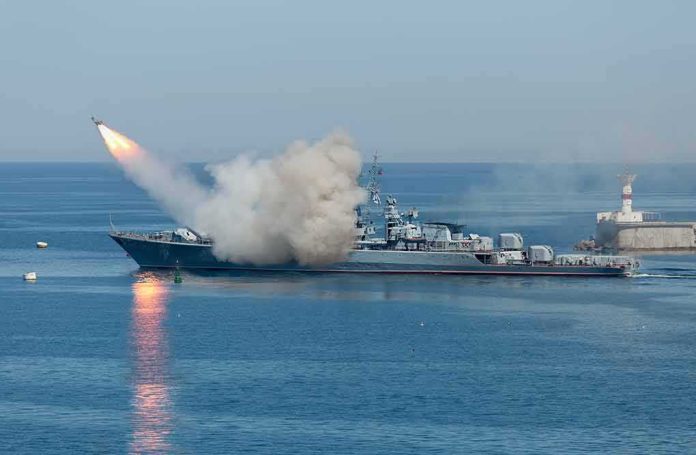
In the Gulf, words are weapons: Iran’s repeated vows to answer any new U.S. strike with a “crushing,” “powerful,” and potentially “dozens of times stronger” response are not improvisation but deterrent signaling—calibrated to raise costs, condition U.S. choices, and keep actual escalation inside boundaries Tehran still believes it can manage.
The Short Version
- Tehran has publicly tied retaliation to specific triggers—especially strikes on infrastructure—promising immediate and forceful responses.
- The U.S. frames its strikes as defensive moves to degrade Iranian threats to shipping and regional bases; both sides message for deterrence.
- Despite ferocious rhetoric, Iran’s pattern favors tit-for-tat reprisals and asymmetric tools over open-ended war.
- The credibility of future “stronger” retaliation rests on capability, risk tolerance, and the political utility of calibrated escalation.
What Tehran Is Signaling When It Threatens “Crushing” Retaliation
Iranian military and political leaders have, across multiple official and state-aligned channels, warned that any further U.S. attacks will draw a more painful response. These are not one-off flourishes. The Armed Forces General Staff vowed a “crushing” answer to U.S. aggression; the Supreme National Security Council has explicitly linked retaliation to attacks on infrastructure—“eye for an eye”—and the foreign minister underscored an “immediate and powerful” response doctrine. In late summer, an official amplified that any new American strike could elicit a reply “dozens of times stronger.” Taken together, the messaging codifies a trigger-action ladder rather than a vague threat: hit critical assets, face prompt payback of increasing intensity.
The emphasis on infrastructure is deliberate. In Iranian doctrine, attacks that degrade command-and-control, coastal radars, or missile forces are not merely tactical losses; they signal attempts to blind or disarm Iran’s coercive levers. Tying retaliation to such strikes raises the expected price for U.S. planners contemplating further raids. Tehran’s state-aligned press amplifies this line because it serves two audiences at once: external adversaries calculating risk, and domestic constituencies that demand visible resolve.
How Washington Frames Its Own Use of Force
U.S. Central Command has cast recent operations as necessary, proportional, and aimed at maritime security. Official statements describe precision strikes on Iranian air defenses, coastal radar, anti-ship missile batteries, logistics nodes, and swarms of small IRGC boats—measures intended to “degrade” Iran’s ability to menace commercial shipping and “innocent civilian mariners” in the Strait of Hormuz. The public rationale is consistent: the United States responds immediately to Iranian or proxy attacks on vessels or U.S. positions, then strikes to prevent recurrence. President Trump’s own rhetoric—promising to “hit them hard” and warning “there will be a response”—fits a deterrent template that mirrors Tehran’s certainty of reprisal, albeit with opposite attribution of blame.
In practice, both sides use official statements to shape the same decision space. Washington stresses the defensibility and precision of its operations, minimizing the prospect of civilian harm and keeping the legal frame on freedom of navigation. Tehran stresses reciprocal justice and the inevitability of payback, deterring further strikes by threatening costs at sea and across nearby bases. Messaging battles do not decide outcomes, but they do influence thresholds and pacing.
Mechanism: Why Iran’s Threats Are Both Real and Bounded
Rhetorical maximalism coexists with operational calibration. Over four decades, Iran has built a repertoire that favors asymmetric tools—ballistic and cruise missiles, drones, maritime mining and interdiction, cyber operations, and partner militias—executed in measured salvos rather than unconstrained barrages. Analysts who track this pattern argue fears of automatic “all-out war” are routinely overstated: Tehran wants deterrence, not annihilation, and therefore choreographs retaliation to restore perceived balance of pain without triggering regime-threatening escalation.
That logic explains why threats of “dozens of times stronger” are best read as deterrent multipliers, not binding promises of unlimited force. Capability matters, but so does escalation management. Iran can raise intensity—more missiles, simultaneous axes, deeper target sets—while still avoiding targets that would force a massive U.S. reply. The risk is not empty talk; it is a ladder with missing rungs above a certain height.
History and Doctrine: From Strategic Patience to Active Deterrence
Iran’s strategic posture has evolved from “strategic patience” to what many describe as “active deterrence”—faster retaliation cycles, a greater willingness to strike directly, and less reliance on deniability when signaling resolve. The shift reflects lessons drawn from repeated exchanges: restraint without visible reciprocity invited pressure; calibrated, attributable force better stabilized the deterrent balance. Even so, the escalation remains bounded by regime survival imperatives and the high costs of industrial-scale war.
The U.S. approach likewise oscillates between compellence and deterrence. Degrading specific threat vectors—radar, anti-ship missiles, drone hubs—advertises military dominance and aims to reset Iran’s cost-benefit math in key corridors like the Strait of Hormuz. But repeated cycles show that tactical success rarely compels strategic acquiescence; it yields adapted Iranian tactics, fresh salvos, and another round of messaging about “proportionate” or “crushing” replies.
Where the Evidence Is Strong—and Where It Is Thin
On the public record, the strongest evidence concerns what each side says it will do and the target sets it claims to have hit. Iran’s senior military bodies and foreign ministry have made explicit, on-the-record warnings—sometimes via state-aligned outlets, sometimes carried by international wires—of immediate and forceful retaliation tied to infrastructure strikes. CENTCOM’s statements specify the categories and volume of targets—“over 80” or “90” at times—attacked to degrade maritime threats.
What remains thinner is independently verified detail about the scale and effects of specific retaliations. Claims and counterclaims over casualties, battle damage, and the precise linkage between a given U.S. strike and a named Iranian response often diverge across official and media channels. That evidentiary gap does not negate the deterrent messages; it limits confidence in predicting the exact form of “stronger” retaliation promised next, or its immediate operational payoff.
What “Dozens of Times Stronger” Could Mean in Practice
Translating rhetoric into military options yields a bounded menu. Iran can compress timelines (faster retaliation), expand salvos (more missiles and drones), diversify axes (simultaneous maritime, cyber, and regional base strikes), and elevate target criticality (deeper hits on radar, C2, or energy-linked infrastructure). It can also exploit geography—strait chokepoints and coastal clutter—where saturation attacks stress defenses. None of these require crossing into strategic bombardment that would trigger overwhelming U.S. escalation; all raise marginal costs and strategic uncertainty for planners on the other side of the Gulf.
For Washington, the counter is familiar: keep degrading the enablers—sensors, launchers, magazines, boats—while demonstrating the capacity to absorb and blunt reprisals. Publicly, the United States will continue to frame each new strike as both immediate response and forward defense of commerce—an argument that resonates with allies so long as tanker traffic flows and collateral damage remains limited.
Iran’s Parliament Speaker Mohammad Bagher Ghalibaf said Sunday that the United States has realized that the era of tit-for-tat retaliation is over, warning that any further aggression against Iran will draw a stronger response.
“The United States has realized that the era of… pic.twitter.com/v3qJnmMHe1
— Al Mayadeen English (@MayadeenEnglish) September 6, 2026
Implications: Navigating a Deterrence Competition That Prefers the Edge
The most important truth in this standoff is structural: both sides need the other to believe that the next rung on the ladder is painfully real, and both are invested in preventing the climb from turning into a fall. That is why threats harden with each round, and why actions, though deadly, tend to remain constrained by recognizable patterns. Expect future statements from Tehran to reiterate immediate, reciprocal, and infrastructure-linked retaliation, and expect Washington to answer with targeted strikes designed to sap maritime and strike capacity while claiming defensive necessity. The danger is not a sudden doctrinal reversal; it is accumulation—misread thresholds, unlucky effects, or domestic political pressures that reward one more step up the ladder.
Sources:
feedpress.me, tehrantimes.com, cnn.com, reuters.com, cnbc.com, moneycontrol.com, aljazeera.com, cbsnews.com, bbc.com