
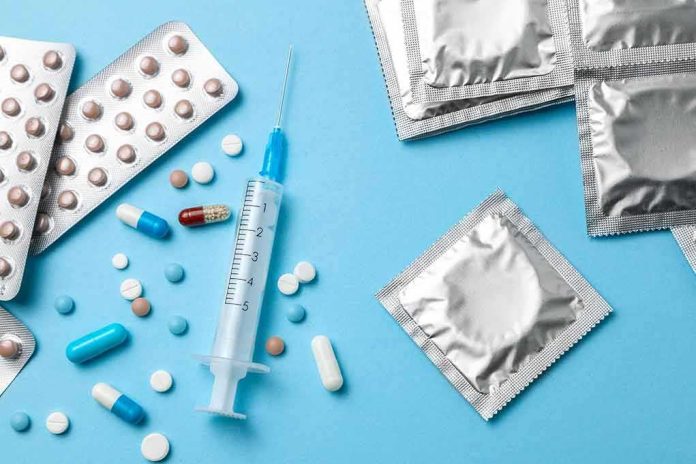
What sounds like a punch line — a freed American journalist saying his government-issued recovery kit included Viagra — is in fact a window into how methodical, and sometimes oddly stocked, post-detention care can be when a hostage or political prisoner comes home.
At a Glance
- Evan Gershkovich says his repatriation “recovery kit” included a Viagra tablet; he kept it as a souvenir
- His account is anchored to a well-documented August 1, 2024 U.S.–Russia prisoner exchange that returned him to American custody
- His description of decompression and readjustment aligns with established post-captivity recovery practice
- The larger exchange and homecoming were publicly recorded, including reception at Joint Base Andrews and White House images
What Gershkovich said — and why it matters beyond the novelty
Evan Gershkovich has described a small but memorable detail from his repatriation: among the items in his government-prepared recovery kit was a Viagra tablet, which he says he saved as a keepsake. He attributed the kit’s assembly to the CIA and contrasted that with his understanding that State Department teams typically handle such packages. On its face, the anecdote is quirky. In context, it highlights how the United States treats the hours and days after release as clinical, logistical, and psychological triage — a practice that can result in kits carrying medications and comfort items that, without explanation, seem incongruous to the recipient.
The timing and setting of the claim are tethered to a well-documented event: the August 1, 2024 prisoner exchange between the United States and Russia. That swap — the largest of the post-Soviet era — saw 24 people change hands and delivered Gershkovich, Paul Whelan, and others back to Western custody; Reuters counted 16 moving West and eight to Russia. The homecoming was public, with freed Americans met by families and U.S. officials at Joint Base Andrews and with White House imagery from the return aircraft. Those records ground the setting for the recovery-kit story even if they do not inventory its contents.
How repatriation “recovery kits” fit into a staged return to normal life
Professionals who manage post-captivity care design the first 72 hours after release as a decompression runway rather than a victory lap. The clinical priorities are consistent across cases: stabilize physical health, create psychological safety, reduce sensory overload, support re-bonding with family, and begin trauma-informed follow-up. The American Psychological Association’s guidance is explicit: medical attention, a secure environment, structured connection to loved ones, and clear pathways to counseling are essential; time and pacing matter. The International Committee of the Red Cross experience with aid workers points to a staged model — immediate care, protection from media exposure, peer and organizational support, and reintegration planning — that maps closely to U.S. government practice.
Gershkovich’s own account of the weeks after release — that re-entering ordinary life felt like “coming down from the International Space Station,” and that talk therapy and writing were his means of regaining equilibrium — is consistent with those established patterns. In that frame, a “recovery kit” is not a novelty bag; it is a pre-positioned set of supplies for a body and mind that have been living under deprivation and control. Agencies vary in who builds and hand-carries such kits depending on the operation, the health profile of the returnees, and the flight or transit environment.
What could a pill like Viagra be doing in a recovery kit?
Without an official packing list, the only confirmed detail is Gershkovich’s recollection that a Viagra tablet was inside and that its purpose was unclear to him. Still, pharmacology and field practice offer plausible, prosaic explanations. Sildenafil — the generic for Viagra — is an FDA-approved vasodilator also used for high-altitude pulmonary hypertension and certain circulatory conditions; its hemodynamic effects have off-label applications in austere medicine where oxygenation, vasospasm, or altitude-related symptoms are concerns. It also appears in some emergency and expeditionary kits because it is orally administered, fast-acting, and stable under typical storage conditions. None of that proves why a tablet would be present in this particular kit, but it does show that its presence need not be salacious or whimsical on its face.
There is also the practical reality that standardized kits, whether assembled by diplomatic security, military medical teams, or intelligence support units, sometimes include broad-spectrum items to cover a range of foreseeable needs for mixed-age, mixed-health cohorts on long flights and uncertain stopovers. Recipients often are not briefed on each blister pack in the moment; they are exhausted, sensory-overloaded, and focused on seeing family. That can make otherwise rational inclusions feel strange out of context.
The verified spine: release, transport, and early decompression
Strip away the single surprising pill and the verified spine of the episode remains straightforward. On August 1, 2024, the United States and partners executed a complex, multi-country swap with Russia that moved two dozen individuals and returned three Americans, including Gershkovich, to U.S. custody. The Associated Press and Reuters documented the scale and choreography of the exchange — with counts of who moved where and when — and U.S. officials greeted returnees at Joint Base Andrews within hours. Those facts establish the setting in which a recovery kit would plausibly be issued: during handover, in transit, or immediately on landing, when medical and psychological screening begin.
Gershkovich has since described a decompression arc familiar to practitioners: overwhelmed senses, disorientation in ordinary spaces, and the slow rebuilding of routines. He reports using talk therapy and writing to translate months of isolation into a narrative he could live with — a step widely recommended because trauma integration requires pacing, consent, and a sense of control reclaimed by the survivor. In other words, his macro story tracks known best practice; the micro anecdote lives inside it.
Evan Gershkovich was handed a ‘recovery kit’ on his way back to the US
🔗 https://t.co/fpnOnUyyf6 pic.twitter.com/lNK3eqCFnh
— The Telegraph (@Telegraph) October 10, 2026
Why the small details endure — and what they risk obscuring
After major releases, the public memory often clings to a single tactile detail: a sweater knitted by a spouse, the first meal, a stray item in a duffel. Journalists and readers do this for understandable reasons; concrete objects make abstract systems human. The hazard is letting a curious object — in this case, a sildenafil tablet — eclipse the unglamorous architecture that gets returnees from a tarmac to a livable tomorrow. The architecture matters more. It is the system that ensures bloodwork gets drawn before the press conference, that arranges a quiet room before the cameras, that pairs a survivor with a clinician who speaks in terms of consent and pacing rather than “moving on.”
The takeaway for readers: focus on the system, not the souvenir
Gershkovich’s story is credible where it counts: it is anchored to a recorded exchange, a documented homecoming, and a recovery process that aligns with expert guidance. The oddity of a single pill should be read the way professionals read it — as a reminder that standardized kits sometimes contain multipurpose medications and that recipients, rightly preoccupied with surviving the transition home, will not always know why every item is there. The deeper truth is the durable one: successful repatriation is staged, clinical, and deliberately boring in its logistics because that boring groundwork is what makes life after captivity possible.
Sources:
feedpress.me, pbs.org, apnews.com, reuters.com, abcnews.com, english.ahram.org.eg, tandfonline.com