
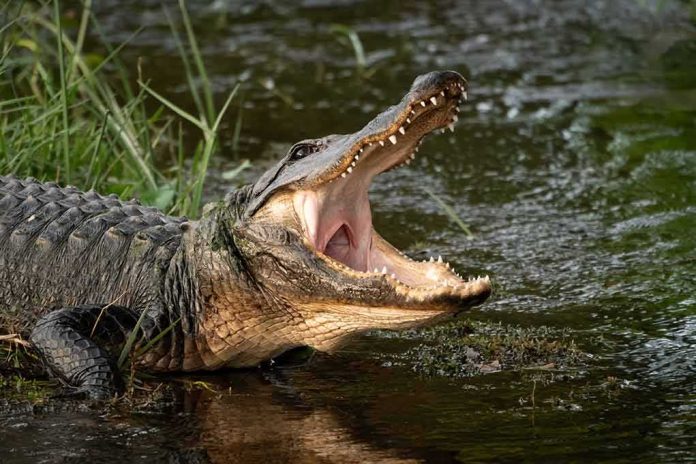
Florida’s gator encounters are not anomalies; they are predictable intersections of wildlife biology, water, and suburban design—and when they happen, well-trained deputies or state-contracted responders turn a dramatic scene into a controlled relocation.
At a Glance
- Indian River County deputies safely secured and relocated an approximately 8-foot alligator from a condominium driveway; no injuries were reported to people or the animal.
- Body-camera video shows the approach, restraint, containment, transport, and release sequence, underscoring a managed operation rather than a chaotic tussle.
- The call was time- and place-specific: a mid-day 911 report from the Pelican Pointe complex along Riverside Drive near Sebastian.
- These events fit Florida’s broader nuisance-alligator framework: public-safety response in a state with about 1.3 million gators and thousands of removals annually.
What Happened: A Controlled Intervention, Not a Spectacle
Deputies in Indian River County responded to a 911 call from a resident who found a large alligator in a condominium driveway at the Pelican Pointe complex, in the 9600 block of Riverside Drive near Sebastian. The mid-day call triggered a standard public-safety response: contain the animal, protect residents, and move the gator out of a high-conflict setting. According to multiple outlets citing the sheriff’s office, two deputies used capture poles—long-handled tools designed to control the head and body safely—progressed the animal into a containment cage, and transferred it for release within the county; subsequent footage documents three deputies releasing the alligator at a more suitable site. No one was injured, including the animal.
The body-camera video is the operational spine of this account. It shows methodical, low-tech wildlife control executed with professional caution: measured approach, coordinated restraint, and a clean transfer from capture to cage to release. The animal’s defensive behaviors—barrel rolls, tail lashing, hissing—read as textbook alligator responses to restraint, visible without signaling loss of control by the deputies. It makes for dramatic television precisely because the animal is large and powerful, but the sequence itself unfolds as trained fieldwork rather than improvisation.
Why Gators Show Up in Driveways: Water, Edges, and Florida’s Built Habitat
Officials tied this particular appearance to recent flooding—high water can displace alligators from preferred cover and push them along canals, swales, and retention ponds into residential corridors. Florida’s coastal and riverine counties overlay wetland mosaics with human infrastructure; when seasonal rains or storm bands stack tides and surface runoff, wildlife follows the hydraulics. The Indian River County flooding coverage during that period underscores the water backdrop in which such encounters occur, even after initial floodwaters recede and animals search new resting or foraging sites.
To understand frequency and posture, scale matters. Florida sustains an estimated 1.3 million alligators across all 67 counties, and the Statewide Nuisance Alligator Program (SNAP) processes thousands of conflict calls each year; the program authorizes the removal of roughly 7,000 nuisance alligators annually. Despite that volume, Florida’s long-term average of about five unprovoked bites a year places risk in perspective: encounters are common, serious incidents are uncommon, and agency posture is therefore pragmatic—reduce conflict where people live without declaring an ecological emergency for every sighting.
How the System Normally Works—and What’s Different Here
Florida’s SNAP framework is explicit about process. When a resident perceives a threat from a four-foot-or-larger alligator, the recommended path is to call FWC’s nuisance hotline. FWC then dispatches a contracted trapper licensed to remove the animal under specific permits and conditions. The default disposition, especially for larger animals, is not feel-good relocation; it is removal—often meaning transfer to licensed possession or euthanasia—because large gators are territorial, may attempt to return, and can create downstream conflicts at release sites.
Because relocation can harm both the transported animal and resident wildlife at the destination, FWC limits when and how it occurs. Written permissions, same-county constraints, minimum acreage for release sites, and short time windows for disposition are the rule set intended to cut risk, not amplify it. City and county agencies may operate under special-use authority in specific scenarios; however, Florida’s published guidance still treats relocation as the exception that must be justified, documented, and executed to code.
Placing the Indian River Response in That Framework
Against that policy background, the Indian River County episode is notable because deputies captured and then released a sizable alligator within the county—precisely the outcome many residents cheer but that state policy treats cautiously. The sheriff’s office described the animal as safely secured and relocated to a “more suitable area” with no injuries. Local reporting, grounded in the agency’s video, aligns: driveway discovery, capture with poles, caging, and later release by a deputy team. The operational output—conflict resolved, gator not killed—fits the public’s intuitive preference while still comporting with Florida’s guidance that, if relocation is used, it be in-county and to appropriate habitat under proper authorization.
Context helps explain the choice. When flooding redistributes animals, the nearest low-conflict wetland or river margin may be a viable release point, particularly if responders can access large, contiguous habitat and secure any required permissions or operate under standing local authority. Florida’s rules contemplate such possibilities; they simply require discipline in how they are carried out to avoid creating a revolving door of nuisance returns or competitive stress at the release site.
Mechanics of Safe Capture: Tools, Technique, and Stress Mitigation
Professionals rely on a few principles shaped by alligator biomechanics. Control the head first; the bite is the danger, not the tail. Use catch poles or snares to stabilize the jaws and cervical area, then immobilize the thorax and hindquarters to prevent the rolling torque that can injure handlers or the animal. Tape or bands are often used on the snout once controlled; movement is limited to short, deliberate carries or slides into a transport cage. The goal is to compress the window of acute stress, minimize struggling by preventing leverage, and keep the airway unobstructed. The Indian River footage shows that choreography: two points of control, coordinated timing, and quick containment—hallmarks of a practiced team.
Relocation adds a second choreography: staging the cage near a water’s edge with a clear egress path, orienting the door toward shoreline cover, and releasing when human foot traffic is nil. A clean release is quiet rather than theatrical—the animal bolts or glides, disappears into tannic water or marsh grass, and the operation ends. That is what the deputies’ video depicts; drama yields to procedure once the door opens.
WATCH: No backup. No fancy equipment. Just a Florida deputy, a roll of duct tape, and an alligator that picked the wrong place to wander.
Wild video shows the deputy carefully grabbing the gator near a fence outside a busy Kissimmee plaza as tourists gather to watch. He manages… pic.twitter.com/akbYLW926R
— Fox News (@FoxNews) November 5, 2026
What This Means for Residents and Property Managers
For coastal and riverine communities, prevention still starts with design and habit. Retention ponds should maintain vegetation buffers that discourage basking near sidewalks; pet areas should be fenced, lit, and kept away from water edges; and trash discipline matters—subsidized foraging trains wildlife to linger. When a large alligator shows in a driveway or parking apron, the right response is simple: step back, clear others from the approach path, and call for help via local law enforcement or FWC’s nuisance hotline. The Indian River case shows why. Trained responders can convert a frightening moment into a managed transfer that protects both people and animal, and they can do it quickly.
Sources:
news.com.au, cbs12.com, weather.com, veronews.com, foxweather.com, myfwc.com