
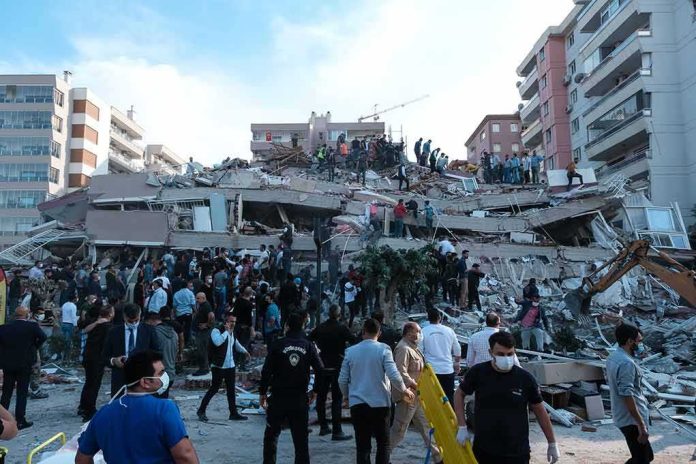
The most revealing image from Kyiv after the latest Russian strike is not the collapsed apartment tower, but the rescuers who refuse to leave the rubble.
Story Snapshot
- A massive Russian missile and drone barrage flattened part of a Kyiv apartment block during the night assault.
- Rescuers spent hours digging through debris for missing residents as the death toll and injuries climbed.[1]
- Moscow claims broad “infrastructure” targets; evidence on the ground shows a concentrated civilian hit zone.[1][2]
- The strike fits a wider pattern of urban bombardment that raises serious questions under the laws of war.
When A Nine-Story Home Becomes A Military “Objective”
Russia’s latest attack on Kyiv did not look like a precision strike on a hardened bunker. Ukraine’s Air Force reported one of the largest combined assaults of the war, with dozens of missiles and drones aimed chiefly at the capital.[1][2] In the middle of that maelstrom, a section of a nine-story apartment block simply ceased to exist. Concrete slabs folded onto each other, exposing living rooms like dollhouses, with dinner tables and children’s beds hanging over empty air.[1]
Russian officials frame these barrages as attacks on energy nodes, command posts, or air defense systems. That narrative might sound plausible from hundreds of miles away. On the ground in Kyiv, the picture looks different. Ukrainian authorities describe the strike pattern as hitting residential areas and civilian infrastructure, with the apartment block as the most brutal example.[2] The building was a modern residential complex, not a camouflage-painted barracks, and nothing in available reporting credibly identifies a military asset inside.[1]
The Night The Ceiling Came Down
Residents of the building went to bed expecting another tense, noisy night of air raid sirens. Many had done this routine for over two years. What they did not expect was for the entire vertical slice of their home to collapse. A combined missile and drone wave rolled over the city; within hours, a chunk of the nine-story block was gone, leaving an open wound in Kyiv’s skyline.[1][2] Firefighters described flames, shattered glass, and a debris field that looked more like an earthquake than a “precision” strike.
Official counts tell only part of the story. Three people were initially confirmed dead, more than thirty injured, and over ten missing as rescuers scrambled through the wreckage.[2] Later tallies and video evidence point to a higher civilian death toll, including children and elderly residents who had no realistic chance to reach a shelter in time.[1] Emergency crews pulled at least two dozen survivors from the rubble, some carried out on blankets because there were not enough stretchers.[2] This profile—unarmed, sleeping civilians in their own homes—is impossible to square with any serious claim of a legitimate front-line target.
Rescuers, Rubble, And The Politics Of Blame
Search and rescue teams worked through the day and into the next night, cutting through twisted rebar and jackhammering concrete while listening for faint tapping under the ruins.[2] These are not elite soldiers; they are firefighters, medics, and volunteers who have repeated this nightmare in city after city. Each recovered body becomes another data point against the idea that these strikes are about “infrastructure” rather than intimidation.[1] The pattern reflects not accidental overshoot, but tolerance for predictable civilian carnage as the cost of hitting broad urban areas.
Ukrainian rescuers, for an entire day, have been pulling the bodies of civilians from a Kyiv apartment building, killed by Russia in the largest missile strike since 2022
The confirmed death toll has reached 8, and at least 20 people remain missing beneath the rubble
📷 DSNS pic.twitter.com/VqFchgDMDF— Euromaidan Press (@EuromaidanPress) May 14, 2026
Supporters of Russia’s position often argue that Ukraine hides military assets in residential zones, or that failed Ukrainian air defense interceptors cause the destruction. That claim has worn thin. Ukrainian and independent reporting has documented past Russian attempts to blame Ukrainian defenses for apartment hits, even when debris clearly traced back to Russian systems. American conservative common sense says this: if you launch large salvos into densely populated cities, you own the outcome, especially when the visible target is an apartment tower full of families.
A Bigger War Inside The City Limits
The Kyiv strike fits a broader campaign of Russian attacks on Ukrainian urban infrastructure that began well before any claimed “retaliation” cycles. Power plants, heating networks, and transportation hubs have all been targeted, but apartment blocks repeatedly appear among the most visible victims.[1] Urban warfare always carries risk to civilians, yet repeated direct hits on large residential complexes suggest either systematic disregard for civilian immunity or deliberate use of terror to sap morale. Both options undercut Moscow’s claims of scrupulous military targeting.
For Americans watching from a distance, the question is not whether war is messy; that is obvious. The question is whether we still draw a moral and legal line around civilians. The strike on this Kyiv apartment building exposes the gap between rhetoric about “legitimate targets” and the reality of children pulled from collapsed bedrooms. Americans across the political spectrum once agreed that hitting families at home is not “strategy,” it is a failure of both ethics and discipline. The rubble in Kyiv is a harsh reminder of why that line mattered—and still should.
Sources:
[1] Web – Russia destroyed a section of a 9-story Kyiv apartment block …
[2] Web – Apartment Block Collapses In Kyiv During Massive Russian Attack