Celebrity endorsements matter less for persuasion than for signaling, but when a star shows up in person, names down-ballot candidates, and pledges loyalty on stage, that signal is unambiguous: a campaign is closing ranks and borrowing the reach, language, and audience of pop culture to mobilize voters.
At a Glance
- Nicki Minaj appeared with President Trump at a Port Huron, Michigan rally and delivered an emphatic, on-stage endorsement.
- Her remarks included a vow of continuing support for Trump and encouragement for Michigan Republicans, including Senate candidate Mike Rogers.
- Contemporaneous reporting and local coverage place Minaj at the event, alongside video she shared en route with the campaign.
- Research shows celebrity endorsements can extend reach and boost engagement; their direct vote effects are mixed and context-dependent.
What Happened: A high-profile endorsement delivered from the rally stage
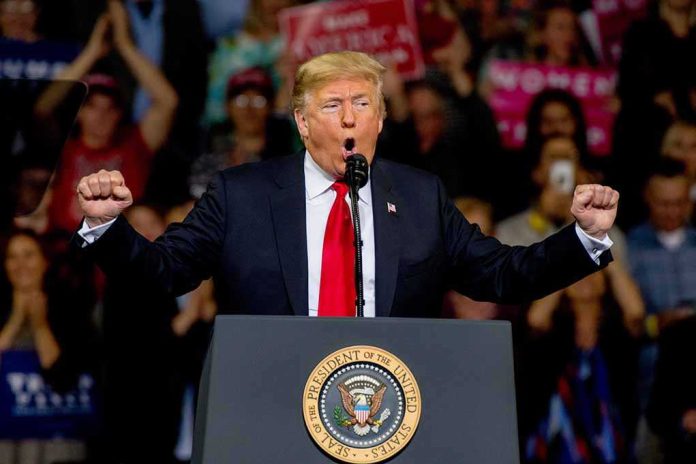
At a Port Huron rally ahead of the midterms, Nicki Minaj joined President Trump on stage and gave a full-throated endorsement, telling the crowd she would continue to support him and, if he ran again, support him again. Multiple outlets described her presence and the substance of her remarks, including praise for Trump and calls to back Michigan Republicans. Coverage from Newsweek quoted her vow of ongoing support; local reporting from MLive detailed her rally participation and her encouragement for voters to support Mike Rogers, the Republican Senate candidate, aligning her message with the ticket the Trump campaign was promoting in Michigan that day.
The appearance was not a mere name-check. Minaj traveled with the campaign—coverage highlighted that she posted video from Air Force One—and then used the rally microphone to energize the audience and point them toward specific races on the ballot. That on-stage blend of presidential co-sign and down-ballot advocacy is what campaigns seek when they court marquee entertainers in the final stretch of an election cycle: a single moment that can be clipped, shared, and replayed across audiences that political media often struggles to reach on its own.
How Campaigns Use Star Power: Mechanism over mystique
Campaigns do not chase celebrities because they are guaranteed vote-winners; they do it because stars can alter the attention market. An artist with a massive following can create an event-within-the-event, lifting local coverage, shifting social conversation, and seeding highly shareable video. In Michigan, Minaj did three things that matter operationally: she physically appeared with the principal (legitimacy by proximity), echoed the top-of-ticket message (alignment), and named key races (conversion opportunity). When those elements coincide, the endorsement behaves more like an integrated field-media tactic than a standalone celebrity cameo. That is why strategists prize stage time and specific mentions; the conversion path is clearer when a star affixes their brand to actionable asks like “support Mike Rogers.” MLive’s account of Minaj urging voters toward Rogers captured that practical through-line.
There is a second-order effect as well: elite media and local outlets tend to amplify a surprising celebrity-political pairing. Even when coverage lingers on color—the back-and-forth between Trump and Minaj, or a memorable turn of phrase—it still retransmits the core image: a famous artist endorsing, from the candidate’s own stage. In Port Huron, national and lifestyle-oriented outlets highlighted the moment, ensuring that even politically marginal audiences encountered at least the headline version of Minaj’s stance.
What The Evidence Supports: Clear endorsement, specific down-ballot cues
The factual spine is straightforward. Reporting anchors Minaj at the Port Huron rally with President Trump. Accounts describe her praise for Trump, her declaration of continued support—“I will continue to support you forever and ever. If you run again, I will support you again”—and her advocacy for Michigan Republicans, including Mike Rogers for Senate. Newsweek captured the language of ongoing support; MLive documented the Port Huron setting and Minaj’s cues toward the Michigan ticket; Fox News’ live reporting added the travel context and expectation that she would join Trump at the rally supporting Rogers. Together, those sources corroborate a public, on-stage endorsement aimed both at the presidential figurehead and the immediate electoral map in Michigan.
Some coverage also notes the rally’s theatrics—Trump’s ribbing and the crowd’s reaction—a reminder that such events are designed for entertainment value as much as political messaging. That framing does not diminish the endorsement’s content; if anything, it is the entertainment wrapper that carries the political ask to broader audiences, where a conventional stump speech might fade. The net effect is headline clarity: Minaj stood with Trump in Michigan, pledged continuing support, and amplified specific Republican candidacies in the state.
Do Celebrity Endorsements Move Votes? What the research really says
For readers evaluating practical impact, the political science and communications literature offers a sober baseline. Celebrity endorsements tend to expand reach, energize supporters, and stimulate small-dollar fundraising and social engagement; they are less reliable as pure persuasion tools. The academic record is mixed, with context doing most of the explanatory work. The standout counterexample—Oprah Winfrey’s 2008 endorsement of Barack Obama—has been credibly linked to substantial vote gains, aided by her unusually powerful media platform and the timing of a fluid primary contest. By contrast, experimental studies and field observations often find weak or inconsistent direct effects on vote choice, especially when the celebrity’s brand does not closely match the electorate’s salient identities or issues.
Applied to Port Huron, that means Minaj’s appearance most predictably helped with awareness and enthusiasm—particularly among demographics overlapping her fan base—while any marginal persuasion effect would hinge on fit: her credibility with Michigan voters in the rally’s catchment area, the salience of issues she referenced, and the campaign’s ability to convert attention into turnout. As Virginia Tech’s analysis of contemporary cycles suggests, endorsements can “expand candidates’ reach” and help harvest donations and sign-ups, but they do not substitute for message discipline, field operations, or candidate quality.
https://twitter.com/ArtOfDialogue_/status/2114495081205866724
Why It Matters Going Forward: Signaling, coalition-building, and the long tail
This kind of endorsement functions as coalition theater. When a high-visibility artist publicly aligns with an incumbent president and names state-specific candidates, she is lending brand permission to fans who are already leaning that way, communicating to wavering supporters that their choice has cultural allies, and potentially prompting light supporters to convert into volunteers, donors, or voters. In a battleground like Michigan, where outcomes often turn on mobilization at the margins, that can matter more than any single persuasion effect. The long tail—reposts, clips, and continuing chatter—keeps the endorsement alive beyond a single news cycle, embedding it in the campaign’s digital field assets.
Sources:
facebook.com, newsweek.com, mlive.com, yahoo.com, foxnews.com, themirror.com, thetimesherald.com