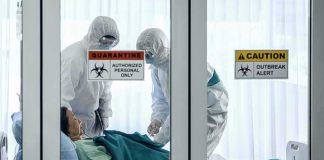
A cartel that can field surgeons is a cartel that has stopped hiding its wounded — and that shift in Jalisco tells us more about how the Cartel Jalisco Nueva Generación sustains itself than any single raid ever could.
Key Points
- Security forces raided a farm in Tecalitlán, Jalisco, dismantling what the state prosecutor called a clandestine CJNG “hospital” used to treat cartel members wounded in armed clashes.
- Eight people were freed from the property and six others were arrested; the prosecutor said the freed individuals had been forcibly recruited and held against their will.
- Investigators cited surgical materials found on-site as evidence the finca functioned as a medical recovery point for injured combatants.
- The rescued group came from at least seven Mexican states, pointing to a recruitment network that reaches well beyond Jalisco’s borders.
- The find fits a documented CJNG pattern — fake job offers, coercive training camps, and improvised medical infrastructure — seen repeatedly in Jalisco since at least 2017.
What Was Found in Tecalitlán
Jalisco’s state prosecutor, Salvador González de los Santos, told reporters that a joint state-federal operation had entered a rural property in Tecalitlán and dismantled a clandestine medical facility the CJNG used to treat members injured in armed confrontations. Surgical materials recovered at the scene, he said, supported the conclusion that the site functioned as a rudimentary field hospital rather than an ordinary farmhouse. Eight people held at the property were freed, and six others were arrested in connection with running the operation. The prosecutor described the freed individuals in blunt terms: “Estaban allí en contra de su voluntad” — they were there against their will.
The raid did not emerge from routine patrol work. It traces back to a missing-person complaint filed by the family of a 20-year-old man from Tlaquepaque, who told investigators he had left home saying he was going to work at a ranch and then vanished. That single report, filed with Jalisco’s missing-persons deputy prosecutor, opened a thread that authorities followed to the Tecalitlán property. It is a pattern investigators in Jalisco have learned to take seriously: a young man promised a job, a family that never hears from him again, and a rural property that turns out to be something other than what it claimed.
A Recruitment Pipeline, Not an Isolated Site
What makes the Tecalitlán case significant is not just what was found on one piece of land — it’s where the freed captives came from. Authorities identified people rescued from Mexico City, Guerrero, Michoacán, Sinaloa, Jalisco, Colima, and Nayarit. That geographic spread is the signature of an organized recruitment operation, not a local labor dispute. It suggests a network capable of luring or coercing young men across a large swath of central and western Mexico and funneling them toward a single point of confinement and, when necessary, medical triage.
This is consistent with a recruitment method that has been documented in Jalisco for close to a decade. As early as 2017, reporting described the CJNG posting fake job listings on Facebook, then forcing recruits who showed up into training camps against their will. Investigative outlets have since traced a consistent playbook: false offers of security-guard or driver positions at legitimate-sounding companies, followed by confinement, threats, and coerced participation once recruits arrive. The prosecutor’s account of forced recruitment at Tecalitlán sits squarely inside that established pattern rather than outside it.
Why a Cartel Needs a Hospital
Armed groups that sustain regular combat losses eventually need somewhere to put their wounded, and taking injured fighters to a public hospital carries obvious risk of exposure to authorities. Reporting on organized crime’s reach into Mexico’s health sector has documented cases where cartels effectively took over operating rooms and emergency departments in contested territory, forcing medical staff to treat gunmen under duress. A self-built field clinic, staffed informally and hidden on private land, solves that exposure problem for a group like the CJNG that fights frequently against rivals and state forces alike. Jalisco has produced precedent for exactly this kind of infrastructure before: a hospital reportedly built in the Jalisco community of El Alcíhuatl, allegedly tied to CJNG leadership, was cited years earlier as a rare example of a cartel investing in permanent medical infrastructure rather than relying on captured or coerced civilian doctors.
The prosecutor in the Tecalitlán case also raised the possibility that regional medical personnel could be involved in supplying or staffing such sites, though no provider or employee has been publicly named in connection with this property. That detail matters less as an accusation against any individual and more as a marker of how deeply cartel logistics can intertwine with legitimate local institutions when territorial control is strong enough to compel cooperation.
The Broader Jalisco Pattern
Tecalitlán does not stand alone in the recent history of Jalisco cartel sites. In 2025, the discovery of Rancho Izaguirre in Teuchitlán drew national and international attention after Mexico’s federal security chief, Omar García Harfuch, confirmed that people had been held there against their will after being lured through deceptive job offers to undergo criminal training. Mexico’s then-attorney general later concluded the ranch functioned primarily as a recruitment and training site rather than a systematic extermination camp, a distinction that mattered for how the case was ultimately charged but did not change the underlying finding that coercive recruitment had occurred there. That earlier case, and a related one dubbed La Vega, ended with a judge determining that the overwhelming majority of detainees — 36 of 38 — were victims of forced recruitment carried out through false job advertisements, not willing participants.
Set against that backdrop, the Tecalitlán hospital reads less as an anomaly than as the latest documented instance of a mechanism Jalisco’s cartel landscape has now produced multiple times over: fake employment as the lure, an isolated rural property as the holding ground, and — when the group’s operational needs demand it — improvised infrastructure built to keep its own wounded, and its recruitment pipeline, out of view of the state. One detail from initial reporting has already needed clarification: some outlets put the number freed at eight, others at nine, a discrepancy typical of fast-moving raid coverage and one likely to be resolved as the state prosecutor’s office finalizes its incident report.
What Comes Next
The practical questions ahead are evidentiary rather than narrative. Investigators will need to establish ownership and tenancy of the Tecalitlán property, trace whether payments moved through CJNG-linked intermediaries, and determine whether any medical personnel knowingly supplied or staffed the site. The eight rescued individuals, once past any immediate family reunification, represent the strongest source of testimony about how recruitment and confinement actually functioned there — testimony that, if secured and made part of the judicial record, would do more to cement the public account than any prosecutor’s press briefing. Given how often Jalisco has now produced sites matching this exact profile, the more durable story is the mechanism itself: a cartel sophisticated enough to run its own trauma ward, and desperate enough for manpower to keep filling it through coercion.
Sources:
borderlandbeat.com, ground.news, jamaicaobserver.com, english.elpais.com, democrata.es, cbsnews.com