
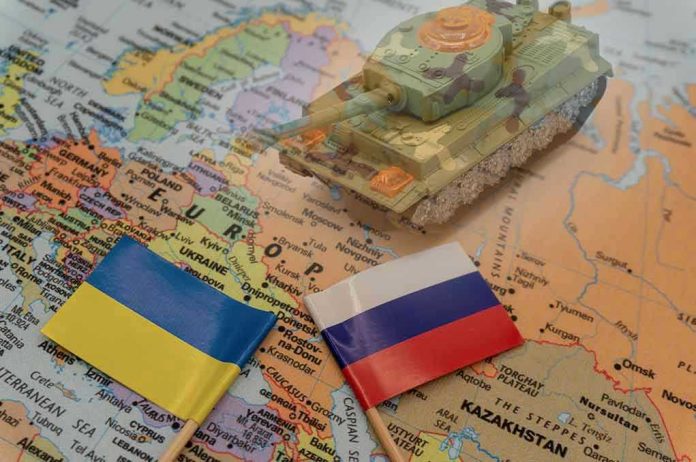
Russia’s refusal to commit to any timeline for ending the Ukraine war signals a calculated strategy of indefinite attrition that favors Moscow’s military position over negotiated resolution.
Quick Take
- Russia explicitly rejects deadlines in US-brokered Geneva talks concluding February 18, 2026, framing the conflict as a prolonged “special military operation” without rushed concessions
- The Kremlin’s no-deadline stance reflects a shift from rapid 2022 advances to a “war of exhaustion” powered by drone dominance and incremental territorial gains totaling 3,604 square kilometers in 2024 alone
- Ukraine faces mounting casualties—55,000 troops killed by early February 2026—while civilian infrastructure absorbs repeated strikes as negotiations stall without resolution timelines
- US pressure through aid and diplomatic leverage has produced temporary concessions like Kyiv strike halts, yet Russia maintains strategic patience while advancing on multiple fronts including Pokrovsk
Russia’s Strategic Patience Rewrites the Rules of War
When Moscow rejects deadlines, it weaponizes time itself. Russian officials, including Kremlin spokespeople, have repeatedly emphasized no fixed endpoints for the conflict, framing it as an indefinite operation without pressure to make concessions. This stance emerged clearly during trilateral US-brokered talks in Geneva that concluded February 18, 2026, where Russia’s refusal to commit to timelines dominated discussions. Unlike the rapid territorial advances of early 2022, Russia’s 2026 posture reflects a fundamentally different calculus: victory through exhaustion rather than swift conquest.
The shift reveals a critical strategic insight. Russia seized 3,604 square kilometers in 2024—a modest 0.6 percent of Ukraine’s territory—yet this incremental approach continues unabated into 2026. Recent confirmed advances include Russian control of Pokrovsk and Rivne as of late February, demonstrating that Moscow views slow, cumulative gains as superior to negotiated settlements. The Kremlin’s rejection of deadlines effectively announces that it will outlast Ukraine’s ability to sustain conflict, betting that Western support will eventually waver or that Ukrainian will to fight will fracture under prolonged attrition.
Drone Warfare Redefines the Conflict’s Trajectory
The 2024-2026 phase of the war bears little resemblance to the conventional battlefields of early invasion. Ukraine formed its Unmanned Systems Forces in February 2024; Russia established equivalent drone capabilities by November 2025. These unmanned forces now dominate tactical operations, with Ukrainian drones striking Russian energy infrastructure including the Neftegorsk plant and Crimea depots as recently as February 21, 2026. Meanwhile, Russian drone strikes killed civilians in Sumy the same day, illustrating how aerial warfare has decentralized the conflict across civilian and military targets alike.
This technological shift reinforces Russia’s no-deadline strategy. Drone warfare favors the side with deeper industrial capacity and lower operational costs per sortie, advantages Moscow possesses through North Korean military support confirmed by Russian Chief of General Staff Valery Gerasimov. Ukraine’s Kursk incursion of August 2024 was recaptured by Russian forces with North Korean assistance by April 2025, demonstrating how external support amplifies Russia’s staying power. The 4 percent decline in weekly battles recorded between February 14-20, 2026, suggests the conflict has entered a grinding stalemate where attrition, not momentum, determines outcomes.
The Human Cost of Indefinite Conflict
Ukraine’s human toll underscores why Moscow’s rejection of deadlines constitutes a strategic weapon. President Zelenskyy disclosed 55,000 Ukrainian troop deaths by February 4, 2026, a figure that accelerates as Russian advances continue. Civilian casualties compound the tragedy: twelve civilians died in a minibus strike in Ternivka on February 1, and seven more in Druzhkivka on February 4. Infrastructure strikes targeting energy systems and ports destabilize the entire Ukrainian economy, with strikes on Odesa ports recorded as recently as January 7, 2026.
These casualties reflect Russia’s deliberate choice to sustain conflict indefinitely rather than negotiate. Each passing month inflicts irreplaceable losses on Ukraine’s military-age population while degrading civilian morale and economic capacity. The Kremlin’s position—no deadlines, no concessions—effectively tells Ukraine it must either surrender territory or accept perpetual warfare. This psychological dimension of Russia’s strategy proves as potent as its military advances, grinding down Ukrainian resolve through the sheer weight of accumulated suffering.
US Leverage Proves Limited Against Russian Intransigence
President Trump’s personal requests to Putin produced temporary tactical pauses—the Kremlin agreed to halt Kyiv strikes until February 1, 2026—yet these concessions revealed Russia’s confidence in its position. A strike halt without broader ceasefire negotiations demonstrates Moscow’s ability to grant minor gestures while maintaining strategic momentum. US-Ukraine discussions restarted aid flows after talks in Jeddah, yet fluctuating American support creates uncertainty that favors Russia’s patient approach. The Kremlin calculates that Washington’s attention and resources will eventually redirect toward other global concerns, leaving Ukraine to face an indefinite conflict alone.
Russia’s rejection of deadlines also reflects confidence in its diplomatic position. With Ukraine’s NATO screening completed by September 2025, the alliance remains divided on military escalation risks, particularly regarding nuclear doctrine shifts Russia announced in November 2024. Expert analysis from CSIS and CFR interprets Russia’s stance as deliberate leverage denial—refusing to commit to timelines prevents Ukraine from planning for victory and prevents the West from imposing costs on prolonged conflict. Moscow has effectively transformed the absence of a deadline into its most powerful negotiating tool, signaling that only Ukrainian capitulation or NATO military intervention can alter Russia’s indefinite trajectory.
Sources:
Timeline: 4 Years of Russia-Ukraine War—Key Turning Points
Timeline of the Russo-Ukrainian War (1 January 2025–31 May 2025)
Timeline of the Russo-Ukrainian War (1 January 2026–Present)
Russia-Ukraine War in 10 Charts
CFR Global Conflict Tracker: Ukraine
ACLED Ukraine Conflict Monitor