Undercover video succeeds or fails on a single question that has nothing to do with whether the tape is real: does what the camera caught represent something systemic, or does it represent one clerk, one official, one bad afternoon dressed up as a pattern? James O’Keefe’s latest run of hidden-camera investigations — into SNAP-funded purchases at New York City bodegas and into a senior Pentagon official’s private remarks about undoing Trump administration policy — has forced that question back into the open, and into a Senate hearing room, at a moment when both SNAP fraud and loyalty inside federal agencies are live political fault lines.
Key Points
- O’Keefe Media Group footage shows New York bodega and smoke-shop clerks processing EBT cards for kratom and other non-food items, coded variously as “EBT Cash” and “EBT Food.”
- A separate hidden-camera recording captured Brandon Newsom, a 16-year Pentagon official in the Office of the Secretary of the Navy, saying he intends to “undo” administration policy after leaving office; the Navy publicly said it takes the conduct shown seriously.
- O’Keefe testified before the Senate Homeland Security and Governmental Affairs Committee, tying the bodega footage and other undercover work to a broader “Exposing Fraud in America” hearing.
- Federal SNAP fraud is real and prosecutable — DOJ and USDA cases have alleged tens of millions of dollars in trafficking and skimming schemes in New York alone — but enforcement data show it concentrated in specific schemes, not diffuse across the retail sector.
- O’Keefe’s methods carry a documented history of controversy, including lawsuits from federal employees and criticism from organizations like the Brennan Center over selective editing and representativeness.
What the Bodega Footage Actually Documents
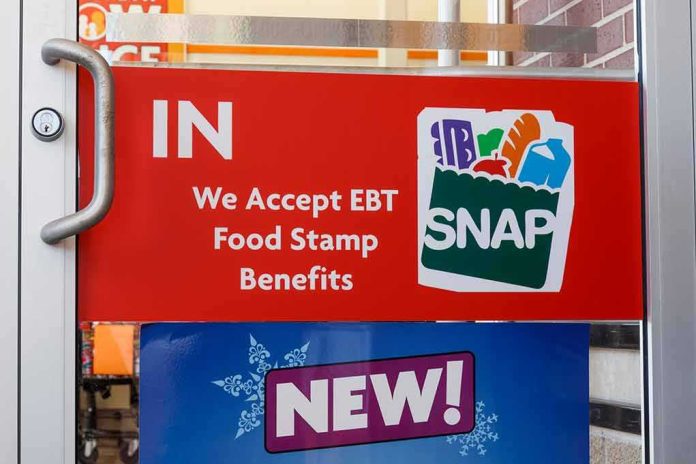
The mechanics matter here, because SNAP’s fraud vulnerabilities are structural, not incidental. Benefits load onto an EBT card that functions like a debit card at authorized retailers, restricted by point-of-sale coding to eligible food items. O’Keefe Media Group’s video, released as “Fraud Is the New Dope,” shows investigators attempting to buy kratom — a psychoactive substance not eligible under SNAP rules — at multiple New York City bodegas and smoke shops, with clerks allegedly processing the transactions under either an “EBT Cash” or “EBT Food” designation. If accurately represented, this is a straightforward violation: retailers are required to restrict SNAP funds to eligible food purchases, and knowingly circumventing that restriction is the textbook definition of retailer-level trafficking fraud.
What the footage cannot tell you, on its own, is how common this behavior is across the roughly 40,000 SNAP-authorized retailers in New York State, or whether the clerks recorded understood the products’ ineligibility versus simply miscoding a transaction. That gap — between a documented instance and a documented pattern — is precisely where undercover exposés live or die in credibility, and it is a gap O’Keefe’s critics have flagged for over a decade.
The Pentagon Tape: A Career Official Caught on Camera
The second thread is structurally different but politically louder. In a hidden-camera recording published by O’Keefe Media Group, Brandon Newsom — a senior official in the Office of the Secretary of the Navy who has served at the Pentagon for sixteen years and whose portfolio includes corporate operations supporting Secretary Pete Hegseth — is recorded saying he intends to “undo whatever’s been done” at the Pentagon once the Trump administration leaves office. The Department of the Navy responded publicly and quickly, stating it “takes the conduct shown seriously,” effectively confirming the tape’s substance rather than disputing it. That official acknowledgment is significant: unlike many O’Keefe targets who deny or minimize what was recorded, the Navy’s own account did not contest that the conversation happened.
This fits a recognizable pattern in O’Keefe’s recent body of work — what one of his subjects’ attorneys has called “Dating the Deep State,” a series of undercover encounters designed to catch federal employees expressing political intentions or grievances in unguarded settings. A separate case in that series, involving a DHS employee named Wright, is now the subject of a federal lawsuit alleging the recordings violated free-speech and due-process protections, an unresolved legal question that will shape how far this style of workplace sting can go.
From Hidden Camera to Senate Floor
O’Keefe did not simply publish these videos and move on; he brought them, and a slate of other investigations, directly into congressional testimony. At a Senate Homeland Security and Governmental Affairs Committee hearing titled “Exposing Fraud in America,” O’Keefe described the bodega footage alongside separate undercover work in Los Angeles, where he says he disguised himself as a homeless man on Skid Row in February 2026 and documented petition circulators paying cash for signatures and using an online database called Sigvalid to process registrations. Senator Rick Scott questioned him at length about the Los Angeles nonprofit and homelessness-funding allegations in a companion hearing. The same broader hearing series included USDA Inspector General Phyllis Fong’s office disclosing $13.3 million in SNAP enrollment anomalies identified in Ohio, giving O’Keefe’s retail-level footage a data-driven companion piece from an official federal watchdog.
How This Fits the Larger Record on SNAP Fraud
SNAP fraud is not a hypothetical concern manufactured for a hearing room; it is a documented, prosecuted phenomenon with real dollar figures attached. The Justice Department has indicted defendants in Brooklyn accused of stealing or misusing $20 million in SNAP benefits through trafficking schemes, and a separate Southern District of New York case charged a USDA employee and five others in a bribery and trafficking scheme that generated more than $66 million in unauthorized transactions. Reporting has also documented card-skimming operations at New York bodegas using hidden devices to steal EBT data outright, distinct from the coding-violation fraud O’Keefe’s footage depicts. The throughline across these cases is that SNAP fraud tends to cluster in specific, organized schemes — skimming rings, retailer collusion, insider bribery — rather than existing as a uniform condition of the retail sector, which is the more defensible reading of an admittedly serious problem.
That context cuts both ways for O’Keefe’s footage. It confirms that the underlying vulnerability he filmed is genuine and has cost taxpayers real money in adjudicated cases. It also means a handful of undercover clips, however damning individually, function as anecdote rather than audit — useful for prompting oversight, insufficient on their own for quantifying the problem’s scale. Enforcement overreach carries its own cost, too: a Bronx bodega lawsuit alleges a federal sting operation banned SNAP transactions over a single bottle of bleach, cutting off a food source for a majority-Latino neighborhood, a reminder that aggressive enforcement can misfire against legitimate merchants.
The Standing Question Around O’Keefe’s Methods
No assessment of this body of work is complete without accounting for the source. O’Keefe founded Project Veritas and has built a two-decade career on undercover sting journalism, from a 2010 attempt to record Senate staffers that led to a criminal sentencing, to the ACORN videos, to his current independent outlet. Mainstream reference sources describe Project Veritas’s technique as reliant on selective and sometimes deceptive editing aimed at progressive and mainstream institutions, and the Brennan Center has cataloged consequences — legal and reputational — for manufactured or misleadingly presented evidence across the undercover-sting genre broadly. None of that history proves any specific claim in the bodega or Pentagon videos false; the Navy’s own response to the Newsom tape suggests at least that recording held up. But it is the reason serious observers evaluate each O’Keefe release on its individual evidentiary merits rather than as automatically dispositive proof of a system-wide indictment — a demonstrated capability, not a get-out-of-scrutiny card.
What It Means Going Forward
The durable lesson here is not about O’Keefe specifically; it is about how undercover video functions as an oversight tool inside a federal benefits system and bureaucracy too large for routine forensic auditing to catch every violation. A single viral clip can trigger a congressional hearing, an inspector general disclosure, and an agency’s public acknowledgment within days — faster than most formal audit cycles move. That speed is the technique’s real power, and also its real danger: it rewards footage that is vivid and clip-length shareable, which is not always the same footage that is representative. Readers evaluating the next O’Keefe release, or any undercover exposé like it, should ask the same two questions raised here — is the underlying conduct independently corroborated, and does the sample size support the scale of claim being made — before treating a bodega counter or a P