When a sitting president opens the doors of Camp David to cameras and a full Cabinet, the result is more than a scenic backdrop—it is a deliberate blend of high-stakes policy work and political theater, staged at one of the most symbolically charged places in the modern presidency.
Key Points
- President Trump convened a rare, televised Cabinet meeting at Camp David, using the secluded retreat as a venue for on-camera policy discussion and performance.
- The White House framed the session as a transparency move, keeping news media in the room throughout the public portion of the meeting and broadcasting it live across networks and platforms.
- Coverage and live streams show that the agenda touched on the Iran war, the economy, border security, and other domestic and national security priorities.
- The event fits a broader pattern in which Camp David is alternately a setting for history-making diplomacy and a stage for modern political messaging, with cameras now part of the governance toolkit.
A televised Cabinet meeting at the presidential retreat
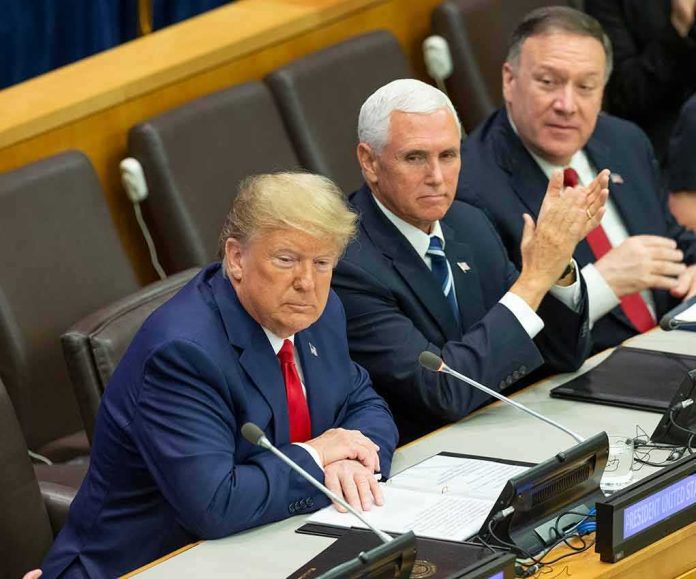
The Camp David Cabinet meeting at the heart of this discussion brought together the core elements of executive power: the president, his senior advisers, and a set of pressing policy questions, all transported from Washington into the wooded seclusion of Maryland’s Catoctin Mountains. At its most basic, the event was exactly what major outlets described it to be—an official Cabinet meeting, held at Camp David and conducted in front of cameras. Live video feeds from C-SPAN and networks such as Fox, CNN, and CNBC all carried “President Trump Holds Cabinet Meeting at Camp David” banners, confirming public visual access to the proceedings and underscoring that this was treated as a genuine governance session, not merely a photo call.
According to live-stream descriptions and wire copy, the meeting’s stated purpose was to review Trump’s policy agenda and key domestic and national security priorities, with particular emphasis on the ongoing war with Iran, economic conditions, and border security. That agenda aligns with the wider context of Trump’s second term, in which Iran negotiations, wartime decision-making, and economic headwinds have repeatedly drawn the Cabinet into strategic deliberations. In practice, the meeting followed a format familiar from earlier Trump-era Cabinet sessions: an extended, on-camera roundtable where department heads offered updates on their portfolios and the president used their remarks as launch pads for his own views on policy, politics, and performance.
Transparency as message and method
What made this Cabinet meeting distinctive was not that it happened—presidents have long used Camp David for serious work—but that it happened this publicly. The White House leaned into that choice. ABC’s reporting on Trump’s Cabinet style noted that he “allows the news media to stay for the duration of the meetings,” and Press Secretary Karoline Leavitt explicitly framed this as proof of the president’s commitment to transparency. Letting cameras and reporters remain throughout the public portion of the meeting, rather than limiting access to brief opening remarks, turned a normally closed senior-level conversation into televised content. The live feeds ran long enough to capture not only formal statements from the president but also extended contributions from Cabinet secretaries about their agencies’ activities, mirroring earlier three-hour Trump Cabinet marathons in which officials updated him publicly on their work.
In this sense, transparency was both a claim and a design principle. Modern White Houses increasingly treat press access as part of event architecture rather than an afterthought; by deciding, in advance, that the Camp David meeting would be broadcast live, the administration ensured that the public saw a curated slice of Cabinet-level deliberation. C-SPAN’s listing and PBS’s “watch live” framing reinforced that design, presenting the session as an on-the-record window into executive governance at a site more often associated with private diplomacy. At the same time, the strongest transparency language comes from the White House itself, not from independent auditors—there was no immediate release of a full transcript or detailed readout covering everything said once cameras stopped.
Camp David’s dual identity: retreat and decision center
To understand the significance of broadcasting a Cabinet meeting from Camp David, it helps to appreciate the place’s unusual institutional role. Built in the late 1930s, the retreat has served as both a presidential sanctuary and a high-level conference venue, hosting everything from Jimmy Carter’s Camp David Accords talks between Israel and Egypt to George W. Bush’s meetings with his national security team after the September 11 attacks. Its wood-paneled cabins and wooded trails were designed to pull presidents out of the capital’s grind, but its secure facilities and communications infrastructure make it fully capable of supporting war councils and intensive policy workshops. That dual identity means every presidential trip to Camp David carries an interpretive question: is this about rest, policy, or politics—and in what proportions?
Trump’s historical use of Camp David reflects that tension. In his first term he visited the retreat for a mix of family weekends and structured sessions—reviewing Afghanistan strategy with Defense Secretary James Mattis and Vice President Mike Pence, monitoring Gulf hurricanes, and gathering Republican congressional leaders to prepare for midterm elections. In his second term, he has returned far less frequently than some predecessors; public tallies note just a handful of trips compared with dozens by presidents like Obama and Clinton. That scarcity made the televised Cabinet meeting stand out: it was not routine, and reporters, noting the rarity, framed it as a “historic” or “rare” moment when Trump chose Camp David as the stage for collective governance rather than private consultation.
Substance on display: Iran, the economy, and border security
On the policy front, the Camp David Cabinet meeting unfolded against the backdrop of an Iran war that has become a defining challenge of Trump’s second term. C-SPAN’s event listing explicitly situates the meeting “as the Iran War continues,” signaling that the conflict was not merely a peripheral topic but a central reason for convening the Cabinet at the retreat. Separate reporting describes Trump using Camp David visits to hash out peace frameworks and tension-management strategies with senior military commanders and foreign policy advisers, including prior sessions in which immigration protests and Gaza were discussed alongside Iran.
Live coverage and subsequent write-ups also highlight other strands of substance woven into the meeting. The Washington Times account, for example, notes that Trump used the session to tout his record on tariffs, foreign investment, drug pricing, and border security. These themes track closely with long-standing administration priorities: aggressive trade measures presented as pro-worker, efforts to lower prescription drug costs, and a steady push to tighten the southern border in response to migration pressures. In earlier Camp David remarks, Trump had spoken about security, infrastructure, military funding, DACA negotiations, and the flow of illegal drugs into the United States, underscoring the retreat’s role as a venue for complex policy bundling rather than single-issue focus.
The spectacle question: praise, politics, and performance
Any honest appraisal of a televised Trump Cabinet meeting has to grapple with its theatrical dimension. During his first term, long, praise-saturated Cabinet sessions became a signature of his style; reporters documented scenes in which secretaries went around the table offering glowing endorsements of the president’s leadership before pivoting to agency updates. The Associated Press, in a piece later carried by PBS, described such meetings as “overly long and consumed by administration officials’ endless praise for their boss.” At Camp David, that tradition did not disappear. Accounts of the retreat meeting mention Trump using the occasion to tout his performance ahead of midterm elections, a clear signal that political messaging was intertwined with policy talk.
Viewed in that light, the open-camera format does double duty. It allows citizens to see real Cabinet-level discussion—who speaks, what topics are raised, how the president responds—but it also creates incentives for participants to perform for an audience far beyond the room. Secretaries can emphasize successes, downplay internal disagreement, and deliver lines calibrated for later news clips or social media snippets. The president controls not just the content but the atmosphere, setting the tone for whether the session feels like a candid working meeting or an orchestrated show of unity. Critics argue that praise-heavy structures tilt toward spectacle; supporters see them as a normal assertion of leadership in a hostile media environment.
How transparent is “transparent”?
That tension raises a practical question: how far does this kind of televised Cabinet meeting move the needle on genuine transparency? On the one hand, cameras at Camp David are not a given. The retreat is typically a press-light environment, with many of its highest-stakes conversations conducted entirely behind closed doors. Bringing news media into the Cabinet room for an extended session and distributing the footage across major networks and streaming platforms meaningfully increases public visibility into presidential decision-making compared with traditional practice.
On the other hand, the evidence set available to the public has limits. There is no full verbatim transcript in the material at hand, no detailed agenda memo or post-meeting readout linking specific on-camera exchanges to subsequent policy actions. We can see that the discussion touched on Iran, economic policy, and domestic security priorities; we can hear Trump’s framing and his Cabinet’s responses in the segments that aired. But we cannot independently verify whether more contentious debates, sensitive intelligence briefings, or politically risky disagreements occurred off-camera in closed segments of the retreat. Security norms at Camp David, and the administration’s discretion over what to broadcast, inevitably narrow outside verification.
Cameras as a permanent feature of modern governance
Stepping back, the Camp David Cabinet meeting illustrates a broader evolution in the presidency: cameras and live feeds are no longer external observers of governance, they are instruments within it. From campaign-style rallies in official settings to extended Cabinet sessions designed for broadcast, modern presidents use visual media to construct narratives about competence, resolve, and openness. Trump’s choice to hold a televised Cabinet meeting at Camp David fits squarely within that pattern. It leverages the retreat’s historic aura—where accords were negotiated and war plans drafted—to lend gravity to contemporary policy debates, while simultaneously feeding a content-hungry media ecosystem with real-time footage of power in action.
For citizens, the value of such events lies in their dual nature. They do show something real: which issues occupy the president’s attention, how Cabinet members talk about their work, and how the administration wants to be seen handling crises like the Iran war or economic turbulence. At the same time, they are inevitably constructed, with camera angles, seating charts, and speech rhythms tuned to convey a particular image. The Camp David Cabinet meeting does not resolve long-running arguments over whether Trump’s governance is more show than substance, or vice versa. It does, however, exemplify how a modern presidency can turn even the most secluded of retreats into a stage—and invite the country in to watch.
Wheels down at Camp David, where President Trump will hold a Cabinet meeting. Tune in! 🇺🇸 pic.twitter.com/W5f3XzU4lf
— Anna (@anna_201xv) July 31, 2026
Why this episode will endure in the Camp David story
Camp David’s history is written in episodes—Carter’s summitry, Bush’s war councils, Obama’s quiet weekends, Trump’s own earlier strategy sessions and midterm planning retreats. The televised Cabinet meeting belongs in that lineage as a marker of how the place is used in the twenty-first century. It shows that the retreat is no longer only for private negotiation or presidential downtime; it can be repurposed as a highly visible stage for executive deliberation, with transparency framed not as a regulatory obligation but as a political choice. Future historians looking at Trump’s second term will likely read this event alongside his rarer trips to Camp David, his Iran negotiations, and his media strategy, seeing in it a convergence of architecture, policy, and performance that is uniquely of its moment—and yet entirely in keeping with the long arc of presidents adapting Camp David to their own needs.
Sources:
facebook.com, abcnews.com, ms.now, youtube.com, trumpwhitehouse.archives.gov, c-span.org, nypost.com, fox9.com