
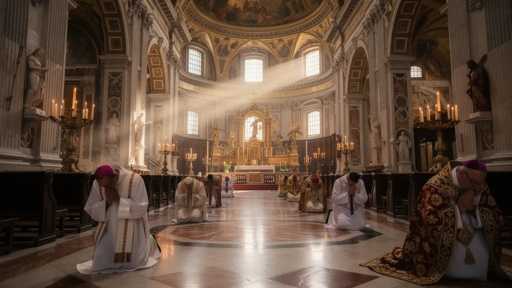
The fight over a rosary on cathedral steps is not about whether Catholics may pray; it is about who governs the Church’s symbolic front porch when the public square becomes a stage for competing signals.
At a Glance
- Cathedral steps are ecclesial space with pastoral and legal stewards; bishops increasingly manage that space to avoid politicized optics.
- Cincinnati’s Archbishop Robert G. Casey has emphasized dialogue and welcome toward LGBTQ persons; his approach shapes how diocesan property is used when civic events pass by.
- A lay men’s group with a history of “reparation” rosaries tied to a Pride parade asserts a devotional, not protest, intent—yet the event’s framing inevitably reads as counter-programming.
- The decisive evidence is not about doctrine on prayer but about jurisdiction, optics, and risk management on church grounds; explicit canonical citations remain sparse in public.
What the dispute is really about: governance of symbolic space
When a bishop tells a lay group not to hold a rosary on cathedral steps during a Pride parade, the headline tempts a false binary—piety versus politics. The real issue is control of symbolic space. Cathedral steps function as the Church’s threshold: visible, newsworthy, and inevitably read by passersby as the Church speaking in public. In Cincinnati, Archbishop Robert G. Casey—installed as the 10th Metropolitan Archbishop and therefore juridically responsible for the cathedral basilica—has pursued a pastoral strategy of welcome and dialogue with LGBTQ Catholics. That pastoral horizon informs how he adjudicates events positioned, however devoutly, as counterpoints to a Pride procession on the cathedral’s doorstep.
Property stewardship is not a footnote. Cathedrals are not parks; they are ecclesiastical property with custodians obligated to ensure order, safety, and the Church’s authentic witness. The line between public prayer and public demonstration blurs most on those steps, where cameras are drawn, crowds accumulate, and meaning gets assigned by context as much as by intent.
Casey’s pastoral frame: welcome, dialogue, and the optics of neutrality
Archbishop Casey has publicly emphasized inclusivity and transparency as marks of his leadership. In local coverage of his appointment and transition, he is quoted leaning into Pope Francis’s pastoral approach—listening, hospitality, and engagement with those who often feel marginal at the Church’s edges. Accounts from Catholic groups also describe an early invitation extended by Casey to LGBTQ Catholics for dinner and discussion at the cathedral complex, framed as pastoral inclusion rather than policy change. Whatever one’s appraisal of that strategy, the through line is consistent: use ecclesial space to lower the temperature and build conversation.
That lens translates into a prudential judgment about the steps during a Pride parade: a desire to avoid the image of the cathedral as an opposing rally point at precisely the moment when public attention is highest. Reports circulate that the archbishop asked the men’s group not to pray on the steps to remain “neutral” as the parade passed; while the archdiocese has not published a canonical memo to that effect, the rationale is intelligible within his stated pastoral aims. His installation as ordinary—completed in April 2025—settles the question of competence: he is the steward of that space.
The men’s rosary rallies: devotion, intent, and the gravity of framing
The lay organizers are not improvising agitators. Cincinnati has seen recurring “men’s rosary in reparation” events scheduled to coincide with the Pride parade, with listings on Catholic media calendars and promotional posts detailing logistics and devotional purpose. Organizers call the gathering a “solemn act of love” and “reparation,” not a protest, underscoring kneeling prayer and pious restraint rather than confrontation. The group’s coordination, signage guidance, and “Catholic men” framing convey seriousness and order, and they cite years of precedent to claim legitimacy in the public square.
Intent, however sincere, does not fully control perception. To situate a public “reparation” rite on the cathedral threshold, timed to a Pride march, is to create an interpretive collision. Even if participants avoid hostile language, the juxtaposition carries a countermarch valence that media and bystanders will read as institutional opposition—especially when the backdrop is the bishop’s cathedra. That is the Archbishop’s practical dilemma: not the content of the rosary, but the public inference that the Church as Church has chosen that moment, that place, to answer Pride on its steps.
Authority, law, and the missing memo
Observers looking for a paragraph of canon law that says “no rosaries on steps during parades” will not find it. Canon law grants diocesan bishops broad governance of ecclesiastical goods and liturgical-pastoral order; local particular law and property policies do the rest. Yet the public record here lacks a posted directive spelling out the legal basis and scope of such restrictions—whether they apply to all assemblies, only concurrent counter-events, or only on certain parcels of cathedral property. That silence invites speculation about arbitrary decision-making and yields easy talking points for critics who frame the choice as suppressing piety rather than managing optics and risks. Still, the fundamental governance fact remains: as ordinary, Casey holds authority over cathedral use and can restrict assemblies on its steps for prudential reasons.
On the other side, the lay organizers have not produced a diocesan policy guaranteeing their access to cathedral steps for timed public acts, nor a canonical opinion establishing such a right against the ordinary’s contrary directive. Their strongest claim is precedent—prior years’ gatherings—and devotional character. Those are relevant to prudence and goodwill; they are not dispositive against the steward of the property.
How we got here: a broader pattern of contested thresholds
This Cincinnati flashpoint echoes a wider trend. Over the past decade, lay-led “rosary rallies” have proliferated—from Spain to Sydney to U.S. cities—often framed as public reparation for moral or political drift and coordinated online. In several locales, bishops and civil authorities have steered these gatherings away from cathedral forecourts, citing neutrality, safety, or the risk of misreading the Church’s stance amid polarized spectacles. The pattern is consistent: the more symbolically charged the timing and location, the more assertively ecclesial stewards manage the front steps. Devotion in public is not the issue; custody of the Church’s visible threshold, and the messages inferred from it, is.
There is also a security subtext. Since 2020, hundreds of incidents targeting Catholic sites have been cataloged across the United States—vandalism, arson, defaced statuary. That backdrop encourages risk-averse posture on crowded forecourts during contentious civic events, where flashpoints and misattributed messages can escalate unpredictably. That context does not prove the prudence of any particular decision; it does explain why ordinary pastors might default to tighter control of cathedral grounds when high-attention events pass by.
Substantive disagreement: witness versus hospitality, precedent versus prudence
The men’s rally advocates argue that public reparation is integral Christian witness in a culture that has normalized what they regard as grave sin; silence on the steps at the hour of provocation looks, to them, like abdication. They appeal to perennial Catholic practice of public prayer, to masculine spiritual leadership, and to the formative power of embodied witness. The Archbishop’s decision, in their reading, discounts devotion to manage optics—and the request for “neutrality” can sound like moral indifference. Their point is serious: the Church’s mission is not to avoid being misunderstood; it is to preach Christ crucified and risen.
The Archbishop’s side argues that the mission includes shepherding all the sheep—including those who will only take a first step toward the Church if they do not experience its very threshold as an opposing rally platform. He can invite robust moral teaching inside a framework of encounter; he need not cede the steps to any party’s messaging, however pious, at the precise moment when the city is primed to read countersignals. That point is also serious: pastoral governance involves not only saying yes to good things but sequencing them so the Church’s voice is heard rather than caricatured.
What would resolve the impasse
The current evidence stack supports the Archbishop’s authority to regulate use of cathedral steps and situates his choice within a coherent pastoral strategy of welcome, but it leaves two gaps that perpetuate mistrust. First, the archdiocese could publish a clear, standing policy for assemblies on cathedral property: scope, timing, security thresholds, and criteria for concurrence with civic events. Codifying the rule would convert a one-off “ban” into even-handed governance, cutting off charges of ad hoc politics. Second, a brief canonical note explaining jurisdiction, together with a pastoral letter explaining the theological rationale for sequencing public witness and hospitality, would ground the prudential call in principle rather than optics alone.
On the lay side, organizers who wish to remain in communion with diocesan governance can reframe the witness: shift from the cathedral steps to a permitted public space nearby, alter the timing to avoid head-on juxtaposition with the parade, and coordinate with the chancery on text and conduct. Nothing in the Archbishop’s posture forbids public rosary; the crux is claiming the Church’s porch at the hour when the city is watching for signs of opposition.
The durable lesson
Cathedral steps concentrate meaning. Who stands there, when, and for what is always more than logistics; it is ecclesiology manifested. As long as American cities stage polarized rituals in the streets, bishops will manage thresholds to prevent the Church from becoming a prop for anybody’s script, and lay Catholics will keep looking for ways to witness without being absorbed into the culture war’s choreography. When both sides accept that stewardship and discipleship are not enemies—just different charisms reading the same moment—the rosary will be prayed, the doors will stay open, and the threshold will keep doing its ancient work: inviting people in.
Sources:
lifesitenews.com, local12.com, athenaeum.edu, chicagocatholic.com, sacredheartradio.com, facebook.com, ewtnnews.com