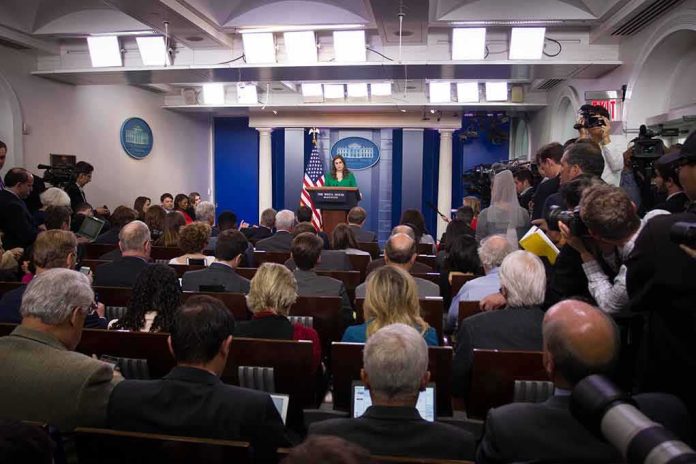
The significance of this personnel move is not the name alone; it is what the choice signals about how this White House intends to manage the flow of information, set the terms of public debate, and reengage the daily briefing as an instrument of power.
The Short Version
- A White House official said President Trump offered Katie Zacharia the role of White House press secretary, a development multiple outlets reported on the same day.
- Reports consistently describe the move as an offer to succeed Karoline Leavitt, who left the post in late August.
- Zacharia’s background—DHS spokesperson, attorney, conservative commentator, and communications adviser to Trump Media & Technology Group—aligns with a message-forward, loyalty-inflected communications strategy.
- The press secretary’s office is the presidency’s front door to the press and a command post for shaping the public record; who holds it alters how an administration governs in public.
What happened and why it matters
On a single October afternoon, a White House official’s confirmation that President Trump had offered Katie Zacharia the press secretary job ricocheted across major outlets—BBC, Axios, The Hill, CBS News, and others—using strikingly similar language and succession context: she would replace Karoline Leavitt, who exited in late August. The core fact is narrow and clear: an offer originated from the White House and was conveyed to reporters on background. Acceptance and timing of first duties were not established in those reports, but the institutional stakes are already visible: by selecting a media-native communicator who has worked inside Trump’s orbit, the White House is choosing a press strategy as much as a spokesperson.
Zacharia’s résumé explains the choice’s logic. She has toggled between government communications—a stint as a Department of Homeland Security spokesperson—and partisan media roles, alongside legal training and experience as a conservative commentator. Most recently, she advised Trump Media & Technology Group, placing her within the president’s owned-media ecosystem, where message discipline and speed are prized. A press secretary with that profile is positioned to knit together official briefing machinery with direct-to-supporter channels—two systems that often run in parallel rather than in concert.
The modern press secretary’s job: message control and record-keeping
The title sounds ceremonial; the work is nothing of the sort. The press secretary is the administration’s chief spokesperson, the fulcrum between policy staff, the president, and the press corps, responsible for shaping and disseminating the official record—statements, answers, and the logic behind them. The daily briefing (when it runs daily) is not merely a ritual of questions; it is agenda-setting theater in which the White House decides which issues occupy oxygen, which frames get elevated, and which lines hold under cross-examination. Over decades, the role has institutionalized into a command center for attention—triaging crises, sequencing announcements, and coordinating language across agencies to maintain coherence under pressure.
Two corollaries follow. First, the job is as much internal as external; briefing room performance depends on the press office’s authority to extract clear guidance across policy shops each morning and enforce message discipline throughout the day. Second, the press secretary’s words become the presidency’s contemporaneous record—quotable in court filings, congressional hearings, and history books. That dual mandate—operational traffic cop and archival voice—makes the identity and instincts of the officeholder consequential well beyond optics.
How this appointment fits the current communications environment
Reports noted the post had been vacant since late August, with sporadic engagement from cabinet officials and the vice president filling some of the public-facing gap. In that context, offering the job to a figure who is comfortable both in televised formats and in the cadence of social-first communication suggests an appetite to reassert centralized message control ahead of legislative fights and the election calendar. The timing, clustered reports indicate, was interpreted by newsrooms as an inflection point for the White House’s public posture.
Administrations that lean into direct channels often downshift formal briefings; yet history shows that when political intensity rises, the value of a disciplined podium operation increases. The press secretary’s briefing can preempt narrative drift, lay down defensible lines on contentious issues, and, critically, reduce the distance between policymaking and public explanation. If Zacharia assumes the role, expect a blend of assertive framing, rapid response, and closer integration with the president’s owned media infrastructure—an approach aligned with her recent work and with the presidency’s broader shift toward permanent campaigning.
Qualifications and the craft of briefing
Effective press secretaries carry three toolkits. The first is substantive fluency: absorbing complex policy quickly, translating it without mangling it, and spotting where legal and political risk hide in a question. A legal background helps—not to dodge, but to calibrate language when words become exhibits. The second is procedural power: commanding the morning message meeting, extracting accountable talking points from policy shops, and coordinating interagency lines so they survive contact with the briefing room. The third is performance: knowing when to narrow the aperture of a question, when to concede a premise to move the story, and when to plant a headline that travels.
Zacharia’s blend of government communications and media commentary maps neatly onto the performance and procedural demands, while her legal training can buttress the precision side of the craft. The tougher test is internal: sustaining credibility with reporters requires not only fluency but also a track record that the words at the podium are tethered to policymaking reality. That credibility does not require consensus—it requires consistency. The office’s ability to shape coverage depends on it.
Katie Zacharia named new White House press secretary
Katie Zacharia, a former Department of Homeland Security spokesperson, is the new White Housepress secretary, President Trump announced Friday.
She fills the post vacated by Karoline Leavitt at the end of August.“It is my… pic.twitter.com/J8IVbIanD7
— American Politic (@rosewdc) October 10, 2026
Succession, language, and expectations
Personnel stories generate linguistic drift—“offered,” “picked,” “tapped”—but the best reading of the reporting is straightforward: the White House initiated an offer to Zacharia to succeed Leavitt, who left in late August, and did not confirm acceptance in those accounts. That is a common sequencing in presidential staffing news: background confirmation, then formalization, then first day at the podium. If and when she begins briefings, the first sessions will be read as a statement of method: frequency, willingness to take sustained questioning, and the balance between policy exposition and political combat will tell us how this communications shop plans to govern in public.
What to watch next
Three markers will reveal the strategy. Frequency and cadence: a return to near-daily briefings signals a commitment to centralized, on-the-record narrative control; a lighter schedule leans into alternative channels. Integration with agencies: tight alignment of lines across departments shows a strong process spine. And rhetorical posture: does the podium prioritize persuasion aimed at movable publics, or mobilization aimed at core supporters? Each choice has tradeoffs for legislative bargaining, media relations, and long-run presidential credibility.
Sources:
foxnews.com, yahoo.com, axios.com, myfox28columbus.com, reference-global.com, en.wikipedia.org, academic.oup.com, usatoday.com, dc.ewu.edu, saylordotorg.github.io