
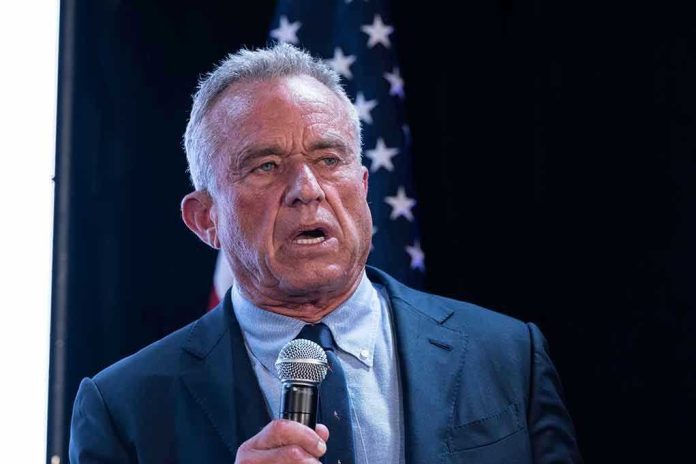
The significance of Robert F. Kennedy Jr.’s Dallas speech is not that it happened at a Republican convention; it is what he chose to argue there: that the modern Democratic nomination process has drifted from its grass-roots self-image toward a rules-driven, leadership-mediated system—and that this drift explains both his estrangement from his ancestral party and his audience’s enthusiasm on the other side of the aisle.
At a Glance
- RFK Jr. addressed the GOP’s midterm convention in Dallas and framed his appearance as a personal and political turning point.
- He argued Democrats “lost their way,” centering politics on opposition to President Trump rather than on historic party priorities.
- Kennedy attacked the 2024 Democratic nomination mechanics around Kamala Harris as elite-driven rather than voter-driven, echoing his earlier claims from July 2024.
- His remarks drew strong audience response and positioned nomination rules—not just ideology—as a live fault line in American party politics.
What happened in Dallas: a Democrat-turned-critic speaks to Republicans
The Republican National Committee’s first midterm convention in Dallas featured an unmistakably pro-Trump program—President Trump and Vice President JD Vance headlined—and RFK Jr. on the roster as a featured speaker, an unusual tableau that underscored the evening’s cross-party theater. From the stage, Kennedy said he would not have expected in his lifetime to address a Republican convention, a line that simultaneously acknowledged his lineage and his break with it. He developed that break into a thesis: that Democrats had abandoned their animating purposes and, in his phrasing, offered voters little beyond hostility to a single person—Donald J. Trump.
As a matter of event fact, Kennedy spoke and the room responded. Accounts from the floor describe cheers punctuating his sharper lines, particularly as he turned to the nomination fight that followed President Biden’s 2024 exit from the race. In that section he delivered his most quotable charge: that no Democratic primary voter had cast a ballot for Kamala Harris and that party leaders engineered a swift elevation without meaningful delegate consultation—language consistent with his July 2024 critique that Democrats were positioned to “anoint” Harris and that she lacked internal popularity.
The mechanism behind the rhetoric: how modern nominations actually work
Set aside the applause lines and the partisan venue; the core claim points to a structural truth about American nominations. Parties are private associations with public consequences. Their presidential picks emerge from a hybrid process: primary and caucus voters elect pledged delegates; party rules determine how those delegates are allocated, what thresholds apply, and what role party leaders (the so‑called superdelegates on the Democratic side) can play in the sequence. The Democratic rulebook aims at majority support among pledged delegates on the first ballot, not a national popular vote; it is a system designed to translate dispersed state results into convention math, then to finalize a nominee through formal delegate action.
When a presumptive nominee exits late, that hybrid design compresses. In 2024, Democrats moved to an expedited, technology-enabled procedure that required would-be candidates to demonstrate a minimum level of delegate support—300 electronic nominating signatures by a stated deadline—before proceeding to a ratification vote. The rules also required a candidate’s explicit consent to be nominated, foreclosing purely symbolic “draft” maneuvers by delegates. Harris secured the necessary support quickly and entered the formal process with a commanding delegate coalition, which is why the endgame moved in hours, not months.
Why Kennedy’s charge landed: efficiency versus legitimacy in elite-mediated decisions
Kennedy’s critique resonates because both things can be true at once: the party followed its rules, and the experience for non-insiders felt pre-decided. Scholars of party governance have long observed that nomination rules shape outcomes by design—thresholds, qualifying petitions, and leadership sign-offs exist to demonstrate viability and hold coalitions together under time pressure. In comparative perspective, centralized nomination rules tend to increase party unity and speed, while decentralization broadens participation but raises the risk of fragmentation or deadlock. In the American Democratic case, proportional allocation, thresholds, and a layered role for party leaders create a structure that is participatory during a normal primary calendar yet can become highly elite-mediated when a late substitution is required.
That is the legitimacy trapdoor. To party professionals, the 2024 sequence looked like institutional responsibility—stabilize the ticket, bind delegates, move on. To outsiders, including an estranged insider like Kennedy, the same steps look like a coronation. His “no voter cast a ballot” line stings not because it is a revelation—no one casts a general-election ballot for a nominee before the convention by definition—but because, after months of contests won by someone else, the final standard-bearer emerged via a rules-governed pivot that prized speed over spectacle.
The Dallas frame: from rulebook argument to political repositioning
Kennedy brought that rules critique into a room primed to hear it. The Dallas convention, cast by many outlets as Trump-centered pageantry, was built to celebrate party unity and contrast it with Democratic turmoil. Kennedy’s speech functioned as both testimony and translation: he supplied a procedural grievance that mapped neatly onto Republican narratives of Democratic elitism, and he used it to justify his personal migration—“the party lost its way”—from a political home to a political audience he once opposed. Whether one views that as conviction or opportunism, the fit was tight. The crowd’s response suggests they heard less a process seminar than a defection story with rules as the plot device.
Importantly, Kennedy’s Dallas lines echoed his own earlier public remarks rather than debuting a new allegation. In July 2024, immediately after Biden’s withdrawal, he previewed the same themes about Harris’s ascent and party control; Dallas was continuity, not departure. That continuity matters for assessing motive. It indicates a through-line in his critique rather than a one-night rhetorical flourish tailored for a Republican crowd.
What it means going forward: governing the gray zone between voters and delegates
Two implications endure beyond Dallas. First, the gray zone between primary voters and convention delegates will remain combustible whenever a late substitution is necessary. Mechanically, parties will continue to require qualifying thresholds, explicit candidate consent, and time-compressed demonstrations of delegate support; these are safeguards against chaos. Politically, those same safeguards will be framed as gatekeeping by any contender—or any faction—left outside the rapid consensus. That tension is structural, not episodic, and it will recur.
Second, cross-party storytelling about nomination legitimacy is now a fixture of American politics. Accusations of “anointment” or “stolen” nominations are not unique to Democrats or to 2024; they are the vernacular of every compressed succession in modern party life. The Dallas speech shows how a procedural critique migrates: crafted in one party’s intramural struggle, it becomes rhetorical fuel in the other party’s arena, especially when the story’s protagonist is a defector with a famous name and a grievance that maps onto the host’s worldview.
Sources:
thegatewaypundit.com, facebook.com, idahostatejournal.com, youtube.com, gop.com, audacy.com, washingtonexaminer.com, fox4news.com, pbs.org, cnn.com