
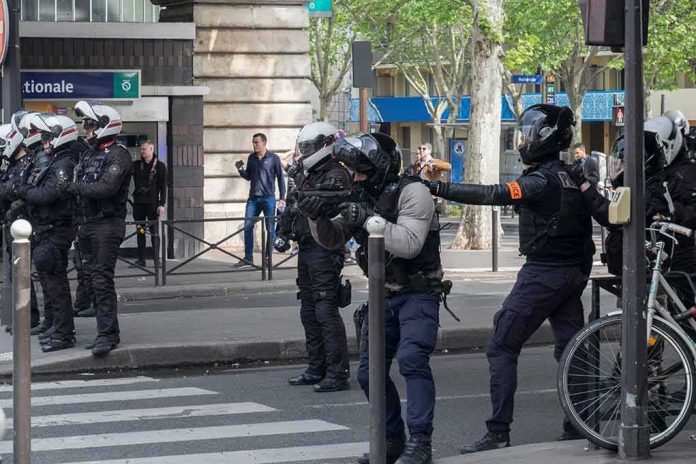
Big protest waves are political Rorschach tests: the same footage of fires and crowds gets read as proof of very different stories. The only way to keep your bearings is to separate what happened, what’s claimed about why it happened, and what the record can actually support.
At a Glance
- President Trump asserted France’s unrest was driven by “out-of-control mass migration” and Islam, not schools; he offered no supporting evidence.
- Independent reporting attributes the movement’s origin to school conditions, staff shortages, and education funding, later widening to cost-of-living and public-services grievances.
- The scale of disruption was large enough to become a political symbol, which is why it was rapidly drafted into U.S. campaign rhetoric.
- Causal claims require mechanism and proof; the immigration-Islam explanation is not substantiated by police, organizers, or policy records in the available reporting.
What actually happened versus what was claimed
The distinction between event and interpretation is not academic here; it determines whether a sweeping cultural diagnosis stands on the facts or simply on repetition. In early autumn, France saw mass demonstrations—hundreds of thousands in the streets—alongside high-school blockades and scattered disorder. That scale made the unrest politically meaningful on its own. But scale is not cause. President Trump publicly framed the turmoil as the product of “out-of-control mass migration” and Islam’s bid for dominance, explicitly dismissing school conditions as the trigger. He then extended the point into an American warning, telling a Kansas audience that “burning steeples and raging fires in France” preview what “radical Democrats” want for the United States.
Reporting that reconstructed the movement from the ground up tells a different story. Journalists on the streets, student statements, and union voices describe an education-centered protest—dilapidated buildings, chronic staff shortages, overcrowded classrooms—expanding into broader complaints about living costs, wages, and the condition of public services. That narrative is consistent across multiple outlets and includes the government’s concrete policy response: a pledge to add 3,000 supply teachers, which targets staffing rather than immigration.
How movements escalate: from a narrow grievance to a broad coalition
France has a well-documented pattern of protest escalation: a discrete grievance draws a core group, related constituencies join with adjacent demands, and the coalition’s size changes how the state responds. Here, the education system’s problems—aging infrastructure, insufficient staffing, overcrowded classes—served as the ignition point. As participation grew, unions and Yellow Vest networks folded in living-cost and wage issues, and some demonstrations turned confrontational, producing the images that travel fastest. The coalition logic explains both the variety of slogans visible on placards and why the strongest immediate government concession addressed schools rather than borders.
That escalation dynamic also explains why unrest becomes politically useful to actors far from the original dispute. In U.S. partisan debate, dramatic incidents in Europe are routinely invoked as proof-of-concept for domestic warnings—immigration, law and order, national identity. The French scenes were taken up by Trump and aligned commentators as a cautionary tale for the United States, even as the proximate demands in France remained education- and cost-of-living–centric.
Weighing the competing causal accounts
Reasonable observers should ask two questions of any causal claim: What is the mechanism, and where is the evidence? On the mechanism, the immigration-Islam thesis would need to show direct links—organizer affiliations, messaging, recruiting channels, financing, or command-and-control—connecting the protests to migration or religious networks. On the evidence, it would need more than imagery of unrest in districts with immigrant populations; it would require police briefings, court records, or credible investigative reporting identifying such a link. The available record in the cited coverage does not provide those elements; multiple reports note Trump supplied no evidence for his attribution.
By contrast, the education-and-public-services account supplies both mechanism and corroboration. Students and teachers described the precise failures—overcrowding, broken facilities, staffing shortages—that map to the institutional actors responsible for schools. Unions articulated wage and service-protection demands. The state’s response—a promise of thousands of temporary teachers—is targeted to those mechanisms. None of that proves every incident within the unrest flowed from school grievances; large protests attract opportunists and factions. It does show that the center of gravity was educational and socioeconomic, not immigration or religion.
Scale is not causation
The size and intensity of the French demonstrations make them easy to conscript into broader ideological claims. But the existence of fires and mass turnouts is neutral on the question of cause. Photogenic disorder can be the effect of many inputs: brittle public services, price shocks, youth unemployment, policing tactics, or ideological agitation. Treating scale as proof of a preferred cause is a category error; it collapses an empirical question into a rhetorical shortcut. That shortcut is exactly what responsible analysis should resist.
Trump, Vance Pin France Unrest on Immigration
Read the full story: https://t.co/wlpwvqEZAL
Trump and Vance blamed immigration for French unrest rooted in education and living-cost grievances, using it to campaign against Democrats.#France #protests #immigration #Trump #Vance… pic.twitter.com/p7uMPZcgtJ
— wondernews.now (@wondernews_now) October 19, 2026
Why the U.S. analogy doesn’t hold without specifics
The jump from “France is burning” to “that is what Democrats want to do to America” requires two bridges: policy comparability and behavioral inference. Policy comparability means specifying which American policies mirror French conditions—immigration levels, integration regimes, school funding formulas, labor-market stressors—and showing those factors’ contributions to unrest through data, not assertion. Behavioral inference means demonstrating that similarly situated groups in the United States would mobilize the same way for the same reasons. The cited materials provide no such mapping; the analogy is purely rhetorical. Without that scaffolding, warnings about “burning steeples” function as campaign talking points, not analysis.
What to watch if you care about causes, not slogans
Three evidence paths would meaningfully test the immigration thesis. First, arrest and prosecution records identifying organizer networks, communications, or funding tied to migration- or religion-centered groups. Second, a credible demographic profile of participants that goes beyond anecdote and respects French privacy law, compared with baseline population data. Third, primary-source content analysis of protest demands—flyers, chants, speeches, posts—to quantify how much of the movement’s messaging concerned immigration or Islam versus schools and living costs. Until such records emerge, the burden of proof remains unmet by those asserting an immigration-Islam cause.
Bottom line
France’s unrest was real, large, and politically salient. But the strongest, sourced account of its origins and main demands centers on failing school conditions and broader cost-of-living pressures, not immigration or Islam. President Trump’s attribution supplies neither mechanism nor corroboration in the reporting at hand; it operates in the realm of symbolic politics, where dramatic disorder is drafted to argue for unrelated policy preferences. If you care about diagnosis that leads to solutions, start where the evidence is: with the institutions that broke, the services that failed, and the socioeconomic pressures that mobilized hundreds of thousands—then demand proof before accepting any broader cultural explanation.
Sources:
afp.com, politico.com, firstpost.com, straitstimes.com, newsweek.com, ground.news, internazionale.it, timesofisrael.com, bignewsnetwork.com