When a White House admits some reporters and excludes others because it dislikes their coverage, it is not managing logistics; it is regulating speech. In American constitutional law, that line matters decisively.
The Short Version
- President Trump announced a ban on CNN, MS NOW, and Politico from White House access and explicitly tied the exclusion to what he called “fake news” and unfavorable coverage.
- Reporters from the targeted outlets were then denied entry and had credentials deactivated or confiscated, demonstrating the policy was enforced, not rhetorical.
- A federal judge in related litigation stated the government cannot open access to some journalists while excluding others for their viewpoints; press advocates call such bans classic viewpoint discrimination.
- The episode fits a recurring pattern: courts have previously rebuffed attempts to punish news organizations for coverage in White House access disputes, even as narrow questions about pool management persist.
What the ban was, and why the stated rationale matters
President Trump announced that CNN, MS NOW, and Politico were banned from the White House because of “constant ‘reporting’ FAKE NEWS” and their negative coverage. This was not cloaked in neutral pretexts like space constraints or conduct rules; it was cast as punishment for disfavored reporting. The difference is not semantic. Under the First Amendment, government may impose reasonable, viewpoint-neutral rules to administer access to limited spaces, but it may not dole out access as a reward for friendliness or a penalty for criticism. Trump’s own framing is thus legally consequential; it ties the decision to content and viewpoint rather than to neutral criteria.
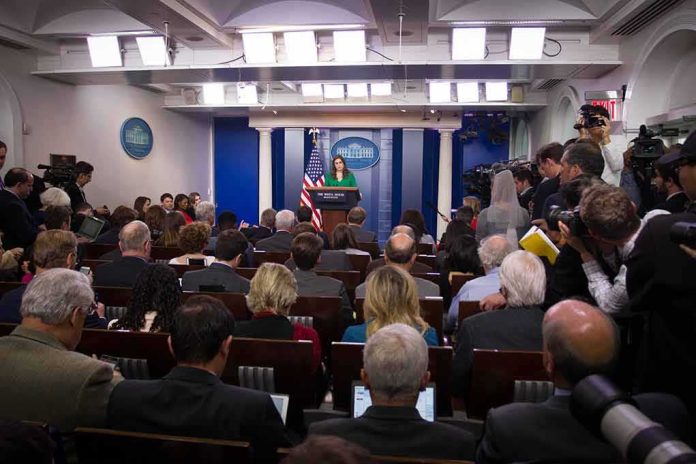
The White House enforced the ban. Journalists from the named outlets were turned away at the gates, and press credentials were reportedly deactivated or confiscated. That operational step shifts the question from rhetoric to law: a live restriction on press access that demands constitutional justification. This is why the subsequent objections came not only from targeted outlets but from institutions that represent the broader press corps.
The constitutional baseline: access once opened cannot be closed for viewpoint
For half a century, courts have carved a path between two realities: there is no general constitutional right to enter the White House, yet when the government creates a system of access and invites journalists to cover official events, it must administer that system on viewpoint-neutral grounds. In the litigation arc surrounding prior White House restrictions on the Associated Press, a federal district judge ordered restoration of AP access, underscoring that the government cannot punish the news organization for the content of its reporting. While later appellate proceedings wrestled with narrow questions about specific spaces and pool logistics, the core rule held: the government may not exclude because of viewpoint.
That principle surfaced quickly again here. A district court, confronted with the 2026 dispute, articulated the standard succinctly: if the government opens its doors to some journalists, it cannot shut them to others because of their viewpoints. The statement is not a press-advocacy slogan; it is the canonical First Amendment line courts use to cabin official retaliation against speech in quasi-public settings like press facilities and credentialed events.
How the 2026 episode fits the legal pattern
Three features place this ban squarely within the doctrine most hostile to the government’s position. First, the president’s own statements identify the rationale as disagreement with coverage, not a neutrally applicable access rule. Second, enforcement was immediate and concrete; the rule was not hypothetical. Third, the press corps and First Amendment organizations responded with a unified theory: this is viewpoint discrimination against credentialed journalism, not permissible management of limited space. The Knight First Amendment Institute’s leadership characterized the ban as unconstitutional retaliation; press associations echoed that line and demanded restoration of access.
Against that, the administration’s public defense has leaned on a familiar refrain: these outlets publish “fake news,” and the president should not have to admit reporters who, in his telling, write fiction or lies. That argument resonates politically with audiences suspicious of media institutions. Legally, it is a nonstarter. The government does not get to be the arbiter of truth in deciding who may observe and report on official proceedings; that is precisely the role the First Amendment denies it. In the access context, the question is not whether coverage flatters the incumbent but whether access criteria apply evenly to all.
Forum doctrine and the White House press complex
Much of the confusion stems from the legal category of the place at issue. The White House briefing room, press workspace, and managed “pool” rotations function as a limited public forum or nonpublic forum, depending on the setting. In both, the government retains latitude to impose reasonable, viewpoint-neutral restrictions tied to the forum’s purpose—credentials, security vetting, rotation rules for scarce seats. What the government may not do is select or expel participants because it disfavors their viewpoint. That is the fulcrum upon which access disputes have repeatedly turned, including the AP litigation, where courts separated routine pool management from retaliatory exclusions.
This is why appeals to “it’s a small room” or “we need order” cannot salvage a ban explicitly grounded in coverage criticism. Space constraints justify rotations; they do not justify blacklists targeted at disfavored reporting.
What remains contested—and what does not
Two questions can be genuinely hard. First, how to classify particular White House spaces and events—briefings versus Oval Office sprays, South Lawn departures versus secure meetings—and what that classification permits administratively. Second, what evidence suffices to prove that a restriction is retaliatory rather than neutral. Those were the apertures through which the government argued, in earlier cases, that some limits could stand even if broader bans could not. Appellate panels have, at times, allowed interim limitations in closely confined settings while merits litigation proceeded.
What is not hard is the prohibition on assigning or revoking access because of disfavored coverage. Here, the record cited by mainstream outlets shows the president tying the ban to “fake news” and “unfavorable” reporting, and reporters being denied entry on that basis. That combination aligns with classic viewpoint discrimination. The White House Correspondents’ Association captured the point plainly: constitutional protections do not depend on whether a president likes a news organization’s coverage.
I agree it's unconstitutional to ban press organizations based on viewpoint, but doing it for a viewpoint-neutral reason is permissible. Here we have @glukianoff falsely claiming that Trump confessed to viewpoint discrimination. The quote Greg attributes to Trump is fictitious. https://t.co/Q3rTXjTiai
— Jeff Norman (@citizenjeff) September 20, 2026
The stakes: beyond a skirmish with three outlets
Selective bans recalibrate incentives for all reporters, not just the named targets. If access becomes contingent on tone, the press corps faces a structural nudge toward self-censorship to preserve proximity, which is dangerous precisely because it can be subtle. That is why institutions representing even unaffected outlets object: today’s exclusion can be tomorrow’s discipline against them. The legal remedy—injunctions that restore access pending litigation—exists to arrest this chilling effect quickly, but clarity in public understanding matters, too. This is not a fight about whether coverage is “fair”; it is about whether the government may use its gate as a lever to shape what the public learns from independent observers.
What to watch as litigation advances
Cases like this typically turn on the written policy record and the operational paper trail. Courts will ask: What directive was issued? By whom? What criteria were applied to deactivate credentials, and were those criteria viewpoint-neutral? Prior decisions also probe the nature of the forum at each disputed event and whether the government’s rationale plausibly serves that forum’s function. The administration’s safest ground is always a neutral, evenhanded rule tied to space, security, or conduct—backed by documentation. Its weakest ground is a president’s own statements announcing that disfavored speech is the reason for exclusion.
Sources:
mediaite.com, reuters.com, usatoday.com, npr.org, cnbc.com, inquirer.com, theguardian.com, bbc.com, hindustantimes.com