
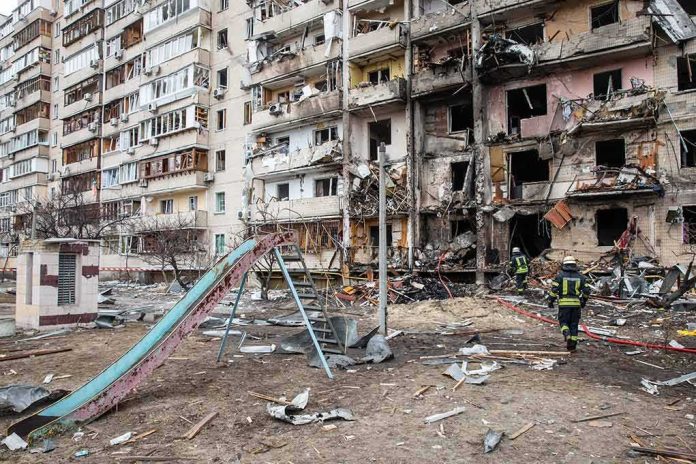
When “no warning” becomes literal in a modern missile war, it is almost never about a single failure; it is about a chain—detection, transfer, reception, and public alert—where a break at any link can blind a city for minutes that matter.
The Short Version
- Zelenskyy said Kyiv received no partner warning before a multi-missile strike; Ukraine’s Air Force reported radar only picked up threats during the attack.
- Early air-raid sirens did not sound, aligning with a lapse somewhere in the warning chain rather than with public messaging alone.
- U.S. and Ukrainian officials publicly deny a current halt to intelligence sharing; reporting points to a technical or weapon-specific detection failure.
- A prior, documented 2025 U.S. pause proves a cutoff is operationally possible, but it does not establish causation for this incident.
What “no warning” really means in ballistic-missile defense
Early warning is not a single feed. It is a time-critical relay spanning space-based infrared sensors that see the thermal bloom of a launch, ground-based radars that confirm trajectory, data links that push alerts across borders, national command centers that validate and disseminate, and civil alert systems that sound sirens. If any handoff is late—detection, classification, transmission, receipt, or authorization—the public hears explosions before sirens. Ukraine’s president stated Kyiv got no early warning from partners before the strike; Ukraine’s Air Force added that its radars only saw the missiles during the attack, meaning initial cueing came too late for a pre-impact alert window.
Those details matter because the fastest inbound threats—short- and medium-range ballistic missiles—shrink the timeline from minutes to seconds. Western support, especially U.S. space-based infrared (SBIR) detection, has been central to restoring those precious minutes by flagging launches, approximate trajectories, and likely impact windows. Multiple outlets have reported that such partner data had previously enabled Ukraine to stage interceptors and warn civilians earlier.
The evidence-backed core: a real lapse in advance warning occurred
Three strands align. First, Zelenskyy’s contemporaneous claim that partners provided no early intelligence. Second, the Air Force’s account that initial radar tracks appeared only mid-attack—consistent with missiles already well into flight. Third, public accounts that sirens did not sound ahead of the first detonations in Kyiv. Taken together, these indicate a failure to deliver actionable pre-launch or boost-phase warning to Ukrainian authorities in time to trigger pre-impact alerts. That is different from saying no one was watching; it says actionable warning did not arrive when it needed to.
What remains indeterminate is attribution. Zelenskyy referred to “partners” in the plural; he did not identify which ally’s data, if any, failed to arrive. Public reporting contains no transmission logs or space-sensor timelines; they are classified by design. As a result, the public case can establish a missed warning without proving whether the break occurred at the detection layer, in cross-border dissemination, inside Ukraine’s command-and-control, or because of a weapon that compressed timelines beyond the practical reach of the usual system.
Competing explanations: cutoff narrative versus technical failure
Two narratives emerged. One ties the lapse to geopolitics: Washington previously paused intelligence sharing with Ukraine in March 2025 after a tense Oval Office confrontation, demonstrating both capability and willingness to flip the switch—albeit briefly and reversibly. That precedent is real and well documented; it proves possibility, not present causality.
The second is operational: U.S. and Ukrainian officials have since said intelligence cooperation continued, and President Trump publicly denied any current halt—“We are helping them, and we are sharing intel.” Reporting anchored in Ukrainian and American sources characterizes the Kyiv episode as a failure to detect or communicate the launch in time, not a policy cutoff; Ukraine’s foreign minister even attributed the delay to Russia’s use of a “special type of weaponry,” which could mean a fast-burning ballistic system, an atypical flight profile, or environmental factors that degraded the cueing chain. On the evidentiary scale available publicly, the technical-failure account is the stronger fit for the facts we can see, because it explains both the lack of sirens and the Air Force’s mid-attack detection without requiring proof of a renewed political shutdown.
How weapon type, trajectory, and weather break warning chains
Ballistic warning timelines hinge on three variables: burn signature, line-of-sight, and handoff speed. Space-based infrared sensors detect the hot plume of a rocket’s boost phase; short-burn systems and depressed trajectories compress detection windows. Cloud cover does not hide infrared plumes from space entirely, but weather and background clutter complicate classification and track quality. Ground-based radars, especially those sited for defense of cities, often rely on external cueing to look in the right slice of sky at the right time; without it, tracks may only appear as the reentry vehicle closes in. Add a congested air picture—drones, decoys, cruise missiles—and deconfliction eats seconds that matter.
Analysts and open reporting have long highlighted Ukraine’s reliance on U.S. early-warning data for ballistic launches and the limited capacity of European sensors to replicate that coverage at equivalent speed and fidelity. When those feeds are late or ambiguous, the civil alert system may not trigger until local radars confirm an inbound track—by which point the first detonations can precede sirens by design, not by malice.
Why the 2025 pause still shapes interpretation—and why it should not decide this case
The 2025 suspension is a powerful prior because it proved a partner-originated interruption was not hypothetical; it happened, lasted days, and then ended. It also exposed institutional fragility: Ukraine’s warning architecture, having been integrated with allied cueing, is vulnerable to policy turbulence far outside the battlefield. But the prior is not a substitute for present evidence. There is no public record that the March 2025 policy was still in effect during this strike, nor that a similar directive was reissued. In contrast, on-the-record denials from U.S. and Ukrainian officials, paired with reporting that frames the incident as a detection or communication failure, better match the operational signatures observed in Kyiv that night.
Precision in language helps here. “No warning from partners” describes an operational effect—what Ukraine did not receive in time—not an adjudicated cause. Conflating the effect with a specific cause, absent logs, invites confident but untestable conclusions and turns secrecy into narrative license.
Zelensky says Russia hit a Kyiv power station with ballistic missiles, and for a second day in a row the U.S. didn’t share an advance warning about a Russian missile strike. Trump hours earlier insisted that U.S. intelligence sharing continues, and the energy ceasefire holds. https://t.co/x5hruFTw3w
— Yaroslav Trofimov (@yarotrof) October 13, 2026
What accountability would look like: timelines, not talking points
A credible after-action review would publish, at minimum, a declassified timeline: first detection timestamp by each contributing sensor; classification and track-quality milestones; cross-border transmission times; receipt and acknowledgment at Ukrainian nodes; and the moment an air-raid alert was authorized. That sequence would reveal where latency accumulated—sensor, network, human—and whether a weapon-specific profile made pre-impact public warning impractical that night. Short of that, a technical annex outlining whether the system met its design timelines, or why it could not, would elevate the discussion from accusation to engineering.
Implications: design for resilience, assume intermittent blindness
For Ukraine, the lesson is to harden each link of the chain. That means diversifying cueing sources—space, high-altitude ISR, forward-based radars—so that the loss or delay of one does not produce silence. It means automating cross-border dissemination to minimize human bottlenecks and pre-authorizing alert thresholds for certain track-confidence combinations to avoid decision lags. For partners, the charge is to publish, even in outline, the service levels they aim to provide—latency targets by threat class—so expectations match capability under wartime load.
Finally, the public should recalibrate what “success” looks like. Against fast ballistic systems, even perfect detection can yield only a few minutes of warning; sometimes, seconds. In those regimes, the right metric is not whether sirens always precede the first blast, but whether overall latency is trending down and interception rates are trending up. Clarity about those constraints will not make the next quiet sky less unnerving—but it will make debates about why it went quiet more honest.
Sources:
military.com, pbs.org, en.interfax.com.ua, ua.news, rnz.co.nz, cnn.com, 24tv.ua, kyivindependent.com, thetimes.com, news.liga.net, yahoo.com, cfpublic.org, reuters.com