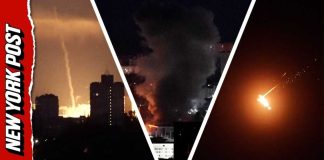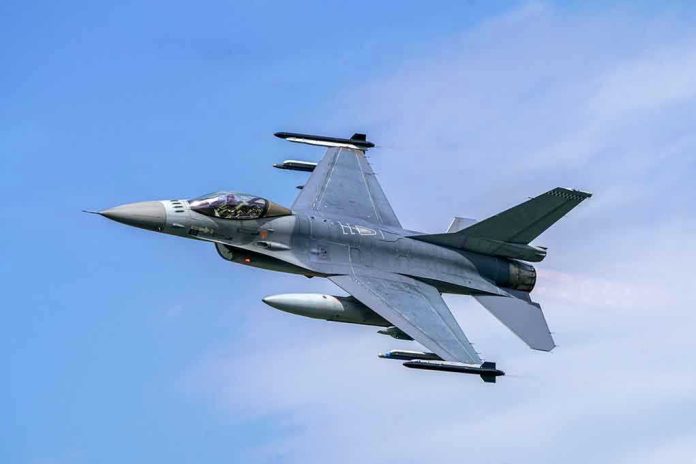
A Thunderbirds F-16 fighter jet exploded into a massive fireball in the California desert, but the pilot’s split-second ejection saved his life in what could have been a catastrophic tragedy.
Story Highlights
- US Air Force Thunderbirds F-16C crashed near Trona Airport in San Bernardino County during training mission
- Pilot ejected safely seconds before impact and survived with only minor injuries
- Aircraft erupted into spectacular fireball visible for miles across desert landscape
- Crash occurred in controlled military airspace near Naval Air Weapons Station China Lake
- Investigation ongoing with cause undetermined; only five of six jets returned to base
Desert Training Mission Turns Catastrophic
The December 3, 2025 incident unfolded during what began as a routine training flight from Nellis Air Force Base. Six Thunderbirds F-16C Fighting Falcons departed for scheduled maneuvers in the California desert, utilizing the vast controlled airspace near Naval Air Weapons Station China Lake. The region serves as a critical training corridor for military aviation due to its open terrain and restricted access, making it ideal for high-performance aircraft operations.
At approximately 10:45 AM local time, one aircraft experienced an emergency that forced the pilot to make a life-or-death decision. The F-16C went down near Trona Airport in San Bernardino County, a sparsely populated desert area south of Death Valley. Eyewitnesses reported seeing the pilot eject just moments before the fighter jet slammed into the ground and exploded into a towering fireball.
Ejection System Saves Pilot’s Life
The pilot’s successful ejection demonstrates the sophisticated safety technology built into modern fighter aircraft. F-16 ejection seats are designed to function even at low altitudes and high speeds, providing pilots with escape options in emergency situations. The system performed flawlessly, allowing the pilot to clear the aircraft before impact and parachute safely to the desert floor.
San Bernardino County Fire Department crews responded quickly to the crash site, treating the pilot for minor injuries before transporting him to a hospital in Ridgecrest for evaluation. The pilot was the only person aboard the single-seat fighter, and authorities confirmed no civilians were endangered by the incident. Emergency responders noted that the resulting fire posed no threat to surrounding vegetation despite the dramatic explosion.
Elite Demonstration Team Faces Operational Loss
The crash represents a significant operational setback for the Thunderbirds, the Air Force’s premier demonstration squadron. These elite pilots showcase American air power through precision aerobatic displays at airshows nationwide, flying F-16 Fighting Falcons modified for their demanding routines. The loss of one aircraft from their limited fleet will likely impact training schedules and potentially affect upcoming performance commitments.
The Thunderbirds issued an official statement confirming the incident: “On December 3, 2025, at approximately 10:45 am, a Thunderbird pilot ejected safely from a F-16C Fighting Falcon aircraft during a training mission over controlled airspace in California.” The team operates under stringent safety protocols due to the public nature of their performances and the precision required for formation flying. This incident marks a rare occurrence for the demonstration squadron, which maintains exceptional safety standards.
Investigation Seeks Answers in Desert Wreckage
Air Force investigators are conducting a comprehensive analysis to determine what caused the F-16C to go down during the training mission. The 57th Wing Public Affairs Office confirmed that the investigation remains active, with detailed examination of wreckage, flight data, and maintenance records ongoing. No preliminary cause has been identified, whether mechanical failure, pilot error, or environmental factors contributed to the emergency.
The dramatic nature of the crash, captured on video showing the massive fireball and thick black smoke, has drawn significant public attention. However, the successful ejection and pilot survival represent a positive outcome in what could have been a tragic loss of life. The incident validates decades of investment in pilot safety systems while highlighting the inherent risks of military aviation operations, even during routine training missions in controlled airspace.
Sources:
Video: US Air Force F-16 explodes into huge fireball after crash in California
US Air Force Thunderbirds F-16C fighter jet crash California
USAF Thunderbirds F-16 fighter jet crashes in San Bernardino County
US F-16 fighter jet crashes in California; pilot ejects moments before explosion