
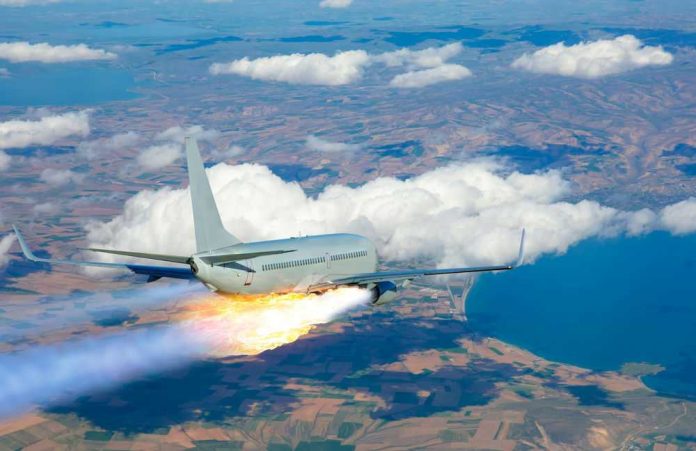
The most haunting part of Lion Air Flight 610 isn’t the final phrase on the cockpit recorder—it’s that two trained pilots spent nine minutes fighting a machine they didn’t know existed.
Story Snapshot
- Lion Air Flight 610, a nearly new Boeing 737 MAX 8, crashed into the Java Sea minutes after leaving Jakarta, killing all 189 aboard.
- A faulty angle-of-attack sensor fed bad data that repeatedly triggered MCAS, an automated system that forced the nose down.
- The crew called air traffic control with a “flight control problem” and tried to use the quick reference handbook while alarms blared.
- The cockpit exchange ended with the captain silent and the first officer saying “Allahu Akbar,” commonly spoken in distress and prayer in Indonesia’s Muslim-majority culture.
Nine Minutes After Takeoff: A Normal Departure Turns Into a Puzzle Box
Lion Air JT610 lifted off from Jakarta at 6:20 a.m. on October 29, 2018, headed for Pangkal Pinang in clear morning conditions. Within roughly two minutes, the first officer told controllers the aircraft had a flight control problem and asked to stay at 5,000 feet. That detail matters: when crews ask for time and altitude, they’re buying space to troubleshoot—space this flight never truly got.
The cockpit voice recorder accounts describe a crew trying to fly, diagnose, and communicate all at once. The pilots worked the problem like a checklist drill: open the quick reference handbook, look for the matching symptom, apply the steps, then reassess. The trouble with JT610 was that the “symptom” kept changing—warnings, stick shaker cues, conflicting indications—while the airplane itself kept quietly trimming nose-down in the background.
MCAS and the Single-Sensor Trap That Turned Automation Into Authority
MCAS—the Maneuvering Characteristics Augmentation System—existed to make the 737 MAX handle more like older 737s during specific high angle-of-attack situations. The system could command the stabilizer to push the nose down. Investigators concluded JT610’s angle-of-attack sensor delivered erroneous data soon after departure, and MCAS responded as designed: it kept pushing, repeatedly, even as the pilots pulled back.
That design choice—relying on a single sensor input for a system powerful enough to move the stabilizer—became the central lesson of the MAX crisis. Common sense conservatism says you don’t bet lives on a single point of failure, especially when the people responsible for the outcome may not even know the system is acting. Redundancy isn’t bureaucracy; it’s humility engineered into metal and code.
Inside the Cockpit: Handbook Pages, Conflicting Alerts, and a Costly Role Swap
From about 6:22 to 6:31, the crew reportedly flipped through procedures while the airplane fought them. The captain, Bhavye Suneja, had thousands of hours and took the lead early, countering the nose-down tendency. Later, the pilots swapped roles, with the first officer, Harvino, taking the controls. In a crisis, a role swap can clarify tasks—or it can transfer a wrestling match to the tiredest arms at the worst time.
Investigators and analysts later argued over what the crew “should” have done. The runaway stabilizer memory items and checklist discipline became a talking point, and the Indonesian final report criticized the crew’s response. That criticism can be partly fair without being the whole truth. A checklist is only as useful as the diagnosis that points you to it. When the aircraft’s behavior disguises the cause, even good pilots end up treating symptoms.
The Last Words: What the Recorder Captured and What Headlines Got Wrong
The Reuters-reported details that rippled through global headlines sounded like a horror script: frantic page-turning, the captain’s dwindling speech, and the first officer’s final “Allahu Akbar.” Some outlets treated that phrase like a surrender or a confession of panic. That framing reflects cultural ignorance more than insight. In Muslim communities, “God is greatest” often functions like “Oh my God” or a last-second prayer—an instinctive expression under extreme stress.
The more meaningful “last words” aren’t religious at all; they’re operational. Controllers heard “flight control problem.” The cockpit reportedly focused on airspeed and altitude while a hidden automation loop kept returning. When people hear the phrase, they remember emotion. When professionals study the flight, they remember the mismatch: two humans using paper logic against a system that could reset and reapply itself faster than they could interpret what it was doing.
Maintenance, Oversight, and Accountability: Where Responsibility Actually Lands
The aircraft had reportedly experienced issues on the prior day’s flight, and that earlier crew managed to get on the ground. Investigators later pointed to maintenance shortcomings and oversight gaps, a familiar theme in fast-growing low-cost markets. That doesn’t absolve the manufacturer. If a commercial airliner can enter a lethal failure mode because one sensor lies, the design invites catastrophe. Aviation succeeds when every layer—maintenance, training, engineering, regulation—assumes the other layer will fail.
The U.S. certification system also took a reputational hit because Boeing’s influence over parts of the approval pipeline became a political and public trust issue. Conservatives should care about this for a simple reason: institutions earn legitimacy by proving they can police themselves. When regulators appear too cozy with industry, the backlash doesn’t just punish a company; it erodes faith in the system that keeps families safe at 35,000 feet.
Why Flight 610 Still Matters Every Time You Board a Modern Jet
JT610 was the first fatal 737 MAX crash and it foreshadowed a second, Ethiopian Airlines Flight 302, that pushed governments to ground the MAX worldwide. Afterward came software changes, revised training, and additional sensor logic intended to prevent a repeat. The fleet eventually returned to service, but the cultural shift remains: airlines, regulators, and pilots now treat automation with more skepticism, and that’s healthy.
The lasting caution is personal, not technical. Humans will keep building smarter machines to reduce workload and increase safety, and that’s progress. The bargain only works when designers tell operators the truth about what the machine can do, when training matches reality, and when the system refuses to become a bully in the cockpit. Flight 610 showed what happens when those promises break at once.
Sources:
Lion Air crash: Pilots’ last words before plane plunged into sea
Lion Air plane cockpit voice recorder reveals pilots’ frantic search for fix: Report
Lion Air Flight 610: The Final Minutes