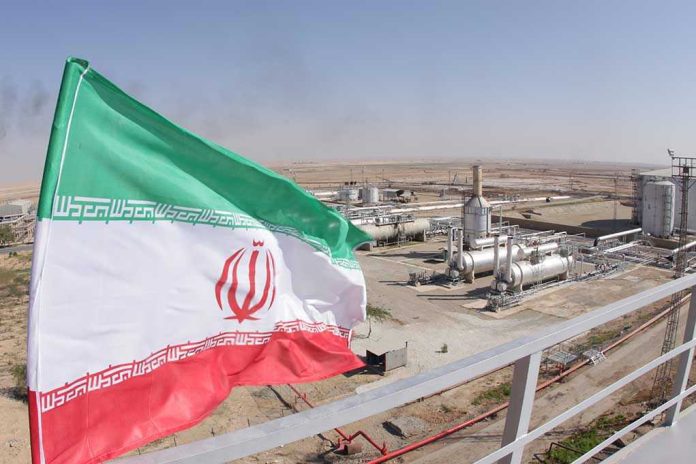
Iran’s economy is spiraling into crisis as inflation hits 73.5% year-on-year, food prices double in weeks, and a U.S. naval blockade chokes off the nation’s primary revenue source—a perfect storm of mismanagement, external pressure, and structural decay that ordinary Iranians are paying for with their savings and livelihoods.
Quick Take
- Annual inflation in Iran reached 73.5% in the March-April period, with food and beverage prices surging 115%, forcing middle-income families to cut meat, eggs, and dairy from their diets [1]
- The Iranian rial has collapsed to approximately 181,000 tomans per dollar, losing more than half its value in a year as currency demand spikes amid economic uncertainty [5]
- A U.S. naval blockade has reduced oil exports by 70%—from 1.85 million to 567,000 barrels per day—costing Iran an estimated $500 million daily in lost revenue [5]
- An estimated 2 million Iranians have lost jobs in tourism, restaurants, and retail, while internet blackouts have cost the economy $1.8 billion and counting [5]
Inflation Reaches Levels Unseen in Modern Iran
The Statistical Center of Iran confirmed that consumer prices rose 73.5% year-over-year between March 21 and April 20, 2026, marking the most severe inflationary spike in contemporary Iranian history [1][4]. Food, beverages, and tobacco prices climbed 115% annually, forcing ordinary households into impossible choices [1]. The 12-month average inflation rate stood at 53.7%, reflecting sustained upward pressure on prices across all economic sectors [4]. This is not temporary volatility—Iran has endured persistently high inflation above 30% for more than seven years, signaling the regime’s complete inability to control the crisis [3].
Currency Collapse Accelerates Economic Unraveling
The Iranian rial has undergone a historic depreciation, reaching 181,000 tomans per dollar by late April 2026—more than double the rate from a year prior [5]. In just two days, the currency lost 23,000 tomans of value as demand for dollars and gold surged among panicked citizens [5]. The euro exceeded 210,000 tomans and the British pound topped 240,000 tomans during the same period [5]. This currency freefall reflects both the blockade’s impact on oil revenues and deeper structural rot: decades of corruption, mismanagement, and wartime spending have eroded confidence in the regime’s economic stewardship [3].
U.S. Blockade Starves Iran of Oil Revenue
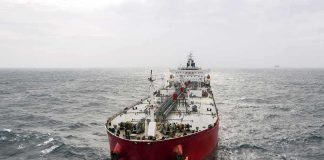
The U.S. naval blockade, which began April 13, 2026, has slashed Iranian oil exports from 1.85 million barrels per day to 567,000 barrels—a 70% collapse [5]. U.S. Secretary of State Marco Rubio stated the blockade costs Iran $500 million daily in lost oil revenue [1]. Iran’s regime rejected this figure as propaganda, but state media itself confirmed the rial’s freefall and acknowledged supply shocks stemming from restricted oil sales [5]. With oil historically providing the bulk of government revenue, this economic asphyxiation is forcing the regime to finance basic services through credit schemes rather than genuine income [5].
Middle Class Evaporates as Food Prices Double
The gap between wage growth and living costs has obliterated purchasing power for ordinary Iranians. Even a 60% wage increase fails to preserve living standards when basic goods cost 73% more [3]. Packaged sugar jumped from 95,000 tomans per kilogram in late March to 125,000 tomans by late April—a 32% spike in weeks [5]. Eggs now sell for roughly 600,000 tomans per tray, or 20,000 tomans per egg [5]. Domestic reports show middle-income families cutting meat, chicken, and dairy from regular meals, turning staples into occasional luxuries [5]. The regime’s own data reveals 98% of eligible citizens have exhausted their electronic coupon credits, forcing families to choose between selling assets or buying essentials on credit against future subsidies [5].
🚨WATCH: Scott Bessent openly admits that US sanctions deliberately fueled Iran’s Economic And Currency Collapse, directly contributing to the wave of protests.
He adds that a Major Iranian Bank went bankrupt, and there is a massive Dollar shortage in Iran. pic.twitter.com/k8Igm5D9DK
— THE GLOBAL WATCHDOG (@glwatchdog) May 7, 2026
War Damage and Job Losses Compound the Crisis
The Iranian government estimates war-related damages at $270 billion, equivalent to 57% of its gross domestic product [1]. The International Monetary Fund projects a 6.1% economic contraction [1]. An estimated 2 million Iranians—over 2% of the population—have lost jobs in tourism, restaurants, and retail sectors [5]. Internet blackouts imposed during unrest have cost approximately $1.8 billion, with daily losses reaching $35 million [5]. This combination of external shock, internal mismanagement, and regime repression has created a perfect storm: ordinary Iranians face simultaneous job loss, price spikes, currency collapse, and restricted access to information [5].
A Chronic Crisis Born of Decades of Decay
The 73% inflation is not an isolated event but the culmination of structural dysfunction spanning decades. The Iranian regime’s economic system is built on mercantile politics hostile to institutional development and long-term investment [3]. Every external shock—war, sanctions, blockade—rapidly translates into currency devaluation and price surges because the underlying economy lacks resilience [3]. Unlike the temporary inflation of World War II, Iran’s crisis reflects the regime’s permanent inability to manage resources, combat corruption, or invest in productive capacity [3]. For millions of Iranians, the daily reality is now a choice between selling family assets, buying essentials on credit, or taking to the streets [5].
Sources:
[1] Iran economy deteriorating amid sanctions, continuing blockade
[5] Iran’s Economic Realities Amid War – Middle East Institute