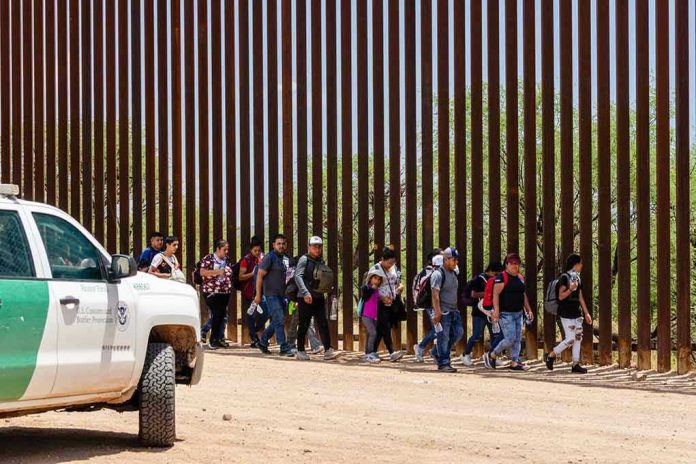
The most powerful law-and-order promise on the southern border right now is a clock: finish the wall’s primary stretch by late 2027.
Story Snapshot
- Customs and Border Protection Commissioner Rodney Scott says the main U.S.–Mexico border wall should be done by late 2027.[1]
- The Trump administration won fresh funding and restarted stalled contracts to push hundreds of miles of wall and smart technology.
- Critics point out that contracts, legal waivers, and vague terms like “primary wall” make that 2027 date a political bet, not a sure thing.[3]
- For conservatives, the real question is not only “can they build it?” but “will they quietly move the goalposts on what ‘finished’ means?”[3]
What Rodney Scott Actually Promised About the 2027 Finish Line
Customs and Border Protection Commissioner Rodney Scott did not mumble when he talked about the wall; he put a date on it. Public remarks shared through outlets like Newsmax quote him saying the United States expects to complete President Donald Trump’s southern border wall by late 2027.[1] Social clips echo the same thing: the “primary border wall” should be done, with only gaps left in hard areas to build.[1][2][3] That is not vague mood music. That is a calendar promise tied to national security.
Scott’s language matters because it joins a pattern. Secretary of Homeland Security Markwayne Mullin has also told Congress the “primary border wall” is on track to be finished around mid-2027. Supporters push this as proof that the Trump-era pledge to build a real barrier, not just talk about one, is finally maturing into steel, concrete, and sensors in the ground.[1] For a country worn out by slogans, a specific year feels like a line in the sand.
How Funding, Contracts, and Smart Tech Are Fueling the Push
The 2027 claim does not float in space; it rides on money and contracts. A White House summary boasts that Congress approved about $46.5 billion for border security, including the wall, and that the administration is tapping both new funding and previously frozen money to push ahead. The Department of Homeland Security then awarded about $4.5 billion in big contract packages to build nearly 230 miles of new land barriers and almost 400 miles of technology systems along the border.
Those contracts support more than metal and concrete. The plan knits together a “smart wall”: fixed barriers in key crossing zones plus sensors, cameras, and command systems spread over hundreds of miles.[3] On paper, that lets Customs and Border Protection combine physical control in choke points with wider digital eyes where a full wall may be too costly, rough, or legally messy.[3] For many conservatives, that mix looks like basic common sense: slow illegal crossings where they are heaviest, and track the rest with tools instead of empty speeches.
Why Skeptics Say the 2027 Date Is More Politics Than Engineering
The counterargument does not deny that steel is going up. It questions whether “late 2027” is a real schedule or a talking point. The White House and Department of Homeland Security describe miles “under construction,” “in planning,” or “under contract,” and call their approach a “robust acquisition strategy,” but they do not publish a detailed master schedule or a clear milestone chart for the public. That kind of language is progress-speak, not proof that every tough segment has a realistic completion date.
The United States expects to complete the primary border wall along the US-Mexico border by late 2027, according to statements made by Customs and Border Protection (CBP) Commissioner Rodney Scott.
— Leinona Aoki (@LeinonaA69) June 10, 2026
Independent monitoring groups note that much of this work leans on legal waivers under the Real ID Act to skip normal environmental and land rules. Those waivers speed some segments but also add risk: lawsuits, local fights, and contractor delays can still slow things down.[3] Skeptics also highlight how federal statements blend very different things—physical wall miles, floating river barriers, and technology grids—under one idea of “border wall,” which lets officials claim “completion” even if some rugged stretches never see a full fence.[3]
What “Primary Wall” Really Means, and How the Goalposts Could Move
The phrase “primary wall” sounds tough, but it is fuzzy. Reports and statements suggest it means the main, continuous barrier stretching across high-traffic sectors of the U.S.–Mexico line, not every single mile of desert and mountain.[2] That gives the administration wiggle room. If they finish those core segments and plug easier gaps, they can claim victory while calling remaining zones “secondary” or better suited for drones and sensors.[2][3]
From a conservative, common-sense lens, that cuts both ways. On one hand, not every canyon needs a twenty-foot wall if crossings there are rare and technology can cover it cheaper. On the other hand, Americans have watched Washington resize words like “secure border” and “infrastructure bill” for years. Without a simple public map that marks which miles count as “primary” and which miles will stay open, the 2027 promise risks turning into another Beltway word game.[3]
How To Judge the 2027 Promise Without the Spin
The gap between hard data and big claims is where trust either grows or dies. Right now, the public sees big funding numbers, confident quotes from leaders like Scott and Mullin, and social videos celebrating new fence panels along the Rio Grande.[1][3] What the public does not see is the integrated master schedule, segment-by-segment progress charts, or a Government Accountability Office audit that shows build rates and choke points in plain numbers.
A careful reader does not have to pick a tribe to ask basic questions. How many miles are truly complete, not just funded? How many remain in lawsuit limbo or design review? What build rate per month is needed to hit late 2027, and are contractors actually hitting that pace now?[3] Those are the questions that line up with conservative values of transparency, accountability, and results. If the answers match the rhetoric, the wall becomes more than a slogan; it becomes a rare example of Washington setting a border promise—and keeping it.
Sources:
[1] Web – CBP Chief Says Border Wall Should Be Finished By Late 2027
[2] Web – BORDER WALL TIMELINE: The United States expects to complete …
[3] Web – Mexico–United States border wall – Wikipedia