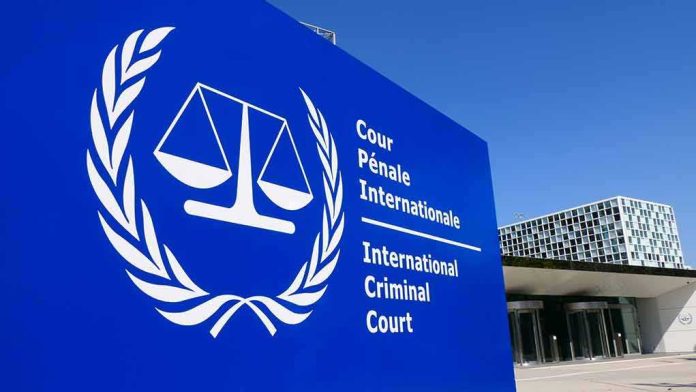
For the first time in its history, the International Criminal Court has fired its chief prosecutor after a United Nations-backed probe found evidence of non-consensual sexual contact with a junior staff member.
Story Snapshot
- International Criminal Court member states voted to dismiss Prosecutor Karim Khan after sexual misconduct proceedings.
- A United Nations investigation found evidence of non-consensual sexual contact, while a panel of judges said the legal bar for misconduct was not met.
- The court’s own executive body later found Khan committed sexual harassment in a relationship shaped by a power imbalance.
- The clash between findings deepens public distrust of global institutions already viewed as unaccountable “elite” structures on both left and right.
How the ICC Ended Up Firing Its Top Prosecutor
Member states of the International Criminal Court met in an emergency session at United Nations headquarters and voted by simple majority to remove chief prosecutor Karim Khan from office after disciplinary proceedings over sexual misconduct claims. This historic step followed his suspension in June 2026, when the court’s governing body sidelined him pending a removal vote. The decision capped nearly two years of crisis that began when a staff member accused Khan of coercive sexual behavior while she worked under his authority.
The case moved through several layers of review common in large international bodies. The Assembly of States Parties first asked the United Nations Office of Internal Oversight Services to investigate the complaint. United Nations investigators interviewed witnesses and reviewed thousands of pages of records over about a year. Their confidential report was then sent to a three-judge panel at the court, an outside advisory panel of legal experts, and finally to the Assembly’s leadership bureau, before reaching all 125 member states for a final vote.
What Investigators, Judges, and the Court Each Found
The United Nations oversight team concluded there was “evidence establishing a factual basis” that Khan’s behavior toward the staffer escalated over time and ended in “nonconsensual sexual contact.” A New York Times account says the investigators found he engaged in “non-consensual sexual contact” with the woman and flagged possible retaliation against staff who supported her. Another report describes claims of unwanted advances in hotel rooms, at his home, and in his office, stretching over months.
The three-judge panel, however, reached a narrower legal conclusion. After reviewing the United Nations file, underlying evidence, and expert advice, the judges said the material did not prove misconduct “beyond a reasonable doubt,” the high standard usually used in criminal cases. According to one summary, they criticized parts of the United Nations work, saying witness credibility was not fully tested, which left them in a “state of factual ambiguity.” Their report did not declare Khan innocent; it found the legal bar for a formal misconduct ruling under that standard had not been met.
The Final Removal Vote and Khan’s Denials
Despite the judges’ view, the court’s own executive body later applied a different standard and found “beyond a reasonable doubt” that Khan had a sexual relationship with the junior employee and that such a relationship could never be appropriate given the power imbalance. Media reports say the Assembly’s bureau earlier made an “initial determination” that he may have engaged in “some form of misconduct,” sending the case toward a full state-level vote. Member states then used a simple-majority ballot to dismiss him from the prosecutor’s post.
Throughout the process, Khan has denied every allegation of sexual misconduct. He told investigators he had “never engaged in any prohibited conduct” toward the complainant, and his legal team called key summaries “not fair or accurate.” His lawyers also attacked the disciplinary decisions as “unlawful, procedurally unfair and unsupported by evidence.” No criminal charges have been filed against him. A legal watchdog in Britain separately suspended him from practicing law at home while the case played out.
Why This Fuels Deep Anger at Global Elites
This fight inside the International Criminal Court lands at a moment when many Americans on both the right and the left already distrust powerful global bodies. For conservatives who see the court as an unelected threat to national sovereignty, the idea that its chief prosecutor faced such serious claims for years before action reinforces a belief that “globalist” institutions protect their own until public pressure forces them to act. The long delay and secret documents feed that anger.
International Criminal Court (ICC) member states voted 82 to 13 to dismiss Chief Prosecutor Karim Khan, following his suspension last month over allegations of serious misconduct and breach of duty.#TV1Updates pic.twitter.com/QqoA1VbTQq
— TV One Uganda (@Tv1uganda) July 25, 2026
For liberals who worry about abuse of workers and unequal treatment of women, the mixed findings send a different but related warning. A United Nations office said there was a factual basis for non-consensual contact, yet judges and diplomats debated standards and process while the complainant stayed in limbo. That looks, to many, like the same elite system that often fails victims in big corporations or government agencies, only this time wearing the badge of international justice.
What This Means for Trust in International Justice
The International Criminal Court was already under fire for its investigations of leaders in powerful countries, including the United States and Israel, and had faced sanctions and political attacks. Now, the court that claims to hold war criminals to account has had to admit it mishandled alleged abuse in its own ranks. Commentators warn that every step in this case, from cautious suspension to final dismissal, will be read through political lenses that have little to do with the woman at the center, and everything to do with whether people trust any global “referee” anymore.
The deeper issue is one many Americans now know too well: systems built and run by distant elites tend to close ranks, move slowly, and hide key documents behind legal walls. Whether one thinks Khan was railroaded or protected for too long, the fact that basic facts are buried in confidential reports makes it hard for regular citizens to judge. That secrecy, on top of clashing findings, only sharpens the sense that big institutions answer more to each other than to the people they claim to serve.
Sources:
thegatewaypundit.com, nytimes.com, bbc.com, aljazeera.com, ap.org, theguardian.com, youtube.com, jurist.org, reuters.com, news.un.org, wsj.com