Trump’s latest bid to “restore” Washington, D.C. is less a straightforward cleanup of monuments than a vivid example of how a president can fuse physical city‑making, patriotic spectacle, and private fundraising into a single, highly contested project.
Key Points
- The administration touts extensive beautification and safety gains in D.C., including monument repairs, graffiti removal, and high‑profile anniversary events.
- Freedom 250, a Trump‑created vehicle for America’s 250th birthday, has absorbed substantial public money while the official bipartisan America250 commission struggles with a funding shortfall.
- Watchdogs and several lawmakers describe the arrangement as a “hijacking” of a national commemoration, pointing to no‑bid contracts and donor‑access packages reaching $1 million and more.
- Independent engineering data, safety audits, and granular budget records for the restoration projects remain largely opaque, leaving genuine public‑benefit claims unverified.
Trump’s Restoration Narrative: Making the Capital “Safe and Beautiful”
At the core of the administration’s story is a simple claim: Washington, D.C. was shabby and unsafe, and Trump, working through Interior Secretary Doug Burgum, has fixed it. Burgum has been the chief evangelist for this narrative, describing a city transformed through aggressive monument repair, park refurbishment, and crime reduction. In media appearances he has cited concrete figures—dozens of monuments restored, fountains flowing again for the first time in decades, and more than a thousand graffiti sites eliminated—as evidence that a coordinated federal push has materially improved the capital’s public realm.[1]
This restoration theme runs directly into the “Great American State Fair” staged on the National Mall, which supporters cast as a kind of modern world’s fair for America’s 250th anniversary. The fair’s programming—over 150 exhibits representing all 50 states and six territories, ferris wheel, rodeos, concerts, military flyovers—is designed to make the Mall feel like a celebratory civic commons rather than a strictly ceremonial space.[3] In speeches, Burgum and Agriculture Secretary Brooke Rollins describe this as proof of a broader revitalization: the capital restored, safe, beautified, and opened up as a festive stage for national unity.
Fireworks and airshows are part of the same tableau. The administration has promised an enormous July 4 display—branded as the opening salvo of America’s 250th—that reinforces the claim that Trump is not only cleaning up the city but re‑imagining its role as the focal point for a quarter‑millennium commemoration.[3] To many supporters, the physical changes and the spectacle hang together as one project: Trump as “builder in chief” reshaping the capital for a milestone birthday.[6]
Freedom 250 vs. America250: Who Owns the Birthday?
Beneath the pageantry sits a structural conflict that explains why Trump’s D.C. restoration effort is so polarizing. Congress created America250 as the official bipartisan commission charged with planning and funding the nation’s 250th anniversary. That commission, however, has been reported to face a roughly $100 million shortfall relative to what lawmakers expected it to manage.[2][14] At the same time, a Trump‑initiated vehicle, Freedom 250—set up within or alongside the National Park Foundation—has secured the bulk of the available federal dollars for anniversary festivities.
Investigative work and watchdog reporting suggest that Freedom 250 and allied entities have received on the order of $100 million in no‑bid contracts and grants, routing taxpayer funds into a structure directly influenced by Trump’s political and fundraising team.[4][14] This is not simply a matter of branding. It means the president’s preferred vehicle, not the congressionally chartered commission, is in practical control of the largest celebrations, including the Great American State Fair and related “restoration” showcases.
Senator Jon Ossoff has given this arrangement its sharpest political label, describing it as a “hijacking” of the anniversary for Trump’s personal gain and a “sale of access corruption.”[7] His critique focuses less on whether fountains work or graffiti is scrubbed, and more on who decides which projects happen, who gets paid to execute them, and who can buy proximity to the president under the guise of patriotic celebration.
Follow the Money: No‑Bid Contracts and Donor Access
The restoration story cannot be separated from its contracting and fundraising architecture. Multiple reports document that Freedom 250 and related entities have benefited from no‑bid awards, including work on high‑visibility elements such as the Lincoln Memorial Reflecting Pool.[2][10] One example that has drawn scrutiny is a $1.7 million, sole‑source National Park Service contract to Greenwater Services—described as Trump‑tied—for cleaning the Reflecting Pool, with only one vendor solicited.[2] To critics, that is emblematic of a system in which infrastructure work doubles as a channel for rewarding loyal businesses.
More broadly, watchdog organizations such as Public Citizen and the Revolving Door Project argue that Freedom 250 is part of a “network of politicized entities” under Trump allies’ control, collectively receiving close to $103 million in public money through streamlined, non‑competitive processes.[4] Parallel reporting has traced how Trump‑connected firms like Event Strategies, the company behind his January 6 Ellipse rally, secured tens of millions of dollars in federal work for staging the anniversary events.[9] The pattern looks less like standard commemorative contracting and more like a patronage ecosystem centered on the president.
Overlaying those public dollars are private sponsorships explicitly marketed as access‑buying opportunities. Solicitation materials and press accounts describe donor tiers reaching $1 million for a private reception and “historic photo opportunity” with Trump, $2.5 million for a VIP speaking slot at Mall festivities, and higher levels for prominent logo placement across Freedom 250 branding.[1][14] That combination—taxpayer‑funded staging plus pay‑for‑access donor packages—drives much of the concern that the “restoration” is a vehicle for monetizing proximity to the president rather than a straightforward public works campaign.
What Is Actually Being Built and Restored?
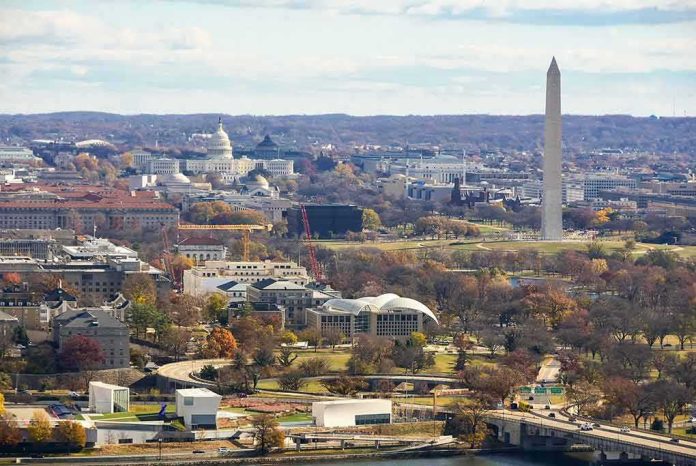
Set aside the funding architecture for a moment and ask the simple question: what, concretely, has changed in the physical cityscape? Here the record is mixed and, importantly, incomplete. On the one hand, there is reasonably well‑documented activity that looks like classic beautification: restored monuments and statues, reactivated fountains, graffiti removal, resurfacing and recoloring of the Reflecting Pool, and spruced‑up park spaces.[1][3][5] Residents and visitors do encounter a cleaner, more manicured Mall, and a capital prepared visually for large gatherings.
On the other hand, much of Trump’s D.C. agenda goes well beyond restoration into significant redesign. Proposals have included demolishing the White House East Wing to build an enormous ballroom, renaming the Kennedy Center, constructing a towering “victory arch” near the Mall, and turning public parkland in East Potomac Park into a world‑class golf course.[3][5][7] Historians and preservationists characterize the scope and personal imprint of these projects as “unprecedented,” raising obvious questions about whether the changes serve broader civic values or primarily the president’s legacy and preferences.[7]
Crucially, the administration’s own messaging offers few hard details on the engineering, safety metrics, or maintenance regimes underlying the touted improvements. Burgum’s remarks speak in aggregate numbers and adjectives—safe, beautiful, spic and span—but do not come paired with project‑level documents, independent safety audits, or before‑and‑after risk assessments. The acknowledged absence of primary technical reports and budget breakdowns in publicly available proponent material means citizens are asked to take both the efficacy and cost‑effectiveness of the restoration largely on trust.[3]
Public Reception: Spectacle, Polarization, and Thin Crowds
Anniversary events of this scale normally serve to generate shared civic enthusiasm; here, the reception has been fragmented from the outset. Right‑leaning media have emphasized the fairness and unity of the Great American State Fair, featuring interviews with attendees who describe the experience as “uniting” and celebratory.[6] In that framing, Trump’s presence and the military flyovers are patriotic centerpieces rather than partisan signals.
Across other outlets, the same events are portrayed very differently. Several performers, including figures once aligned with Trump through reality television, withdrew from Freedom 250 concert lineups, explicitly citing politicization of the celebration.[5][12] Video compilations from the Mall highlight sparse crowds and a noticeable stream of attendees leaving during Trump’s speech, undermining the narrative of overwhelming public embrace.[5] Opinion writers speak of a “militarized, politicized spectacle” that turns a unifying milestone into another Trump‑centric rally.[15][18]
This divergence matters because a restoration project’s legitimacy is not only about stone and water; it is about whether the citizenry experiences the transformed spaces as genuinely theirs. When even the anniversary concerts fracture along partisan lines, and when the president himself is both chief contractor and headliner, many Americans read the makeover of D.C. as an extension of campaign politics rather than shared infrastructure renewal.
Mechanism Without Transparency: What Evidence Is Still Missing
For a skeptical, policy‑minded observer, the most striking feature of Trump’s D.C. restoration is not that it exists—presidents have long leveraged national celebrations—but how little formal verification underpins the loftiest claims. Supporters regularly invoke numbers of monuments repaired or graffiti sites cleaned, yet do not publish the corresponding project lists, inspection reports, or per‑site budgets. They assert dramatic improvements in safety, but without accompanying crime‑trend analyses that isolate the impact of physical upgrades from policing and broader social factors.[1][6]
Likewise, critics marshal compelling evidence about no‑bid contracts, donor tiers, and institutional sidelining, but often treat the restoration work itself as a monolith, without forensic scrutiny of individual engineering jobs. A comprehensive audit of contracts linked specifically to monument and public‑space work—examining whether they met legitimate urgency criteria, whether costs were in line with technical norms, and whether performance matched specifications—would substantially sharpen the debate. So would independent safety and aesthetic assessments of headline projects like the recolored Reflecting Pool or proposed triumphal arch.
Until that kind of granular documentation is made public or compelled through oversight, the D.C. restoration remains an unusually powerful symbol of a broader tension in American governance: the line between public stewardship and personalized rule. The capital is indeed being remade for America’s 250th. The open question is whether that remaking ultimately reads as a gift to the nation or as infrastructure for one man’s brand.
Sources:
[1] Web – Trump’s Latest D.C. Restoration Is Going To Be Huge
[2] Web – For $1 Million, Donors to U.S.A. Birthday Group Offered Access to …
[3] Web – America’s Bipartisan Birthday Commission Is Losing to Trump
[4] Web – First, Freedom 250, an entity run by Trump’s allies, offers access to …
[5] Web – Donations to Trump’s Freedom 250 fund raise ethics questions
[6] YouTube – Trump Using ‘Favouritism’ To Secure Funding For Freedom 250
[7] Web – Who’s paying for Trump’s MAGA-fied Freedom 250 festivities? Major …
[9] Web – Who is paying for Trumps MAGA-fied Freedom 250 festivities, like …
[10] Web – Firm That Planned Trump’s Jan. 6 Rally Received No-Bid Contracts
[14] Web – DOI Procurement Opportunities | U.S. Department of the Interior
[15] Web – No-Bid Contracts: $74B Without Competition | OpenSpending
[18] Web – State of Indiana’s No Bid Contracts – Reddit