
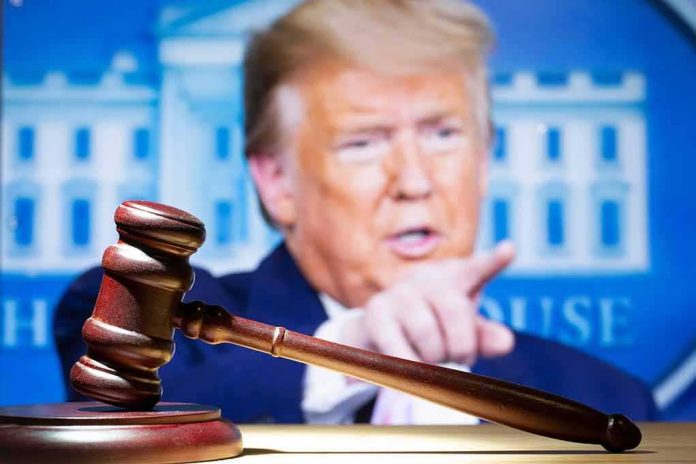
The substantive issue is not whether a third Trump term is legally available; it is not. The real story is that President Trump keeps talking as though the constitutional ceiling is negotiable, and that ambiguity is itself a political instrument: it energizes supporters, bait-checks critics, and keeps a plainly barred idea circulating as if it were a live possibility.
Intro Header
- President Trump did not give a clean, one-line disavowal when asked about a third term; instead, he used language about “methods” and “ways” while saying he was “not joking.”
- The 22nd Amendment remains the governing law, and the reporting record repeatedly frames Trump’s remarks against that bright-line limit.
- The only serious legal escape hatch identified in the available material is a constitutional amendment, not a hidden workaround under current law.
- What makes the episode enduring is not legal novelty, but Trump’s habit of turning constitutional boundaries into performance, provocation, and leverage.
The constitutional rule is simple; the political theater is not
The 22nd Amendment is not a subtle provision. It bars a person from being elected president more than twice, and the reporting around Trump’s remarks consistently treats that limit as settled law. That is the baseline from which every serious discussion must start. When Trump says a third term might be possible, the legal system does not become uncertain; rather, the gap opens between law and rhetoric, between what can be done and what can be suggested aloud. That gap is where Trump has always liked to operate.
His latest comments fit that pattern exactly. NBC News reported that he said, “I’m not joking,” and added that “There are ways you could do it.” CBS likewise summarized his remarks as an acknowledgment that he was looking at “methods” while insisting it was “far too early” to think about it. Taken together, those formulations do not amount to a legal theory. They amount to strategic ambiguity: language designed to keep the door ajar without committing to a concrete mechanism.
Why the legal answer remains no
The record supplied here contains no vetted constitutional route that would let Trump serve a third elected term under current law. ABC News quoted scholars saying there is “no constitutional basis” for what Trump was proposing, and described the only lawful path as amending the Constitution. C-SPAN’s coverage of Speaker Johnson reinforced the same point from a political rather than academic angle: Johnson said he did not see a way to amend the Constitution quickly, noting the roughly 10-year horizon and the supermajority requirements in Congress and the states. That is not a procedural quibble; it is the entire ballgame.
What matters is that the known “workarounds” stay in the realm of commentary, not law. The materials mention hypothetical schemes—ballot access theories, vice-presidential succession ideas, and other speculative routes—but none appear in the package as a filed legal strategy, a court-tested mechanism, or an authoritative constitutional memo from Trump’s team. In other words, the conversation may be lively, but the legal architecture is not. There is a difference between an idea that circulates on television and an argument that can survive institutional scrutiny.
Trump’s own wording matters because he has now said both things
Trump has not been entirely consistent, and that inconsistency is the heart of the story. PBS reported him saying, “I’m not permitted to run. It’s too bad,” which is a direct acknowledgment of the constitutional limit. Other coverage and clips similarly show him saying he was “not allowed to run” or that he was “not permitted” to seek another term. Yet in adjacent remarks he also entertained the idea, joked about it, and spoke as if there were routes around the prohibition. The result is a familiar Trumpian composite: acceptance of the rule in one breath, teasing of an exception in the next.
That combination is not accidental. It preserves plausible deniability for him while maximizing attention. If he were to state plainly, “I will never seek a third term,” the cycle would end. If he were to spell out a real plan, the legal and political fight would begin in earnest. By hovering between those positions, he keeps the matter alive without bearing the costs of clarity. That is why journalists and critics keep returning to the issue; Trump has structured the exchange so that the ambiguity itself becomes newsworthy.
The repeated jokes are not harmless because repetition changes the frame
Coverage shows this is not a one-off quip. Politico reported that Trump raised the idea at a White House event, asking, “Should I run again? You tell me.” NBC later described him joking about the prospect before House Republicans and asking, “Am I allowed to run again?” The Independent reported a State of the Union line in which he said he “should be” in a third term. AP and other outlets also captured the same recurring motif at public events, including jokes about “the third time” being better yet.
That repetition matters because political repetition is how fringe or legally impossible ideas become normalized as conversational objects. A joke repeated often enough stops functioning purely as a joke; it becomes a probe. Supporters hear defiance. Opponents hear test balloons. Institutions hear a leader who is willing to toy with a clear constitutional boundary. All three readings are accurate, which is precisely why the remarks keep drawing attention. Trump is not merely making noise. He is training the audience to treat the boundary as something he can challenge at will.
Speaker Johnson’s role shows how the message is being managed inside Trump’s coalition
Speaker Johnson’s comments are revealing because they translate Trump’s third-term chatter into a coalition discipline exercise. According to the C-SPAN material, Johnson acknowledged the constitutional limit and said there was no practical way to amend it on a short timeline. He also framed the “Trump 2028” cap merchandise as a way to troll Democrats, which recasts the whole subject as partisan theater rather than serious constitutional planning. That is the inner logic of the pro-Trump response: keep the symbolism, reject the legal seriousness.
This matters because it shows how Trump’s allies protect the ambiguity. They do not need to endorse a third term as law; they only need to avoid sharply slamming the door. That posture lets them benefit from the energy the theme generates while avoiding direct confrontation with the 22nd Amendment. It is a familiar form of modern political hardball: use suggestive language, invite the crowd to imagine the forbidden, then retreat to “it was only a joke” when challenged. The tactic works because it exploits the difference between constitutional text and political enforcement.
What the episode tells us about Trump’s governing style
The deeper pattern is not about term limits alone. It is about Trump’s instinct for constitutional brinkmanship: taking an unambiguous rule, speaking around it, and turning the resulting controversy into proof of strength. On the evidence here, he has not presented a lawful third-term theory that deserves to be treated as established policy. He has presented a recurring rhetorical performance that blurs intention, mocks constraint, and keeps the public arguing over whether the barrier is real. It is real. The issue is that Trump knows how to make a real barrier feel politically provisional.
That is why the question should not be reduced to “Was he joking?” Jokes can be diagnostic; they disclose what a politician is willing to test in public. Trump’s third-term comments suggest he is willing to probe the constitutional edge, watch how allies and media react, and measure whether the taboo itself has enough force to stop him from normalizing the idea. So far, the answer from the law is firm and unchanged. The answer from politics is more corrosive: he can keep making the impossible feel discussable.
Sources:
facebook.com, theguardian.com, pbs.org, thehindubusinessline.com, en.wikipedia.org, cbsnews.com, nbcnews.com, nytimes.com, inkl.com, cnn.com