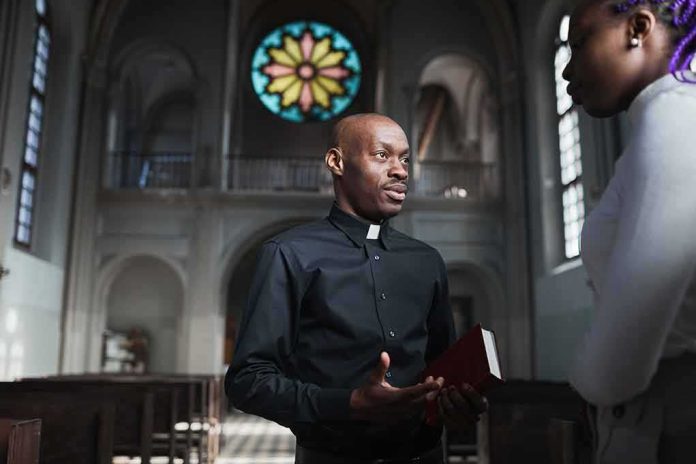
When a diocesan bishop moves from warning to formal decrees, he is not policing taste; he is acting to protect communion. The San Antonio case—disciplinary decrees against a priest who publicly labeled Pope Francis a “usurper” and the withdrawal of approval for his community’s apostolate—shows how Catholic governance responds when private dissent becomes a public challenge to the legitimacy of papal authority.
At a Glance
- The Archbishop of San Antonio issued formal March 15, 2024 decrees: removing a priest’s public ministry, revoking approval of his apostolate, and citing grave scandal and confusion among the faithful.
- The actions were rooted in the priest’s promotion of messages calling Pope Francis a “usurper” and “enemy of the Church,” after admonitions to retract.
- The priest and his community framed their stance as obedience to God amid an “extreme crisis,” explicitly rejecting submission to the pope and diocesan directives.
- This clash illustrates how canon law balances the faithful’s right to voice concerns with the duty to preserve ecclesial unity and avoid scandal.
What the decrees did, and why they matter
The Archdiocese of San Antonio did not handle this as a rhetorical dust-up. On March 15, 2024, Archbishop Gustavo García-Siller issued multiple written decrees: he withdrew his approval of the Mission of Divine Mercy as a Catholic apostolate, removed Reverend John Mary Foster from leadership of that community, and barred Foster from exercising priestly faculties publicly in the archdiocese. The documents state that while serving as the Mission’s guardian, Foster publicly taught that Pope Francis is usurping the papal office; they also reference prior admonitions and Foster’s refusal to remove the messages. The archbishop’s stated rationale was direct: to prevent further confusion and grave scandal among the faithful and to exercise proper governance over ministries in his care.
Contemporaneous reporting across several Catholic outlets tracked the same core facts: explicit “usurper” language applied to Pope Francis, admonitions from the archdiocese, and the consequent withdrawal of the Mission’s status and Foster’s public faculties. These were not informal reprimands; three formal decrees documented the actions and their canonical basis.
The claims that triggered discipline
The disciplinary record is anchored in published messages that the Mission of Divine Mercy attributed to “God the Father,” labeling the pope a “usurper” and “enemy of the Church”—assertions Foster endorsed and propagated. Reports indicate the archbishop requested their removal; Foster declined, arguing that the community had prayerfully discerned a divine mandate to continue publishing. In his own words, he accepted the conclusion that Jorge Bergoglio (Pope Francis) exercises illegitimate authority and acts as the enemy of Christ and the Church, and he framed obedience to God as overruling ordinary obedience to church authorities in an unprecedented crisis.
These are not merely sharp-edged criticisms of prudential decisions; they are frontal claims about papal legitimacy. In Catholic ecclesiology, asserting that the pope is an antipope or acting without legitimate authority is not a dispute at the margin of governance; it is a challenge to the structure of communion itself. Canonically, bishops are expected to act to prevent scandal, protect doctrine, and maintain ecclesial order when teaching that undermines the bond with the Roman Pontiff is propagated by a cleric under their jurisdiction.
How the process typically works in canon law
When a cleric’s public teaching or conduct causes scandal, bishops have a spectrum of tools: fraternal correction and private admonition; precepts (binding commands to cease harmful behavior); restrictions on ministry; withdrawal of diocesan approval for works or associations; and, when warranted, penal processes that can lead to punitive measures. Administrative decrees—like withdrawing approval for an apostolate or limiting faculties—do not require a criminal trial; they do require reasons linked to the bishop’s duty to govern the faithful and safeguard the sacraments. Where a cleric persists after admonition, the bishop’s obligation to prevent harm to the faithful intensifies. The San Antonio decrees, multiple and written, signal a formally documented use of that administrative toolkit rather than a casual rebuke.
None of this strips the faithful of the right to voice concerns; canon law explicitly recognizes that right. But it locates it within duties of reverence toward pastors, adherence to truth, and avoidance of harm to faith and ecclesial order. The line is crossed when personal judgment becomes a public assertion that the pope lacks legitimate authority, especially when preached by a cleric with a pastoral following. That is precisely the sort of claim that bishops are canonically expected to stop, because it destabilizes communion and confuses the faithful.
Competing narratives: obedience, conscience, and scandal
The San Antonio case crystallizes two narratives talking past each other. On one side, the archbishop’s decrees and public rationale emphasize governance: Foster’s messages, viewed as false and scandalous, required decisive action to prevent confusion. The presence of multiple decrees and references to repeated admonitions strengthen the case that this was not impulsive. On the other side, Foster and the Mission framed their persistence as obedience to God in a time of crisis, explicitly rejecting submission to Pope Francis and to diocesan directives. They did not deny the “usurper” language; they defended it as divinely mandated speech and insisted their community discernment justified disobedience.
An intelligent reader may ask: where is the doctrinal tribunal’s ruling, or a line-by-line theological censure? In many administrative discipline cases, especially those aimed at stopping ongoing scandal, bishops act on their ordinary executive authority without awaiting a separate, external doctrinal judgment. The absence of a published Vatican decision does not undercut a diocesan bishop’s obligation to guard his flock. It does, however, leave the public file thinner than theologians might prefer for parsing the exact degree of doctrinal error versus insubordination—an ambiguity that media ecosystems will exploit in opposite directions.
Why “usurper” is not just a hard word
In Catholic theology, the papacy is not an abstract office separable from its occupant; communion with the pope is constitutive of full ecclesial unity. To assert that the current occupant is a usurper is to allege that the chair of Peter is vacant or illicitly held, a claim with immediate pastoral consequences: sacramental doubt, parish factionalism, rejection of diocesan governance, and erosion of trust in church teaching. That is what bishops mean by “grave scandal”—not embarrassment, but destabilization of the faithful’s grasp of who speaks for the Church and under what authority. It is why canon law singles out attacks on papal authority as especially serious and why bishops move quickly when such claims are propagated by clergy with ministerial platforms.
In practice, these controversies rarely stay contained. Once such messages circulate, every homily and pastoral decision in the affected community becomes a referendum on legitimacy. That dynamic explains why revoking an apostolate’s diocesan approval often accompanies restrictions on the cleric: it removes the formal church label from the vehicle spreading the claim, signaling to the faithful that it does not carry ecclesial endorsement.
John🐍XXIII, Paul🐍VI, Francis🐍 and Leo🐍XIV are the ones guilty of schism!
BREAKING: San Antonio archbishop laicizes priest over messages calling Francis and Leo ‘usurpers’ – LifeSite https://t.co/71OyZbWyfk
— Catholic Christendom (@shiningsweu) August 14, 2026
What remains open—and what does not
Two things are not seriously contested in the available record: that Foster endorsed messages calling Pope Francis a “usurper,” and that the archbishop responded with formal decrees removing his public faculties and withdrawing approval of the Mission of Divine Mercy as an apostolate. Those points are documented across sources and, critically, in the decrees themselves or their published summaries. What remains open to fuller documentation are the precise texts, timestamps, and web provenance of every disputed post; the internal advisories and alternatives explored before escalation; and any subsequent appeal in canon law. Those gaps matter for historians and canonists reconstructing the file; they do not erase the bishop’s basic duty or authority to act when scandal is ongoing.
Foster’s defense invokes conscience and prophecy. Catholic law takes conscience seriously but does not grant a cleric carte blanche to deny papal legitimacy publicly. The faithful’s right to make their concerns known is bounded by duties of reverence and the common good; when a claim fractures communion, bishops are obliged to intervene. In that frame, the San Antonio decrees are not institutional fragility; they are the predictable endpoint of a priest’s publicly reiterated denial of the pope’s legitimacy, persisting after admonitions. Whatever future scholarship may add to the file, that core dynamic will not change.
Sources:
lifesitenews.com, ewtnnews.com, thecatholicherald.com, missionofdivinemercy.org, reddit.com, dextercduggan.substack.com