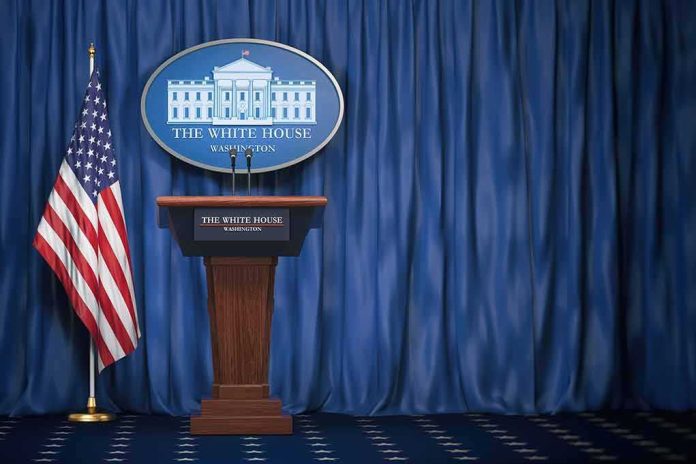
At the heart of the White House ballroom fight is not architecture but authority: who gets to redesign federal property of national significance — a president acting alone under the banner of security, or Congress exercising the constitutional power of the purse and of property? The decisive answer from the courts so far is Congress.
At a Glance
- Federal courts have ruled that major structural changes to the White House require congressional authorization; emergency appeals are pending, but the baseline is clear.
- The administration’s national-security rationale — an “integrated military complex” with a secure ballroom and rooftop drone port — has not supplied a statutory substitute for Congress’s role.
- Judges grounded their decisions in the Constitution’s Property Clause and in spending law: presidents are tenants, not owners, of federal property.
- The dispute fits a recurring pattern: presidents test the edges of executive control over federal sites, and courts steer large-scale projects back toward statute and congressional review.
What the courts have actually decided
Two levels of the federal judiciary have told the administration that it cannot proceed with a 90,000‑square‑foot ballroom to replace the demolished East Wing without a specific green light from Congress. A district judge ordered a halt “unless and until Congress blesses this project through statutory authorization,” and the D.C. Circuit, in a 2–1 decision, affirmed: the Constitution assigns control over federal property to Congress, and no statute identified by the government delegates authority broad enough to justify the project. Put simply, there is no unilateral presidential power to raze and rebuild large portions of the Executive Mansion and its grounds. The panel’s majority put the point crisply: whether a “massive ballroom” should be constructed “is for Congress to decide and is not a matter for Executive self-help.”
In practical terms, the appellate injunction halted above‑ground work while allowing limited, undisputed security-related underground activity to continue during expedited litigation. The administration has sought emergency relief from the Supreme Court to lift the injunction, arguing that pausing now jeopardizes security and strains logistics, but that request — by its nature a plea for temporary relief — does not alter the legal baseline the lower courts have articulated: for construction on this scale, Congress must speak.
The administration’s national-security claim — and why it has not carried the day
The government has cast the project as a security and readiness upgrade, describing the East Wing complex, including a “totally secure ballroom space,” as “vitally required by national security,” with features such as a rooftop “drone port.” In emergency filings, the Solicitor General emphasized mission continuity, secure congregation of principals, and integration with protective infrastructure. Courts did not dismiss security as irrelevant; they rejected it as a substitute for statutory authority. National security, in American law, permits certain flexibilities — classification, operational secrecy, sometimes expedited procurement — but it is not a roving charter to spend money or alter federal property absent an authorizing law. That is especially true when Congress historically funds, oversees, and prescribes reviews for federal buildings.
Appellate judges also confronted an uncomfortable fact pattern: demolition of the East Wing began before the government had identified a clear legal hook for such a significant alteration and before traditional review bodies had weighed in. The majority labeled the resulting predicament — a “large hole beside the White House” and sunk costs — a problem of the executive’s own making, not a reason to override constitutional structure. That critique matters because courts are wary of “self-created emergencies”: the law does not reward racing ahead and then arguing it’s too late to stop.
The constitutional and statutory architecture: why Congress controls the footprint
Two bodies of law converge here. First, the Constitution’s Property Clause vests in Congress plenary authority over federal property — the land, structures, and fixtures the public owns. Presidents administer federal property through agencies, but agency authority must come from statute. Second, federal appropriations and building laws channel how, when, and on what terms the executive can spend funds and alter facilities. There is statutory text that lets the President maintain and improve the “Executive Residence” — the domestic core of the White House — but courts have long read those provisions to cover care, repair, and modest alteration, not wholesale demolition and new construction on the scale of a freestanding 90,000‑square‑foot hall. The D.C. Circuit’s written opinion methodically parses these provisions and concludes “no statute comes close” to authorizing a project of this magnitude without Congress.
Layered atop those rules is the ecosystem of federal planning and preservation. The White House is exempt from some routine preservation procedures, but presidents have typically honored review norms — voluntary submission to the National Capital Planning Commission and engagement with the Commission of Fine Arts — precisely because the mansion is both workplace and national symbol. The East Wing teardown defied that custom, triggering litigation from the National Trust for Historic Preservation and inviting judicial scrutiny of the executive’s claimed authority. Courts did not rest their rulings on preservation processes alone; they treated those process failures as symptoms of the larger defect: the absence of congressional authorization.
What genuine disagreement remains
There is a real, not contrived, dispute about the outer boundary of the President’s maintenance authority over the White House complex. The government reads existing statutes more capaciously, arguing that security-integrated expansion and modernization fall within “care” and “improvement” of the Executive Residence and its support structures, particularly when privately raised funds are on offer. One appellate dissenter echoed that view and questioned the plaintiff’s standing. The majority, however, emphasized both scale and locus — replacing an entire wing and erecting a new hall on National Park Service land abutting the Residence — as crossing from maintenance to remaking, which the Property Clause reserves to Congress. Until Congress legislates specifically or the Supreme Court rewrites the standard, that majority view governs.
There is also a secondary disagreement about timing and remedy. The administration insists that delay itself creates security risk and cost spirals; plaintiffs counter that urgency does not erase constitutional preconditions, and that limited, truly necessary underground security work can proceed while Congress decides the fate of the ballroom. The appellate injunction reflects that compromise: stop vertical construction; do not disable uncontested security maintenance below grade while the case moves quickly.
How we got here: precedent, practice, and a break with both
Presidents have altered the White House before — Truman’s gut renovation, Kennedy’s aesthetic refinements, modern security retrofits — but those episodes share two traits: Congress was involved, and the legal authorities were clear. The D.C. Circuit underscored the novelty here: it was “aware of no instance in American history” of a president unilaterally demolishing taxpayer‑funded portions of the White House using a blend of executive direction and non-appropriated funds. That novelty is not a point of pride in court; it is a warning flag that separation-of-powers lines are being crossed.
Practice cannot override text, but it can illuminate how officials have respected it. Voluntary review by planning and arts commissions, even when not strictly required, has functioned as a circuit breaker — surfacing design, heritage, environmental, and logistical issues before a backhoe arrives. Sidestepping that process invited exactly the litigation and injunction now in place, and it did so in a context — a marquee project adjacent to the seat of executive power — where courts predictably err on the side of structural constitutional fidelity.
What it means going forward
Three implications are clear. First, scale matters. Routine repairs, modernizations, and even substantial security upgrades can fit within existing statutes; tearing down a wing and constructing a vast new hall does not. Administrations that want to build big must do the basic constitutional work of persuading Congress. Second, national security cannot serve as post hoc legal authority. If the project is essential to protection or continuity of government, the administration should be able to articulate a statutory basis, brief relevant committees in classified settings, and secure targeted authorization or appropriation. Courts will credit genuine necessity — but not when it is tethered to vague or overbroad readings of unrelated statutes. Third, process is not red tape; it is risk management. Early engagement with oversight bodies and Congress reduces the likelihood of injunctions that strand half-finished work and elevate costs and risks the executive says it is trying to mitigate.
The administration’s Supreme Court application presses an institutional point — that a single district judge should not second-guess presidential judgments about protection of the Executive — and raises logistical harms from a construction freeze. Those are not trivial concerns. But unless the justices find a statutory foothold the lower courts missed, the Court’s intervention would be about temporary timing, not final authority. The durable rule that emerges from the record to date is unsurprising and, for an old constitutional republic, reassuring: presidents execute; Congress decides when public buildings change in ways that outlast any one administration.
Trump just took the White House Ballroom fight nuclear… accusing the network behind the lawsuit of exposing top military secrets after being warned the ballroom, hardened facilities and rooftop DronePort form one integrated security structure…
Follow the chain… a National… https://t.co/8JB4gAh7bs
— Observing Consciousness (@holonabove) August 15, 2026
How Congress can resolve the standoff
Nothing in the courts’ reasoning forecloses a secure, modern, and even capacious assembly space at the White House; it forecloses doing it without Congress. If the project is truly “vitally required,” the straightforward path is to request a narrowly drawn statute that: (1) authorizes a defined footprint and program; (2) specifies governance for design, review, and transparency; (3) delineates funding sources, including guardrails if private contributions are contemplated; and (4) compels appropriate preservation and environmental due diligence, modified as necessary for security. That approach honors constitutional form, produces a cleaner record, and lets the country debate, through its representatives, the balance between heritage and modern statecraft.
Sources:
cbsnews.com, cnn.com, fortune.com, politico.com, pbs.org, bbc.com, thehill.com, cnbc.com