When soldiers become a fixture of daily life in a democratic capital, the issue is not only security; it is the boundary between emergency power and ordinary self-government—and whether that line is quietly being erased.
At a Glance
- President Trump ordered the District of Columbia National Guard to active duty with an open-ended timeline tied to his determination of “law and order.”
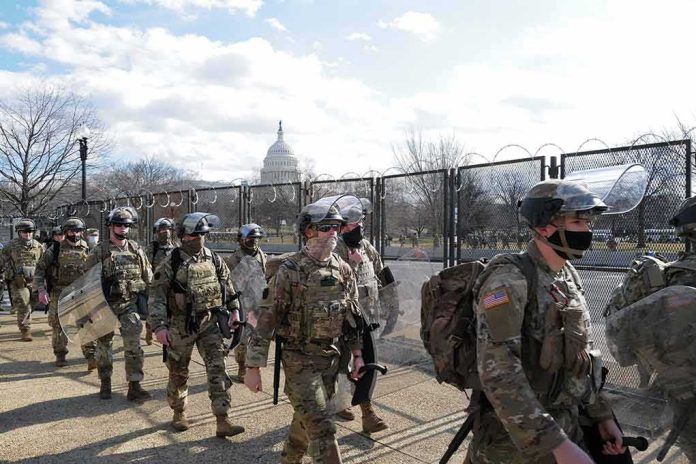
- The deployment evolved into 24-hour operations with a visible, armed presence alongside civilian police, framed by the administration as a public-safety mission.
- Federal courts have found core elements of the deployment unlawful, focusing on purpose (crime deterrence) and the absence of a city request, though litigation and stays have complicated enforcement.
- Independent analyses indicate little to no measurable effect on violent crime from the Guard’s prolonged presence, raising questions about efficacy versus civic costs.
What changed: From exceptional surge to routine backdrop
The decisive shift was not simply that the White House mobilized the D.C. National Guard; presidents have authority to direct limited, time-bound security responses in the federal district. The break with past practice was the construction of an open-ended deployment for generalized “law and order,” with the endpoint resting on the president’s unilateral judgment rather than on discrete emergency criteria or local request. The August 2025 presidential action explicitly directed mobilization and left the duration “in effect until I determine that conditions of law and order have been restored.” In practice, that authorization supported 24-hour Guard operations across the city and an increasingly visible posture integrated with local and federal policing. Pentagon statements and subsequent orders reiterated that troops would remain until “law and order” was restored, a standard both sweeping and elastic.
That elasticity matters. Emergency authorities are typically designed around specific triggers—civil disorder, natural disaster, or a named event—and expire when those triggers abate. A standing anti-crime presence by troops, persisting beyond discrete incidents, treats extraordinary power as a normal tool of municipal governance. The longer the mission endures without clear milestones and independent off-ramps, the more it functions as a policy substitute for civilian policing rather than a temporary bridge during crisis.
The legal fault lines: Purpose, duration, and who gets to ask
Courts scrutinized—not whether the federal government can ever use the Guard in Washington—but why, for how long, and at whose behest. In rulings favoring the District, judges concluded that deploying the D.C. National Guard for routine crime deterrence exceeded statutory bounds, particularly absent a request from the city’s civil authorities. The unlawful findings emphasized that federal actors cannot repurpose military-linked forces into an ongoing domestic police deterrent in the capital simply by invoking public safety in the abstract. Put plainly: the authority for troop use in D.C. is not a blank check. It tightens when the aim shifts from episodic protection of federal functions to open-ended suppression or deterrence of ordinary crime, and it tightens further when the District’s government objects rather than invites assistance.
These decisions do not deny that the District sits in a unique constitutional posture—Congress retains ultimate authority, and presidents can call on certain local resources for federal purposes—but they reaffirm a boundary: emergency mobilizations cannot become a standing substitute for civilian policing. The operative questions, case by case, are whether the mission is tethered to a legitimate, time-limited federal need and whether its continuation respects home-rule prerogatives.
Mechanics and tradeoffs: What troops can and cannot do in a city
National Guard personnel, even when carefully briefed and paired with law enforcement, are not sworn municipal police officers; their training, rules of engagement, and institutional mission differ. In Washington, public explanations framed the Guard’s tasks as safeguarding federal assets, providing a secure environment for arrests, and deterring violent crime through presence. Later statements underscored that troops would be armed and patrol with police. Such visibility can reassure some residents and visitors in targeted corridors. It can just as easily chill public life—particularly in neighborhoods already burdened by over-policing—when soldiers and military vehicles signal occupation rather than safety.
Cost-benefit analysis hinges on outcomes. A year into the mission, independent reporting and think-tank assessments found little or no measurable reduction in violent crime attributable to the Guard’s presence, even as administration officials touted arrests and seizures. This divergence is not unusual: proactive sweeps can raise arrest counts without denting the small subset of repeat violent actors who drive serious harm. Where Guard units do not have arrest powers or investigative continuity, durable gains typically require federal-prosecutorial focus and sustained, civilian-led problem-solving—compatible with, but not replaced by, a military backdrop.
Home rule versus federal prerogative: Why D.C. is perpetually contested terrain
Washington’s governance structure invites conflict in moments like this. The Home Rule Act delegated substantial local authority to the District, but Congress preserved ultimate control and gave the federal executive tools to protect federal functions. In practice, these overlapping layers become flashpoints when a president asserts expansive public-order aims while city leaders object. The legal fights around this deployment turned on exactly that tension: was the Guard engaged in protecting federal property and operations, or in generalized urban crime deterrence that belongs to civilian authorities? Courts leaned toward the latter, finding the mission overbroad.
The political economy of security also exerts gravity. Once an interagency task force stands up—Guard units, federal agents, task orders, briefing rhythms—bureaucratic momentum favors continuation. Each extension normalizes the arrangement, and each visible incident is cited as proof that the mission must persist. Sunset clauses, independent oversight, and narrow mission definitions are the usual correctives; they were the weakest links here.
Consequences for civic life: The quiet costs of a permanent “temporary” presence
Democratic norms rely on a visible distinction between soldiers and police, emergency and ordinary time. Eliding those distinctions erodes trust. Residents habituate to checkpoints, convoys, and uniforms in spaces meant for assembly and dissent; tourists reset their expectations of what safety looks like in a free society. Even those who welcome the orderliness pay a price when constitutional protections are enforced by institutions designed for war rather than civic dispute. It is telling that, even as official narratives highlighted safety gains, neutral analyses questioned efficacy and courts balked at the legal theory underwriting the deployment.
The net lesson is not that presidents can never surge security in the capital. It is that doing so must be bounded: time-limited, tethered to specific federal functions, and, wherever possible, initiated or ratified by local authorities. Broad anti-crime campaigns staffed by troops invite legal defeat, policy underperformance, and civic harm that accumulates invisibly until it becomes a new normal.
What durable policy looks like going forward
Three guardrails would restore balance. First, bright-line mission scoping: define deployments around protecting enumerated federal assets or events, with explicit sunset dates and renewal only upon independent review. Second, home-rule respect: require documented consultation with the District and a presumption of mayoral request or consent for any Guard use outside immediate threats to federal operations. Third, outcome accountability: pair any federal surge with transparent metrics that track violent harm reduction—not arrests or seizures alone—and publish the analysis on a fixed schedule to justify continuation or drawdown.
Sources:
theatlantic.com, whitehouse.gov, military.com, wtop.com, bbc.com, abcnews.com, politico.com