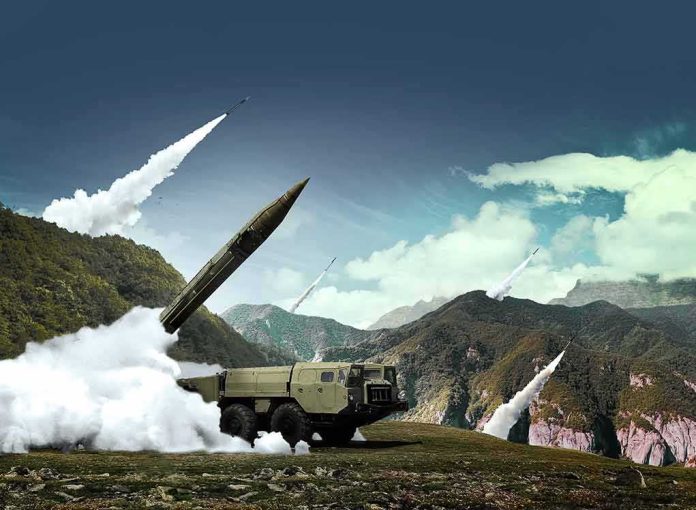
The demise of the INF Treaty did not simply lift a ban; it reopened a geography of deterrence. Once Russia fielded a ground-launched cruise missile the United States judged illegal, the clause that had kept land-based missiles out of the 500–5,500 km band for a generation gave way—and the U.S. Army moved swiftly to fill the vacated range with Typhon, a mobile launcher built to fire Navy missiles from roads and hides ashore.
At a Glance
- Washington concluded Russia violated the INF Treaty with the 9M729; U.S. withdrawal followed in 2019 after years of allied consultations and unresolved compliance talks.
- Russia denied any breach, asserting the 9M729 stayed under 500 km and accusing the United States of its own infractions—but offered no verifiable path back to compliance.
- The Army’s Typhon system restores ground-launched reach from roughly 500 to 1,600+ km, using Tomahawk and SM-6 missiles to bridge the gap between PrSM and hypersonic weapons.
- Ground-based mid-range strike reshapes operational math in Europe and the Indo-Pacific by distributing long-range fires across mobile land nodes rather than keeping them only at sea or in the air.
What ended the INF era—and why the U.S. case carried the day
The INF Treaty’s core bargain was blunt: neither side would possess, produce, or flight-test ground-launched ballistic or cruise missiles between 500 and 5,500 km. Beginning in 2014, the United States formally assessed that Russia had violated those terms by developing and later fielding a ground-launched cruise missile—the 9M729, known to NATO as the SSC-8. The diplomatic pattern that followed is familiar to arms control veterans: repeated compliance demarches, allied briefings, and an explicit U.S. finding of material breach, followed by suspension and, after six months’ notice under Article XV, withdrawal in August 2019 when Moscow neither acknowledged a violation nor took steps to return to compliance.
Russia’s counter-case rested on denial and counteraccusation. Officials argued the 9M729 never exceeded 500 km, described it as an upgrade to the permitted 9M728, and claimed tests and launcher configurations preserved treaty legality; they further accused the United States of treaty issues tied to missile-defense deployments. What Moscow did not provide was a verifiable, technical path back to compliance that satisfied the parties to the treaty. By contrast, Washington presented allies with sufficient detail to achieve NATO consensus that Russia had developed and fielded a violating system—an alignment that, in alliance politics, functions as dispositive even when specific intelligence remains classified. On that evidentiary balance, the U.S. case was decisive.
Design logic: how Typhon restores the banned envelope
Typhon, the Army’s Mid-Range Capability (MRC), is less a bespoke missile than a clever integration of proven naval weapons onto a road-mobile chassis. The launcher and its fire-control architecture adapt the Navy’s vertical launch ecosystem to land use, enabling an expeditionary battery—operations center, support vehicles, and four launchers—to fire Tomahawk land-attack cruise missiles for deep, fixed-target strikes and SM-6 for high-speed, multi-mission shots, including anti-ship roles within the upper end of theater ranges. In the Army’s Long-Range Precision Fires portfolio, that places Typhon between the Precision Strike Missile (PrSM), optimized for roughly sub-500 km engagements, and developmental hypersonic systems intended for still longer reach and time-sensitive targets.
Two design choices matter operationally. First, mobility: unlike fixed magazines, a Typhon battery can displace frequently, complicating adversary targeting and compressing kill chains. Second, munitions commonality: by firing Tomahawk and SM-6, the system leverages existing industrial lines, software baselines, and tactics, accelerating fielding and sustainment compared with inventing a new missile family from whole cloth. The technical result is not theoretical. It yields a near-term, scalable way to put ground-based missiles back into the stricken range band with credible accuracy, reach, and electronic survivability.
From treaty breakdown to force design: the path from 2014 to fielded units
The United States did not pivot to Typhon overnight. The arc runs from the first public compliance finding in 2014, through alliance consultations and unsuccessful remediation efforts, to the formal U.S. notice in early 2019 and withdrawal that August. What followed was a doctrinal and industrial sprint. Army Futures Command prioritized the mid-range gap; Program Executive Offices partnered with the Navy and industry to translate seaborne launch and fire-control into a land battery; Congress funded rapid prototyping with an emphasis on fieldable capability in the early-to-mid 2020s. The result was a system aligned to contemporary operational problems—countering maritime anti-access networks in the Indo-Pacific and complicating Russian planning in Europe—without waiting for the long lead times of novel hypersonics alone.
Arms control’s failure mode helped shape that choice. Verification had atrophied since the late Cold War, while each side read technical ambiguities to its advantage. As intelligence officials have explained in public forums, Russia’s mix of allowable and allegedly covertly banned testing created an asymmetry of proof that was never resolved diplomatically; the political process concluded what the evidentiary process could not adjudicate publicly. When the treaty died, the void in ground-based strike was immediate—and Typhon was designed to fill it quickly.
Russia’s denials, weighed against allied alignment
Sergey Ryabkov and other Russian officials repeatedly asserted that the 9M729 stayed within 500 km and that Russia observed the treaty’s terms; they even staged a missile display to buttress the claim. Yet over five years, Moscow’s stance did not evolve into verifiable transparency that would permit inspections or technical reconciliation. By 2019, NATO stated plainly that Russia had developed and fielded the 9M729 and had taken no demonstrable steps toward compliance—an assessment that, in alliance practice, signals an evidentiary threshold has been met for collective policy decisions. In arms control disputes, this allied convergence is not window dressing; it is the mechanism by which secret intelligence, classified telemetry, and technical analyses are converted into shared political judgments.
Operational consequences: distributed fires change the map
With Typhon, the Army can generate effects traditionally reserved for air and naval forces—deep strikes on command nodes, air bases, and maritime targets—without exposing pilots or concentrating magazines at sea. In the Indo-Pacific, that means land formations can hold coastal infrastructure and surface combatants at risk from austere, camouflaged positions, complicating an adversary’s targeting calculus and diluting the value of fixed anti-access systems. In Europe, reintroducing mobile, ground-based mid-range fires forces any Russian planner to account for dispersed strike cells operating from NATO territory. The point is not redundancy for redundancy’s sake; it is cross-domain deterrence by distributing long-range attack options across platforms, services, and allies, increasing both resilience and decision-making pressure on a potential aggressor.
What this means for the next arms-control chapter
The INF Treaty solved a 1980s problem by banning an entire category rather than adjudicating specific capabilities. Its collapse reflects a different, twenty-first century reality: mobile launchers, dual-use missiles, and overlapping test regimes make bright-line verification harder, while regional balances—in Europe and the Indo-Pacific—reward land-based reach. Any future compact that hopes to survive will have to acknowledge those operational incentives and design verifiable limits around them, not against them. Until then, the United States has concluded deterrence demands capability in the ranges the treaty once erased. Typhon is the manifestation of that judgment—born of a compliance fight, engineered for a contested era, and already reshaping how America and its allies think about distance, time, and risk in war.
Sources:
19fortyfive.com, 2017-2021.state.gov, armscontrol.org, war.gov, en.wikipedia.org, commonslibrary.parliament.uk, nato.int, voanews.com, dni.gov, reuters.com, bbc.com, battlepolicy.com