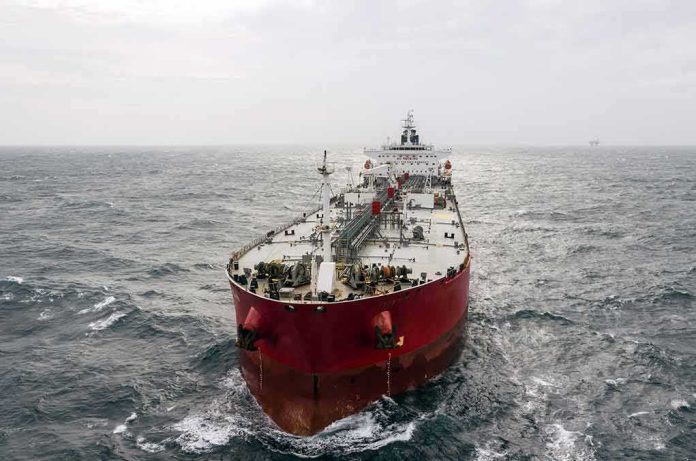
When diplomacy around the Strait of Hormuz stalls, tanker traffic slows and oil markets move within hours; the waterway’s legal status matters less than how safe, insurable, and practically navigable operators judge it to be.
At a Glance
- Oman postponed a planned meeting with Iran and Gulf states on managing Hormuz transits; the announcement arrived just as traders were looking for signs of stabilization.
- Oil prices jumped intraday on the delay before settling closer to flat-to-marginal gains, a familiar reflex to Hormuz headlines.
- Ship-tracking services and market reporters described tanker crossings as markedly reduced, at points near a standstill over 12-hour windows.
- The strait typically carries roughly one-fifth of global seaborne oil and significant LNG volumes, so even partial slowdowns reverberate quickly through pricing and logistics.
What happened: diplomacy slipped, prices flickered, and traffic thinned
Oman’s foreign minister, Sayyid Badr Albusaidi, said a regional meeting intended to manage a pathway for reopening the Strait of Hormuz was postponed “in the interests of consensus.” Oman had been due to host Iran and Gulf neighbors; the delay signaled that talks over practical operating arrangements were not yet converging. Energy markets responded on cue. In early trading after the announcement, crude prices spiked—Reuters tallied gains of more than 4% intraday—before settling closer to about 1% higher as liquidity and position-taking normalized through the session. That pattern fits a decade of market behavior: Hormuz headlines move prices first; only later do traders reprice to what actually changed on the water.
On the water, ships did move—but far fewer than normal. Across several updates, Reuters and maritime analytics firms reported depressed tanker flows and, in one twelve-hour slice, only three observed crossings. Weekend snapshots showed similarly thin movement, with Kpler-reported transits dropping to a handful of commodity carriers on Saturday and none on Sunday. Taken together, the picture was not a formal “closure” so much as a severe operational slowdown. For commodity logistics, that distinction is academic. A corridor that is legally open but functionally unattractive—because of attack risk, insurance costs, or ambiguous rules of engagement—yields similar near-term effects: delayed loadings, reroutes, and risk premia.
Why Hormuz headlines hit so hard: mechanism and exposure
The Strait of Hormuz is the fulcrum of Gulf energy flows—before the current conflict it carried about 20% of the world’s seaborne crude exports and a substantial share of LNG. When throughput confidence erodes, even temporarily, refiners, traders, and shipowners all re-rate risk, and futures curves reflect that reassessment in minutes, not days. The mechanism is straightforward. First, perceived threat raises war-risk premiums and the cost of protective measures (escorts, routing, onboard security). Second, uncertainty widens voyage windows and disrupts scheduling, forcing counterparties to pad delivery times and inventory cover. Third, financial players amplify the move: hedgers add protection and momentum strategies follow price, creating sharp but often reversible swings.
This is why an apparently “paper” event—the postponement of a meeting—can produce a very real price move. Markets discount future barrels, not today’s liftings. If a forum designed to codify safe-transit rules is delayed, operators assume slower progress toward normalized traffic and price that delay immediately. The operating reality during this period matched the thesis: multiple reports pointed to restricted tanker transits and selective standstills across specific windows, underscoring the gap between legal openness and practical operability.
How we got here: conflict risk and contested management of a chokepoint
The current shipping climate sits atop months of regional confrontation, including missile and drone activity that has periodically struck commercial targets or prompted defensive measures across the Gulf approaches. Even when attacks are not ongoing, elevated alerts, GPS interference, and shifting notices to mariners complicate voyage planning and raise insurers’ loss expectations, which translates to higher premia and stricter underwriting terms. Efforts to establish interim passage arrangements have struggled because stakeholders want incompatible guarantees: security of transit without conceding legal leverage over the channel’s management. Industry sources have also warned that some draft proposals were not operationally feasible from a shipping standpoint—too much administrative friction, unclear liability, or rules that misalign with how convoys and pilots actually work.
The practical effect is a corridor that oscillates between “restricted” and “severely disrupted,” even without a de jure closure. Analysts and maritime advisories throughout 2026 have described precisely this pattern: traffic materially below historical baselines, workarounds via alternative routes where possible, and a persistent bid in war-risk pricing that only recedes when safe, predictable procedures are in place and honored by all parties.
Parsing the numbers: traffic snapshots versus sustained throughput
Live reporting necessarily captures moments. One update counted three crossings in twelve hours; another weekend tally observed five commodity ships on Saturday and none on Sunday. Those are not comprehensive ledgers, but they are consistent with a system operating well below capacity and subject to abrupt pauses as masters, charterers, and naval authorities evaluate risk on rolling horizons. For context, pre-war daily ship counts—across all categories—ran far higher, and even a modest absolute reduction at Hormuz cascades through fleet availability, laycans, and demurrage exposure. The operational lesson is simple: a handful of transits do not mark normalization. Normal is when sailings are routine enough that insurance, pilots, and ports can plan by calendar, not by crisis.
Markets, meanwhile, toggle between fear of supply loss and recognition that barrels can still flow, albeit with friction. A sharp upward spike retraces when traders see that some ships moved or that diplomatic channels remain open; it re-accelerates when talks stumble or an incident suggests new constraints on passage. Reuters’ price prints around Brent and WTI during the latest postponement phase fit that oscillation—up fast, then net smaller gains by settlement, as the physical signal remained “slowed” rather than “stopped”.
Efforts to reach an agreement on the future of the Strait of Hormuz were postponed Monday as oil prices surged above $100 a barrel and Iran-backed forces expanded their attacks on energy infrastructure and shipping routes across the Middle East. https://t.co/xFMiAlKgEr
— NEWSMAX (@NEWSMAX) September 15, 2026
What to watch next: operational signals that matter more than headlines
Four signposts will tell you when Hormuz risk is genuinely receding. First, insurance: war-risk premia and exclusions embedded in charter parties will narrow only when underwriters see stable, enforced transit protocols. Second, tempo: sustained daily transits approaching pre-conflict patterns—confirmed by multiple trackers—beat any single-day surge. Third, governance: a durable management arrangement that preserves transit passage norms while clarifying escorts, routing, and dispute resolution will anchor confidence; industry acceptance will be visible in longer, multi-voyage fixtures. Fourth, incident cadence: a measurable lull in attempted or successful attacks, and fewer navigational advisories tied to electronic interference, will convert into lower perceived risk and cheaper capital for shipowners.
Bottom line
Postponed talks in Muscat did not “close” the Strait of Hormuz—but they did prolong a period in which the strait is legally open yet functionally constrained. Tanker movements have been erratic and thin by historical standards, and oil prices behaved exactly as a well-wired market does in a chokepoint scare: jump first, calibrate later. Until diplomacy yields procedures that shipmasters and insurers trust, expect the corridor to behave like a narrow valve—technically open, practically throttled—and for prices to mirror that reality in bouts of volatility rather than a one-way trend.
Sources:
youtube.com, reuters.com, ces-intelligence.com