
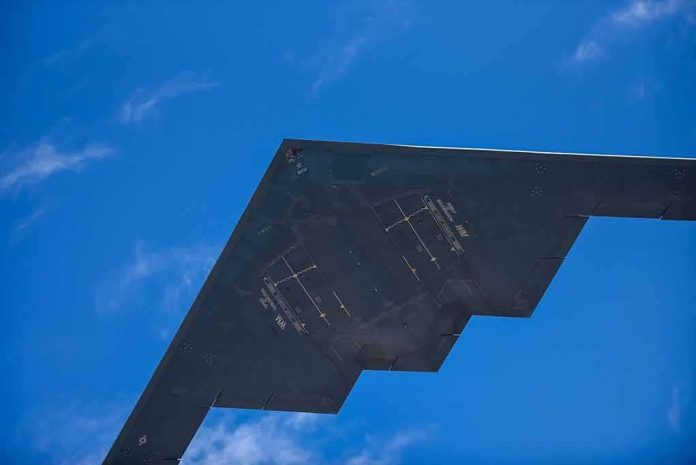
The significance of the Presidential Unit Citation to Whiteman’s B-2 force is not simply that an award was conferred; it is that the Air Force judged the 509th and 131st Bomb Wings to have executed an unprecedented, highly complex global strike with disciplined precision during a defined window of real combat, at a scale never before attempted with the B-2 Spirit.
At a Glance
- The 509th Bomb Wing (active duty) and 131st Bomb Wing (Missouri Air National Guard) received the Presidential Unit Citation for actions tied to Operation Midnight Hammer.
- Air Force accounts anchor the award to mission activities spanning June 13–22, 2025, culminating in a historic multi-jet B-2 strike package.
- Leaders credit the wings with generating aircraft, loading GBU-57 Massive Ordnance Penetrators, and employing them against Iranian nuclear program targets.
- The decoration formalizes the Air Force’s judgment about extraordinary unit performance; it does not hinge on later debates over strategic effect.
What the award confirms: extraordinary unit performance in a defined operation
The Air Force presented the Presidential Unit Citation (PUC) to the 509th and 131st Bomb Wings in a ceremony at Whiteman Air Force Base on November 20, 2026. The service’s official account attributes the honor to “extraordinary heroism and disciplined execution” during Operation Midnight Hammer, specifying the operational period as June 13–22, 2025. The Missouri Air National Guard independently framed the PUC as the service’s highest unit-level decoration and identified both wings as recipients for “outstanding performance in action and extraordinary heroism,” emphasizing that the same combined team generated B-2 aircraft, loaded munitions, and executed the strike tied to Iran’s nuclear weapons development program.
While citations often read broadly in public releases, the through-line here is concrete. Airmen from both wings built and loaded GBU-57 Massive Ordnance Penetrators (MOPs)—a 30,000-pound class, earth-penetrating weapon engineered for deeply buried targets—then generated and launched a historically large B-2 strike package from Whiteman. The Air Force characterizes the package as the largest in B-2 history, with related accounts describing seven Spirits launching to prosecute the mission. That scale matters; it implies a synchronized logistics, maintenance, weapons, and command-and-control effort that stresses every echelon from sortie generation to global tanker choreography.
How the mission worked: stealth, heavy penetrators, and Total Force Integration
The mechanics of a B-2/MOP operation are unforgiving. The B-2’s low observable design trades volume and access—think serrated edges, internal bays, and radar-absorbent structure—for survivability in dense air defenses. Loading and certifying MOPs involves specialized handling equipment, weapons troops trained to exacting technical orders, and maintenance teams sequencing inspections and configurations so that stealth signatures remain within tolerance after weapons integration. Aircrews then fly a long-duration, tanking-intensive profile to insert the aircraft, time-on-target, and weapons release within strict windows. The 509th/131st team did this at scale, under combat timelines, which is precisely what the PUC language—heroism plus disciplined execution—seeks to capture.
Total Force Integration (TFI) is not window dressing in this context; it is the model that blends an active-duty bomb wing and an Air National Guard bomb wing into a single, standing combat team. The B-2 enterprise at Whiteman is a mature TFI construct. In practice, that means Guard maintainers and aviators train to the same mission-ready standards as their active-duty counterparts, share aircraft, and rotate into the same alert, maintenance, and deployment cycles. Senior leadership underscored this linkage in the immediate aftermath: on July 10, 2025, the acting Secretary of the Air Force and the Chief of Staff visited Whiteman and publicly commended personnel for transforming unprecedented planning into global execution—explicitly crediting 509th and 131st Bomb Wing Airmen for how they planned and flew Midnight Hammer.
What we know about the targets and timing—and why that matters for the award
Air Force releases tie the operation to strikes on elements of Iran’s nuclear infrastructure and refer to multiple facilities. Different official retrospectives vary in their shorthand—some citing three facilities, others simply referencing nuclear sites—while timelines in public summaries range from a June 13–22 activity window to mentions of June 21 and June 24 as mission milestones. Variations like these are common across large joint operations: planning windows, launch times, weapons employment, and recovery can straddle dates; distinct command histories also anchor to different segments (e.g., execution night versus the broader sortie-generation period). For purposes of the PUC, what the record asserts consistently is decisive: both wings planned and executed the B-2 portion of Midnight Hammer within the June 2025 window, at multi-ship scale, employing MOPs against deeply buried targets.
The distinction between unit performance and strategic effect is essential. A Presidential Unit Citation recognizes collective gallantry and performance “in action” measured against the difficulty and danger of the assigned mission, not the final, months-later intelligence judgment about an adversary’s program. The Air Staff and major command histories routinely separate those lanes: leadership messages after Midnight Hammer praised execution and integration; subsequent retrospectives continued to highlight the scope and difficulty of the B-2 package, including the unprecedented scale for the airframe.
Why this citation is rare—and what it says about long-range strike
The PUC sits at the apex of Air Force unit decorations, created in World War II and awarded only for actions comparable in intensity and risk to the highest individual valor awards when performed by a unit as a team. It is conferred sparingly; by design it signals that the unit crossed a threshold of danger, complexity, and excellence that ordinary combat credit does not capture. In bomber history, such recognition tends to cluster around operations where the margin for error is thin and the consequences of failure are strategic. Midnight Hammer fits that profile. A stealth bomber force surged from a single continental base, generated a multi-jet package, mated the most demanding conventional munition in the inventory to the aircraft, and executed a global strike profile into defended airspace—then recovered the force.
From a force-design perspective, the award underscores three truths about modern long-range strike. First, readiness in a niche capability like the B-2 is cumulative: you cannot “spin up” MOP integration, low-observable maintenance, or global tanker choreography overnight. Second, Guard-active integration is not simply a manpower strategy; it is an operational advantage when calibrated correctly, as Whiteman’s enterprise shows. Third, survivable deep-penetration platforms still have unique leverage against hardened targets; Midnight Hammer reinforced why heavy penetrators, long endurance, and stealth coexist in the same portfolio rather than compete.
B-2 bomber units receive Presidential Unit Citation for Midnight Hammer https://t.co/ZNCHoaAlCC
— Jennifer Jenkins (@jenkinswarpony) November 22, 2026
Placing Midnight Hammer in the bomber community’s trajectory
Even before the citation, the bomber community signaled how it valued the operation: the 509th and 131st received the 2025 Doolittle Award, a separate honor that recognizes combat excellence in the spirit of the 1942 Tokyo Raid—another moment defined by audacity, integration, and execution under strategic pressure. The pairing of the Doolittle Award and the PUC brackets Midnight Hammer’s meaning inside the profession of arms: a benchmark of what disciplined airpower can accomplish when a specialized enterprise is asked to perform at its absolute edge. That is the story the Air Force put its imprimatur on when it draped the blue streamer over the Whiteman colors.
Sources:
militarytimes.com, af.mil, ang.af.mil, whiteman.af.mil