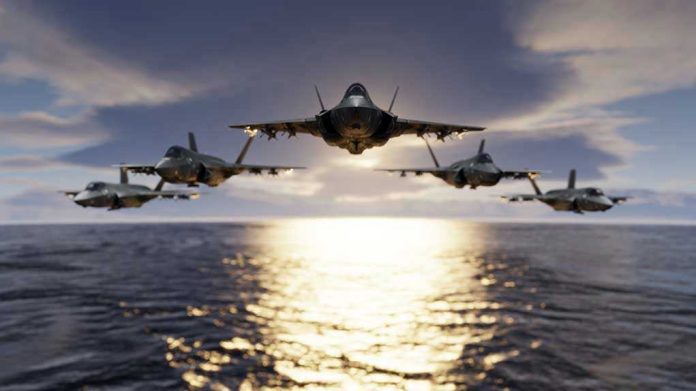
The Air Force’s 1,509-fighter requirement for 2035 is not a wish list; it is a quantified, risk-based force-sizing judgment that links fleet composition, readiness standards, and industrial capacity to the missions the nation expects the service to execute.
At a Glance
- USAF told Congress it needs 1,509 combat-coded fighters by 2035 to meet a moderate-risk posture; 1,723 corresponds to low risk.
- The path starts from roughly 1,271 combat-coded aircraft in 2026 and depends on sustained procurement and retirements paced to mission demand.
- Target mix by 2035: about 40% F-35, 40% combined F-15 and F-16, and 20% F-22 plus the next-generation F-47.
- Execution hinges on congressional funding and on-time output from Lockheed Martin and Boeing.
What “1,509 Combat-Coded Fighters” Actually Means
When Air Force planners say 1,509 fighters, they are pointing to aircraft assigned and configured to deploy for combat—the subset known as combat-coded—not the entire inventory. This is the pool available for wartime tasking under standard readiness assumptions, distinct from training, test, and backup aircraft. In its force-structure briefing to lawmakers, the service tied that 1,509 figure to a moderate operational-risk posture in 2035; the same assessment mapped a low-risk posture to a larger 1,723-fighter fleet. That framing matters. Fighter requirements are not static truths; they are outputs of models that integrate threat scenarios, campaign timelines, sortie-generation capacity, munitions assumptions, and force readiness. A lower-risk posture invariably prices out higher in aircraft, crews, spares, and operating tempo.
The Air Force also anchored the requirement to a measurable starting point: roughly 1,271 combat-coded fighters in 2026, a shortfall that will widen without new procurement as legacy fleets age out faster than fifth-generation deliveries backfill. Lt. Gen. David Tabor, the service’s lead planner, situated the 1,509 target as a growth path from that baseline to a fleet sized—and mixed—for the missions at hand by mid-next decade.
How the Targeted Mix Works
The number is only half the plan; the composition is the other half. Planners outlined a 2035 mix in which F-35s provide roughly 40 percent of the combat-coded inventory, a combined 40 percent comes from F-15 and F-16 fleets, and the remaining 20 percent blends F-22s with the emerging F-47—a next-generation air-dominance family member. Mechanically, that mix balances stealthy, penetrating platforms for contested environments with large-force capacity from modernized fourth-generation jets where survivability and basing permit. It also acknowledges the bridging role legacy aircraft must play while the next-generation segment scales. Matching that composition to operational concepts—distributed basing, resilient command-and-control, and long-range kill chains—demands disciplined upgrades: sensors, electronic warfare suites, data links, and weapons integration tuned to each aircraft’s role.
Just as important is what the 1,509 count excludes: Collaborative Combat Aircraft (CCAs), the autonomous wingmen intended to augment manned fighters. The service’s accounting separates crewed, combat-coded fighters from these uncrewed systems. That choice clarifies the crewed requirement while leaving room to quantify how CCAs will absorb risk, expand magazine depth, and complicate adversary targeting once their availability, survivability, and command-and-control performance are fully proven. In other words, 1,509 is the manned fighter backbone; CCAs are an additive layer the Air Force will size and field on a separate track.
Dependencies: Budgets, Factories, and Time
Force structure is where strategy meets arithmetic. Getting from 1,271 to 1,509 requires consistent, adequately funded procurement over multiple budget cycles and the industrial base to deliver on schedule. The Air Force has been explicit: Congress must appropriate funds, and prime contractors—chiefly Lockheed Martin and Boeing—must produce and deliver at the planned tempo. Delays in either dimension cascade. A slipped production lot, an avionics integration issue, or a prolonged continuing resolution can defer squadron conversions and push retirements into periods when maintenance costs and downtime spike.
None of this is novel in American defense planning; Congress’ own research arm has long characterized fighter force structure as a recurring judgment call rather than a fixed quantity, shaped by technology, mission design series, and evolving threats. The active fighter inventory has swung widely across decades—peaking above 4,700 in the late 1960s and shrinking to a modern force that trades mass for capability and range. The Congressional Research Service frames these choices as persistent oversight terrain for lawmakers, not as one-off technical determinations.
Why the Risk Labels Matter
Risk language in force-planning documents is not window dressing. It reflects the probability of failing to meet operational objectives under modeled conditions: adversary capabilities, warning timelines, logistics and basing access, attrition rates, and munitions stockpiles. A moderate-risk fleet can succeed, but with less margin for surprises and less ability to absorb early losses or dispersal shocks. A low-risk fleet buys back that margin with more tails, more crews, and often more forward posture. The Air Force’s mapping of 1,509 to moderate risk and 1,723 to low risk thus gives Congress an explicit, testable trade space to evaluate budgets against missions.
The choice will reverberate through sustainment as much as procurement. Availability rates, training pipelines, and depot throughput—areas where the Government Accountability Office has repeatedly found gaps across tactical aviation—determine how many of those tails are mission-capable on a given day. Quantity without readiness does not close risk in wartime; resourced flying hours, spares, and maintainers do.
What Could Shift the Number
The 1,509 figure is a requirement for a particular time horizon and a particular risk posture—sized against today’s best read of adversary trajectories and U.S. operating concepts. It can move. Changes in threat systems, allied posture, munitions stockpiles, and basing access all alter the force needed to achieve the same operational effect. Technological inflections—mature CCAs, improved long-range air-to-air weapons, or more resilient battle networks—can also reallocate capacity across platforms. The Air Force has signaled that such dynamics could nudge the number up or down, which is consistent with how serious planning accounts for uncertainty over a decade-long horizon.
How Congress Should Read the Plan
Congress does not need to adjudicate whether 1,509 is metaphysically “correct.” It needs to decide whether that moderate-risk posture, with the stated mix, can be executed with credible schedules, budgets, and industrial performance. Three tests are straightforward. First, reconcile the counting rules: combat-coded fighters versus other inventory measures, so debates are apples-to-apples. Second, check the math on retirements and deliveries across F-35, F-15EX, F-16 upgrades or buys, and F-47 milestones against contractor capacity and depot bottlenecks. Third, pressure-test the risk translation: if lawmakers prefer lower risk in priority theaters, the 1,723 path must be resourced accordingly—or missions, timelines, or geographic assumptions must change.
The Air Force has given Congress a clear backbone: a measurable target, a defined mix, and explicit dependencies. That is what accountability in force planning looks like. The decision now is whether to buy the level of risk the 1,509 fleet implies—or to fund the lower-risk posture and the industrial tempo required to build it in time.
Sources:
breakingdefense.com, yahoo.com, twz.com, airandspaceforces.com, 163.com