When a single gunshot on one of America’s busiest bridges halts evening traffic and ends a commuter’s life, the story is not ambiguity but certainty: investigators rapidly identified a suspect, recovered a vehicle, and filed a murder charge grounded in surveillance and license-plate data rather than rumor.
At a Glance
- Police identified 62-year-old Victor Romero, a retired NYPD detective, and charged him with murder in the fatal shooting of 46-year-old Con Edison employee Koran (Kuran) Irvine.
- The shooting unfolded just after 7 p.m. on the George Washington Bridge’s upper westbound level amid heavy traffic.
- Reporting describes a single shot entering through the victim’s rear passenger-side window and striking him, consistent with fire from another vehicle.
- Investigators leveraged bridge surveillance and license-plate readers to zero in on the suspect vehicle; Romero’s car was secured as evidence.
What Happened: A Fatal Shot During the Evening Commute
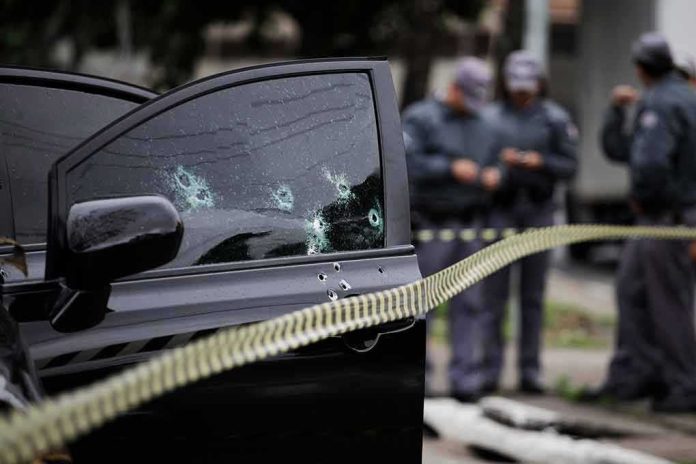
The sequence begins as countless rush-hour drives do: two vehicles converging into limited space. Shortly after 7 p.m., on the upper level of the George Washington Bridge, a single-vehicle crash call drew Port Authority Police to a Volkswagen that had struck the median. Inside, officers found Koran (also reported as Kuran) Irvine, a 46-year-old Con Edison employee, unconscious with a gunshot wound. He was transported to Englewood Hospital and pronounced dead, establishing a clear medical endpoint linked to the shooting injury. The scene bore the marks of a shot fired into a moving car—reporting described the Volkswagen’s rear passenger-side window shattered with an apparent bullet hole, and medical descriptions placed the wound at the rear right shoulder, a trajectory consistent with a projectile entering from behind and to the side.
Amid the choke points and cameras that define a modern major crossing, investigators had tools. Surveillance video and automated license-plate readers, both on and around the bridge approaches, enabled detectives to develop a person of interest and trace a vehicle. Within a day, authorities identified 62-year-old Victor Romero, a retired NYPD detective; his car was in police custody and his home secured pending a warrant, signaling an evidence-driven case rather than a speculative one.
The Charge and the Evidence Behind It
NYPD officials announced Romero had been charged with murder in Irvine’s death. That charging decision aligns with what investigators believe occurred between the vehicles preceding the shot: reporting references a near-collision and an escalation consistent with road-rage dynamics. While headlines often compress that into a single phrase, the evidentiary spine here is more specific—time-stamped movement on a heavily monitored span, a distinctive damage pattern to the victim’s car, and a fast sequence from identification to custody that culminated in the formal charge. One brief ambiguity surfaced in media accounts about whether Romero surrendered at a precinct or was located by officers; PIX11 initially cited a surrender narrative before noting NYPD’s statement that he was found and taken into custody, while News12 cited a police source stating he did not turn himself in. That discrepancy concerns process, not the core facts of the shooting, identification, and charge.
On the core forensic points, early public reporting often lags laboratory work. No outlet at the time described recovery of a specific firearm, a bullet-to-gun match, or gunshot residue findings. That absence from public view does not dilute what is established: Irvine died from a gunshot wound sustained in traffic on the bridge; investigators tied a suspect and a vehicle to that moment; and prosecutors filed a murder count that, under New York law, alleges an intent to cause death or an extreme reckless indifference to human life. Those are the stakes of the charge; proof will ultimately rest on the composite of surveillance, vehicle and trajectory analysis, and any statements or corroborated witness accounts.
How Investigators Reconstruct a Moving-Vehicle Shooting
Traffic-span shootings give investigators both headaches and advantages. The headaches: ballistic evidence may be scarce if a casing wasn’t ejected onto a recoverable surface or if the weapon type complicates recovery; the event can unfold at highway speeds with few stationary eyewitnesses. The advantages: chokepoints like bridge lanes concentrate surveillance, license-plate readers log vehicles precisely, and toll systems timestamp movement. Reconstructing such a case typically involves aligning multiple data streams—camera footage from ramps and the upper level, plate captures on approaches, crash-scene mapping, laminated glass fracture analysis, and wound-path findings from the medical examiner—to model angle, distance, and likely muzzle position. That multi-source alignment is why bridge incidents seldom reduce to “he said, she said.”
Here, the visible damage—rear passenger-side glass shattered with a discrete perforation—pairs with the reported right-shoulder wound to suggest a shot fired from behind and lateral to the driver’s position, consistent with a pursuing or adjacent vehicle during lane merge or overtaking. When investigators overlay that geometry on synchronized video and plate-reader logs, they narrow candidate vehicles quickly. That is, by all accounts, what happened between the Tuesday evening shot and the next day’s identification of Romero and securing of his vehicle.
Road Rage as a Pattern, Not a Mystery
While every case turns on its facts, the situational arc is depressingly familiar: a near-collision on a ramp, perceived slight or danger, retaliatory acceleration, and a weapon introduced into an otherwise survivable traffic dispute. Public-health and criminal-justice literature have long noted the definitional mushiness of “road rage,” since homicide and assault statutes do the legal work, not a standalone category. But the practical risk factors are stable—congestion, merging pressure, obstructed sightlines, and driver anonymity. The George Washington Bridge layers each of these atop a uniquely dense surveillance environment. That’s why, when a shot is fired there, the investigative fuse is short; cameras do not forget.
At the same time, readers should keep two distinctions straight. A murder charge is an accusation that prosecutors believe they can prove beyond a reasonable doubt; it is not itself proof of intent or legal unjustification. And in any serious shooting case, the most probative evidence arrives in phases: scene documentation first, then synchronized video analysis, then autopsy and trajectory, and finally any firearms examination tying a recovered projectile to a particular weapon. The timing of the charge here reflects confidence in the identification of the shooter and the unlawful shooting, not a public release of every lab result.
Retired NYPD detective charged with murder over bridge shooting
A retired New York Police Department detective, Victor Romero, 62, faces a murder charge over the fatal shooting of motorist Koran Irvine, 46, during an apparent road rage incident on the George Washington Bridge on… pic.twitter.com/tMcjKzK8W8
— The CBIJ (@TheCBIJ) October 21, 2026
Why This Case Will Turn on Corroboration
From a trial posture, the features most likely to carry weight are the synchronized surveillance record, the plate and toll-tracking data connecting Romero’s vehicle to the lane sequence, and the wound-path/glass-fracture alignment that pins directionality. If a firearm is recovered and matched to a projectile or distinctive toolmarks, that adds a mechanical link; if not, the video-trajectory-medical triad can still meet the legal threshold. Statements, if any, and any dashcam footage harvested from vehicles queued on the span could further harden the narrative. The legal questions—identity, intent, justification—will be resolved in court. The factual spine is already strong: a shot fired during a traffic encounter on the bridge killed Koran Irvine, and authorities have charged Victor Romero with that killing based on surveillance-enabled identification and rapid evidence collection.
Sources:
foxnews.com, apnews.com, ajc.com, newjersey.news12.com, silive.com, hindustantimes.com, pix11.com