Canada has experienced a measurable surge in serious fires targeting places of worship since 2021, with confirmed arsons, low arrest rates, and uneven public data—exactly the combination that warrants a sober, methodical study focused on facts, not narratives.
At a Glance
- A documented cluster of Canadian church fires since 2021 includes dozens of confirmed arsons.
- Arsons at religious institutions nearly doubled as a share of all Canadian arsons in 2021–2023 compared with earlier years.
- Arrest and charge rates in these incidents appear strikingly low, signaling an accountability gap.
- National hate-crime trends underscore a volatile environment, though motives in specific fires vary and are not uniformly ideological.
What the evidence shows about the fires themselves
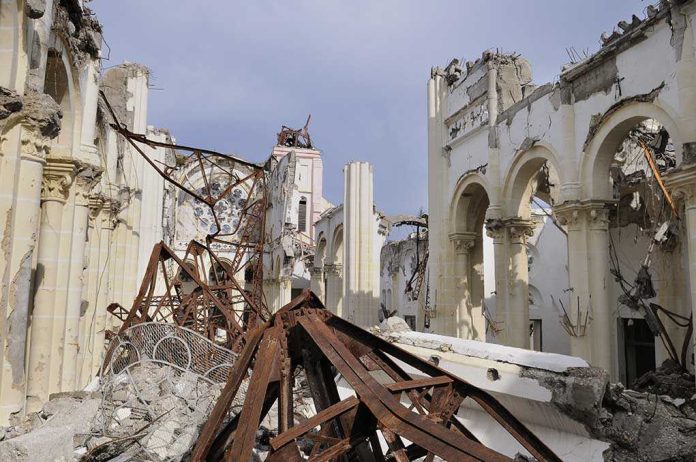
Between May 2021 and December 2023, at least 33 Canadian churches burned to the ground; investigators confirmed 24 as deliberate arsons, while others were deemed suspicious or remain unresolved. That inventory—built from police and court records, media reports, and other official documents—establishes a concrete incident set for scrutiny rather than a vague impressionistic trend. While deliberateness does not automatically resolve motive, the prevalence of confirmed arson among the most destructive events is a fact pattern that merits closer institutional attention.
Beyond individual cases, quantitative analysis points to a broader shift. A study of arson against religious institutions concluded that these incidents nearly doubled as a proportion of all Canadian arsons, rising from approximately 0.38 percent in 2011–2014 to about 0.73 percent in 2021–2023—a relative increase corroborated in media summaries of the research and anchored in Statistics Canada arson data. This relative measure matters: it sidesteps year-to-year noise in absolute counts and asks whether religious sites have become a comparatively more common target within Canada’s overall arson profile. On that question, the answer is yes.
Accountability signal: low arrests and thin public case visibility
For the public, the most practical barometer of accountability is whether perpetrators are identified and charged. Here the record is weak. In the CBC’s database of 33 destroyed churches, nine cases had led to arrests as of publication—a minority outcome for incidents that investigators had often deemed deliberate. Separately, commentary on the quantitative study characterized police charging outcomes in 2021–2023 as extremely rare for religious arsons, amplifying the same concern: severe crimes, confirmable crime scenes, and few named suspects reaching court. No single percentage captures all jurisdictions and case types cleanly, but the alignment between datasets on the scarcity of arrests and charges is unmistakable. That is why a structured, national-level review would be valuable.
This is not about pre-judging motive or collapsing diverse incidents into one orchestrated campaign. It is about standard markers of effective policing and public reporting: incident inventory, cause classification, investigative progress, prosecutorial decisions, and case closure reasons. When destructive, high-salience crimes repeatedly yield no defendant and no public explanation for that absence, governments should test whether investigative capacity, information-sharing, or disclosure practices are falling short.
Why a study should be scoped to facts, not narratives
The temptation in any polarized issue is to jump from incidents to ideology. The evidence base here does not support that leap. Confirmed arson is a finding about ignition source and human agency; it does not, by itself, establish a hate motive, a political ideology, or a coordinated network. Some cases will be motivated by grievance, others by opportunism around vacant or at-risk heritage structures, and still others by factors as mundane as trespass and unsafe heating. A credible review distinguishes among these, with methods rather than speculation doing the heavy lifting.
That caution is reinforced by the parallel reality of elevated religion-targeted hate crime in recent years—an environment that is serious but not coterminous with church arson. Police-reported hate crimes against religion rose sharply from 2020 to 2023, then stabilized at high levels in 2024. Within those totals, Jewish and Muslim communities account for the largest shares; Catholic-targeted incidents comprise a smaller subset, and these figures cover both people and property offences, not only fires. A well-designed study will keep these categories straight: hate-crime trends frame risk, while arson investigations turn on scene forensics, building conditions, and case work-up.
How to build a reliable national picture
An expert review should start with a complete, incident-level inventory of place-of-worship fires and suspected arsons after 2021. That means drawing from provincial fire marshals, municipal fire departments, the RCMP, provincial and municipal police services, and prosecution databases—then de-duplicating entries to reconcile cross-referenced case numbers. The core record for each incident should include the occurrence identifier, location, date, building type and status (active, vacant, deconsecrated), cause classification (accidental, natural, deliberate, undetermined), investigative status, and prosecutorial outcome. Without this spine, the conversation keeps collapsing into competing headline counts.
Next, classification should be standardized. Certified fire investigators can review fire-marshal reports, scene photography, accelerant testing, and insurance files to resolve disputed causes consistently across jurisdictions. A parallel track should request police intelligence assessments for any evidence of coordination—shared methods, accelerants, timing clusters, suspect communications, or claims of responsibility. The point is not to assume a network; it is to check for one using the same evidentiary standards applied to serial property crime or critical infrastructure attacks.
Measuring performance where it matters: arrests, charges, closures
Low arrest and charge rates demand an audit of process rather than a shrug about caseloads. Police services and Crown prosecutors should be asked, case by case, whether investigations are open, cleared without charge, charged and stayed, withdrawn, or concluded with conviction—and why. When courts seal information for valid reasons, aggregate reporting can still show whether specific chokepoints exist: evidence sufficiency, expert availability, inter-agency handoffs, or disclosure burdens. If fire scenes are regularly compromised by late calls or unsafe entry, that is a preventable operational failure; if specialized arson expertise is thin outside major cities, that is a resourcing issue legislators can fix.
Two additional tests can reduce confounding. First, compare affected sites with matched control buildings—similar age, heritage status, and maintenance profile—to see whether deteriorating structures or vacancy rates explain concentration. Second, conduct a time-series analysis of incident timing relative to high-profile media events to check for temporal clustering without inferring motive from coincidence alone. These are routine tools in public-safety research; they convert speculation into analyzable questions.
Veteran Fire Investigator Launches Probe Into Surge in Canadian Church Arson Attacks
A veteran Canadian fire investigator is launching an independent examination of attacks on churches and synagogues, as a leading watchdog accuses political leaders of responding to the…— JulietteSchwartz (@Juliett59778255) October 27, 2026
Keeping the public square honest
High-visibility crimes attract misinformation. Several widely shared social posts have misattributed church fires to false suspects or non-existent ideological plots, and fact-checkers have traced some cited “arsons” to lightning strikes or construction mishaps. A government-led study that releases a clean, auditable incident list—with causes, jurisdictions, and case statuses—blunts both alarmism and denial. It also respects victims and communities by replacing insinuation with precise public accounting.
The bottom line
Canada’s record since 2021 shows real, destructive arsons against places of worship and an arrest-and-charge picture that does not match the severity of the crimes. The data also show that religious sites have become a comparatively more frequent arson target within the national arson landscape. Those two facts are enough to justify a serious, methodical, transparently scoped study. Its mandate is straightforward: build the definitive incident inventory, apply consistent forensic standards, audit investigative and prosecutorial outcomes, and report publicly. The point is not to script a narrative; it is to deliver facts sturdy enough that no narrative is needed.
Sources:
lifesitenews.com, theglobeandmail.com, ckom.com, factcheck.afp.com, www150.statcan.gc.ca, jstor.org, justice.gc.ca