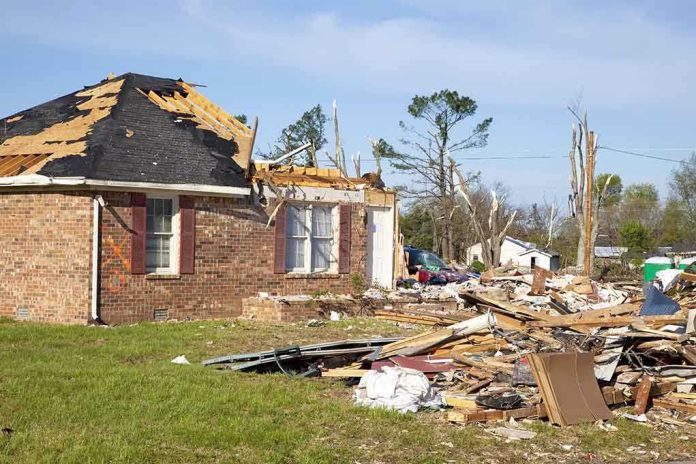
Baseball-sized hail and multiple tornadoes struck rural southern Minnesota this week, exposing vulnerabilities in America’s heartland that federal agencies struggle to address effectively.
Story Snapshot
- Southern Minnesota hit by 2-3 confirmed tornadoes near Truman, Amboy, and Elmore on April 13, 2026, marking the season’s first severe outbreak.
- Baseball- and golf ball-sized hail damaged vehicles, farm outbuildings, and windows across multiple counties, with no injuries reported.
- Storm Prediction Center issued Level 3/5 risk; National Weather Service confirmed touchdowns amid a multi-state severe weather event.
- Rural communities face cleanup and insurance claims, highlighting early-season risks for farmers and residents in agricultural areas.
Storm Timeline and Warnings
Severe storms began around 4 p.m. on April 13 in southeast Minnesota. The Storm Prediction Center issued a Level 3/5 severe risk and an extreme tornado watch for over 10 counties. A funnel cloud appeared near Wabasha at 6 p.m. but did not touch down. The first tornado formed at 6:25 p.m. north of Truman in Martin County, captured on video by spotters. Warnings covered rural areas, enabling quick responses from fire departments and residents.
Confirmed Touchdowns and Hail Damage
A second tornado touched down between 6:30 and 6:32 p.m. near Amboy in Blue Earth County, verified by spotters and fire departments. At 7:20 p.m., another formed six miles west of Elmore in Faribault County. Baseball-sized hail pelted towns like Dennison, Faribault, Northfield, and Lake City into the evening. The tornado watch expired at 10 p.m. Damage focused on farm outbuildings and vehicles, sparing lives but straining local resources.
Impacts on Rural Communities
Farmers in Martin, Blue Earth, and Faribault counties reported outbuilding destruction and potential crop risks from hail. Motorists faced shattered windshields and dented cars, sparking insurance claims in these agricultural heartlands. Residents shared photos of hail-covered roads and damaged property, fostering community solidarity. No injuries occurred, a relief amid first-season unpredictability, but cleanup burdens working families already grappling with economic pressures.
This early outbreak signals an active 2026 severe weather season for Minnesota, which averages 27 tornadoes annually. Past events like the 2011 Minneapolis EF4 and 2020 west-central EF4 caused deaths, underscoring the stakes for underprepared rural areas.
Expert Confirmation and Outlook
National Weather Service Twin Cities confirmed at least three tornadoes by April 14 morning, with surveys pending for EF ratings. Meteorologists noted supercell formation from Gulf moisture clashing with cold fronts, enabling winds up to 150 mph. As of Tuesday, spotty showers lingered, with thunderstorms forecast for Wednesday and temperatures in the 70s. The event tied into a regional outbreak affecting Kansas, Iowa, and Wisconsin.
Federal Response Gaps Exposed
Americans on both sides of the aisle share frustration with government failures, from weather preparedness to broader crises. Rural Minnesotans depend on accurate NWS alerts, yet early-season surprises like this reveal limits in federal forecasting amid budget strains. President Trump’s administration prioritizes energy independence and disaster resilience, but deep state inefficiencies persist, leaving hard-working families exposed to nature’s fury and elite neglect of heartland needs.
Sources:
CBS Minnesota weather forecast for severe storms on April 13, 2026.
KSTP photo gallery of hail storm in southern Minnesota.
KROC News southeast Minnesota storm update.
Tornado outbreak in Kansas, Minnesota, Iowa, Wisconsin on April 13, 2026.