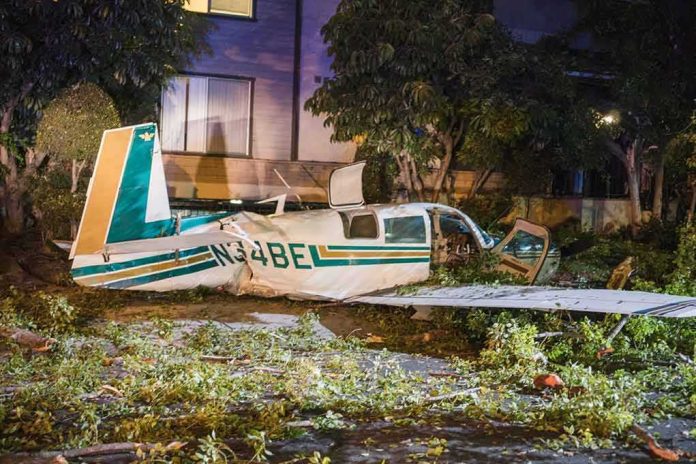
In a nighttime emergency that followed the classic contours of a survivable forced landing, a pilot, his wife, and their two dogs walked away after a Piper PA-32 lost engine power and settled into trees rather than slamming the ground—an outcome that underscores the single most durable truth in general aviation mishaps: control at minimum speed, guided by disciplined procedures, is what turns a crash into an escape.
The Short Version
- A Piper PA-32 carrying a husband, wife, and two dogs lost engine power at altitude at night and came down into trees; all survived with minor injuries.
- FAA officials acknowledged the aircraft experienced mechanical trouble before contacting trees, consistent with a treetop “catch” that dissipated impact energy.
- The pilot reported troubleshooting, contacting ATC, and executing a last-moment flare to reduce impact severity.
- The case illustrates the general-aviation pattern: powerplant trouble, controlled off-field landing, and survivability driven by airspeed control and energy management.
What Happened: A Forced Landing Done Right
On a nighttime flight over eastern North Carolina, a single-engine Piper PA-32 with two people and two dogs aboard lost engine power at roughly 6,000 feet above the ground, according to the pilot’s account. He and his wife worked through emergency checklists and contacted air traffic control. With the propeller no longer producing thrust, glide planning replaced navigation: pick a survivable surface, manage airspeed, and fly the aircraft all the way to the crash. As the treeline rose to meet them, the pilot executed a final pull to check descent. The airplane struck trees, which bled off the last of its kinetic energy, and came to rest a few feet above the ground; the couple and their dogs exited with minor injuries. Local outlets later identified the pair as Dustin and Autumn Davis.
The broad contours of this account were supported by multiple outlets. The Federal Aviation Administration told reporters the airplane experienced mechanical trouble before it hit trees. Photographs and scene descriptions placed the wreckage low to the ground, suspended or nestled in foliage rather than cratered, with the nose close to—but not into—the dirt. Those details map to a treetop landing sequence as opposed to an uncontrolled ground impact.
Mechanics of Survival: Energy Management, Surfaces, and Structure
When a piston engine quits, the airplane becomes a glider with a poor glide ratio. The pilot’s job narrows to three tasks: maintain best glide speed, choose the least-hostile landing surface within reach, and configure the aircraft to absorb energy. In day VMC that might be a field; at night, with uncertain surface cues, trees can be the least bad option. Airframes are designed to sacrifice structure to protect occupants—wings shear, landing gear collapses, and the belly bears load. Trees add a deformable “crush space” that shreds aluminum and branches instead of spines and skulls. The Davis outcome reads like the textbook case: the airplane stayed under control, arrived as slowly as practicable, and used both airframe and environment to dissipate energy.
The pilot’s report of a last-instant flare—a brief pitch-up trading remaining airspeed for vertical deceleration—also fits standard guidance. In a forced landing, this maneuver is the capstone: it reduces sink rate just before touchdown, buying survivability at the expense of damage to the machine. Accounts that the airplane’s belly took much of the hit, with the nose stopping inches above the ground, are consistent with that technique working as intended.
How We Got Here: A Familiar Pattern in General Aviation
Engine-related abnormalities are a persistent feature in general-aviation accidents. Power loss, however, is not monolithic. It can flow from maintenance error, component failure, fuel starvation or contamination, or thermal and detonation phenomena; in many cases the exact mechanism is established only after teardown. FAA training material and safety curricula emphasize that while mechanical issues can begin the chain, loss of control is the killer—so the discipline is to stay ahead of the airplane, fly the checklist, and preserve control to touchdown. The Davis case follows that script: a reported power loss, checklist discipline, ATC communication, and a controlled off-field arrival at low speed.
AOPA’s instructional literature on emergency landings draws a useful distinction between precautionary and forced landings: the latter begins when you run out of options. Fatality rates climb accordingly. Yet even in forced landings, survivability rises sharply when pilots keep the wing flying and select a surface that yields—water, soft soil, or trees—rather than a rigid obstacle. The logic is simple physics: extend the deceleration distance to lower peak loads on the body.
Where the Facts Are Firm—and What Remains Procedural
Multiple outlets reported the couple and their two dogs survived and described injuries as minor; follow-on coverage named the couple and quoted the pilot’s account of engine power loss and the final flare. FAA officials told reporters the aircraft experienced mechanical trouble before contacting trees. Scene descriptions of the airplane suspended or set just above the ground square with a treetop energy-dissipation sequence.
What the reporting does not attempt to do—and need not, to understand why this landing was survivable—is identify the failed part or maintenance error. That finding typically belongs to an NTSB docket and engine teardown. The operational takeaway stands without it: airspeed control, checklist use, and a last-moment flare turned an engine-out at night into a survivable off-field arrival.
Lessons for Pilots and Passengers Alike
For pilots, the case is a reminder of the unglamorous habits that pay off when the engine goes quiet. Trim for best glide immediately. Run the flow and the checklist in that order—carb heat or alternate air, fuel selectors, mixture, mags, fuel pump, and restart attempts as the POH prescribes. Declare the emergency and work with ATC for vectors and lighting. Commit early to a surface you can actually reach rather than one you wish you could, then fly a stabilized approach to it. If trees are the only option, plan to arrive as slow as practical and keep the wings level; as this accident shows, a canopy can act like layers of crush boxes, spending the airplane to save the people.
Passengers draw a different lesson: seat belts tight and low, harnesses snug, and attention on the briefing. Survivable does not mean painless; it means the structure and the environment absorbed the fatal forces so your body did not have to. That outcome is built in the minutes before contact, not in the milliseconds after it.
The Broader Meaning: Celebrate Skill, Not Luck
Headlines will always reach for “miracle,” but the sturdier explanation is training meeting physics. The Davis family benefited from a forgiving environment, yes—but mostly from a sequence of correct decisions under pressure: maintain control, manage energy, choose the least-hostile touchdown, and execute the flare. The airplane was lost; the people walked away. That is not a miracle story so much as a well-flown forced landing, the kind every general-aviation syllabus prepares for and, when done with discipline, often ends the same way.
Sources:
nypost.com, wsoctv.com, wwaytv3.com, us.headtopics.com