
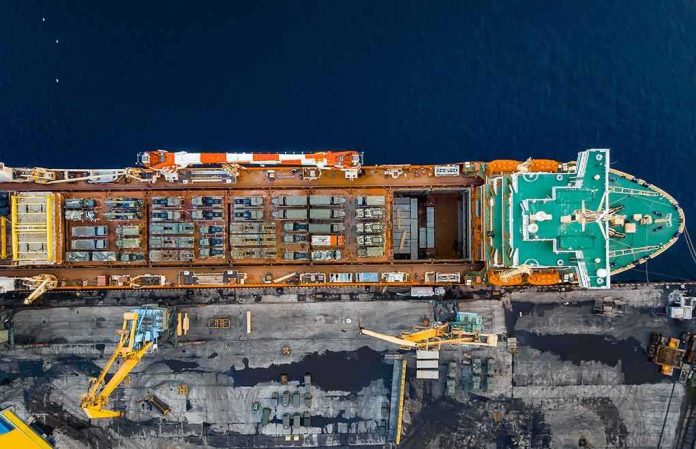
Industrial scale—not a single ship design or budget line—now sets the terms of maritime power, and China’s dominance in global shipbuilding means the United States cannot close the gap alone; only a purposeful division of labor with capable allies can matter at the speed strategy requires.
The Short Version
- China’s shipyards command extraordinary aggregate throughput; U.S. defense and congressional materials treat the disparity as strategically relevant, even while cautioning against simplistic, one-number comparisons.
- Commercial tonnage is not the same as warship complexity, but the scale behind China’s industry underwrites naval production, repair, and sustainment in ways the U.S. cannot match today.
- U.S. submarine and surface-ship output is below plan, with backlogs and workforce constraints; the Navy’s own production targets have gone unmet in recent years.
- An allied counterweight—structured, financed, and tasked against specific classes and timelines—can realistically augment U.S.-available capacity; credible proposals already outline coalition options.
What “capacity” really means—and why the distinction matters
The headline comparison that ignited debate—a roughly 230:1 capacity ratio between Chinese and U.S. shipyards—originated from an Office of Naval Intelligence slide that compiled public sources to illustrate strategic industrial trends. The figure captures the vast difference in gross shipyard throughput, not a clean measure of how many complex, combat-ready hulls each side can field in a year. That nuance is not a technicality; warships concentrate propulsion, sensors, weapons, and software integration in ways a bulk carrier does not. The Congressional Research Service has been explicit on this point, warning that the tonnage ratio largely reflects commercial cargo vessels, and that combat-system integration is a separate, harder frontier. Still, the trend-line message endures: China’s industrial base is operating at a scale the United States cannot match domestically under current conditions, and that scale shapes naval options.
Capacity debates often dissolve into ratio contests. That is a mistake. The strategic question is practical: can the United States and its partners generate, sustain, and repair enough hulls—crew, supply, and upgrade them—on timelines relevant to deterrence and war? On that question, the U.S. Navy’s own production struggles, particularly in submarines, show a mismatch between ambition and throughput.
How we got here: the split between commercial scale and naval specialization
Over decades, the United States allowed commercial shipbuilding to migrate offshore while consolidating its remaining yards around naval work. Analysts who study the maritime industrial base describe this not as an accidental “loss” but as a policy and market choice: American yards became, in effect, a one-customer industry serving the Navy, while foreign—eventually Chinese—yards scaled up in the commercial market. That choice compounded over time. China built a vertically integrated maritime ecosystem—yards, component suppliers, financing, and logistics—that let commercial scale reinforce naval capability. U.S. yards, focused on complex combatants, retained extraordinary craftsmanship but shed the broad industrial depth that permits surge and redundancy. This is why the ONI slide’s blunt ratio punches above its methodological weight: it signals the industrial flank of maritime power, not merely a statistic.
Congress and naval planners increasingly treat the industrial base as a central variable in fleet design, not an afterthought. Recent Navy force-structure discussions tie China’s growing fleet to its magnitudes-larger industrial engine and flag the U.S. capacity shortfall as a strategic constraint on options and timelines.
Today’s bottlenecks: submarines, backlogs, and a thin merchant marine
Submarine production illustrates the problem in relief. The Virginia-class program has averaged roughly 1.2 boats per year since 2022—well below the two-per-year objective—and a backlog of funded but unfinished submarines has grown. That delta matters operationally in the Indo-Pacific and strains the parallel demands of allied commitments such as AUKUS. In surface combatants and auxiliaries, program slips, supplier fragility, and workforce churn compound schedule risk. These are not abstract procurement dilemmas; they limit how quickly the Navy can recover from losses, rotate ships for maintenance, or surge presence in a crisis.
Commercial capacity shortfalls also show up in logistics. U.S.-flagged merchant shipping carries a tiny fraction of America’s trade, and the country ranks far down the league table by tonnage—an industrial reality that translates into operational exposure in any protracted contingency requiring sealift, repair, and replenishment. Multiple analyses describe China as dominating global shipbuilding and shipping; that commercial dominance is not equivalent to naval power, but it is the scaffolding that supports it.
Why an allied counterweight is not symbolic
Calls for a multinational shipbuilding coalition are not a rhetorical flourish. They emerge from a basic arithmetic: no plausible near-term U.S. investment can replicate decades of commercial scaling achieved by China. Center for a New American Security analysts have outlined coalition constructs that deliberately allocate work—new builds, modules, auxiliaries, repairs, and conversions—across South Korean, Japanese, European, and U.S. yards, with security and export controls architected in from the start. Properly designed, such a coalition could augment U.S.-available capacity for specific mission sets and timelines, rather than simply admiring the problem.
Crucially, the coalition concept is not a panacea; it is a tool. A serious plan blends near-term allied construction and maintenance with sustained U.S. yard modernization, workforce pipelines, and supplier reconstitution. The coalition handles speed; domestic investments handle staying power. Framed this way, allied capacity becomes a bridge that buys time for U.S. rebuilding without leaving near-term gaps in hulls, spares, and repair windows.
A second suspected Chinese uncrewed underwater vehicle (UUV) mothership has emerged in Guangzhou, built by China State Shipbuilding Corporation subsidiary GSI.
The vessel is about a third smaller than the first ship spotted in Shanghai, featuring 6 lift towers instead of 12,… pic.twitter.com/2lnnrIZbEB
— Zubiqo (@zubiqo) October 18, 2026
Designing a coalition that actually moves steel
Strategy means specificity. A viable coalition framework would make a handful of concrete decisions up front. First, define classes and outputs: which auxiliaries, patrol vessels, logistics ships, or frigate variants can allies produce to U.S. standards on a five- to ten-year clock? Second, modularize intelligently: subassemblies and mission systems can be coproduced abroad, then integrated in U.S. yards to preserve sensitive combat systems while exploiting allied steelwork prowess. Third, lock in maintenance and repair capacity overseas—dry dock slots, parts pipelines, and certified work packages—so ships forward-deployed in the Indo-Pacific can turn quickly without sailing home. Fourth, finance at program scale, not year-to-year discretion, to let yards hire and train to stable demand. This is not speculative; the menu of pathways—overseas construction, modular coproduction, allied maintenance—has already been mapped by reputable analysis.
Governance matters as much as tonnage. Technology security, export-control harmonization, data rights for digital twins, and sovereign workshare rules must be negotiated once, then embedded contractually to avoid case-by-case friction. The payoff for getting the plumbing right is measured in cycle times and delivered hulls, not communiqués.
Answering the fair objections
Three critiques deserve a straight answer. First, “commercial tonnage isn’t combatant output.” Correct—and irrelevant to the core claim. The coalition thesis does not mistake a bulk carrier for a destroyer; it asserts that a larger commercial base accelerates what truly matters: modules, auxiliaries, repairs, and the industrial learning that shortens schedules for complex ships. The CRS caution stands; the strategic conclusion still follows.
Second, “the United States chose specialization; it can choose differently.” Also correct. But undoing three decades of industrial migration is a generational project. Deterrence timelines are measured in years, not decades, hence the need for allied bridging capacity while the United States rebuilds.
Third, “coalitions are complicated.” Yes. That is why the right model is hybrid: commit to allied output for near-term speed while capitalizing U.S. yard modernization and workforce development to regain depth. Done this way, allied help is a force multiplier, not a crutch.
What success looks like over the next decade
Measure outcomes, not announcements. A credible path would show, within five years, allied-built logistics and auxiliary hulls delivering to U.S. standards; modular frigate sections arriving for final integration in U.S. yards; forward repair capacity in allied dry docks cutting maintenance availabilities; and U.S. submarine output climbing toward plan as supplier bottlenecks ease. Within ten years, U.S. yards should show higher labor productivity, stabilized supplier bases, and shorter design-to-build cycles on surface combatants—while coalition yards continue to handle volume work that preserves U.S. capacity for the highest-end tasks. Throughout, Congress will expect proof that dollars buy days off schedules and hulls in the water; the Navy’s own reporting on submarine output and program slippage has set the baseline to beat.
Sources:
19fortyfive.com, asiatimes.com, eir.news, andrewerickson.com, firstbranch.ai, gcaptain.com