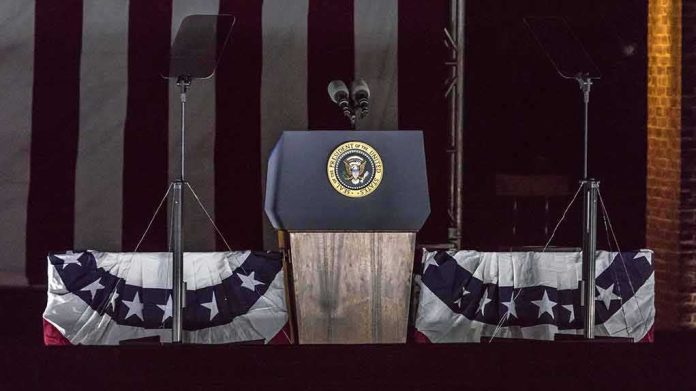
When a sitting American president stands before Mount Rushmore and declares communism a greater threat to the nation than Pearl Harbor, World War II, and the September 11 attacks combined, the claim demands scrutiny on two levels simultaneously: what he actually said, and whether the evidence supports the characterization.
Key Points
- Trump’s Mount Rushmore speech on July 3, 2026 named communism the single greatest threat in American history — surpassing every major war and terrorist attack.
- The rhetorical move is part of a 90-year Republican tradition of linking Democratic opponents to socialism or communism, particularly effective with certain immigrant communities.
- No sitting member of the U.S. House or Senate belongs to the Communist Party USA; the equation of progressive Democrats with communism is not supported by verifiable evidence.
- Trump’s specific claims — that progressive Democrats are “hardcore, godless communists” and that communism has killed 100 million people — rest on rhetoric rather than documented fact.
- The speech nonetheless reflects genuine anxieties about ideological drift in American politics, and the political effectiveness of the framing has real historical precedent.
What Trump Actually Said at Mount Rushmore
The speech itself was striking in its scope and certainty. Standing before the granite faces of Washington, Jefferson, Lincoln, and Roosevelt on the eve of America’s 250th anniversary, Trump declared: “Communism is a mortal threat to American liberty… It is the greatest threat to our country, including World War I, World War II, Pearl Harbor or even 9/11.” He characterized communism as “death, tyranny, and the pursuit of evil,” called it “godless,” and framed its opposition to religion and traditional American values as a defining moral fault line. He cited a figure of 100 million deaths in the last century as evidence of the ideology’s destructive capacity.
The speech went further than condemnation. Trump vowed to “vanquish communism quickly,” dismissed its proponents as “thieves, radicals, and lunatics,” and promised to “send them into exile.” He drew a stark binary: “You can be loyal to Karl Marx, or you can be loyal to America. You can be a communist, or you can be a patriot. You cannot be both.” He also linked the Communist Party to “illegal immigrants, criminals, and everybody that doesn’t want to work” — a rhetorical cluster that conflated ideological opposition with social deviance. These are documented statements from primary-source transcripts and White House video; that part of the record is not in dispute.
Where the Evidence Holds and Where It Breaks Down
Some of Trump’s underlying concerns have legitimate grounding. Communism as a system of governance has produced catastrophic human suffering — the scholarly literature on deaths attributable to Soviet collectivization, Maoist land reform, and Khmer Rouge policies is extensive, and figures in the range of tens of millions are well-documented in serious historiography. The Black Book of Communism, a widely cited academic study, put the 20th-century death toll from communist regimes at approximately 94 million — close to Trump’s cited figure, though the precise 100 million number was not sourced to any specific study in the speech itself. The concern about ideological influence in American institutions is also not invented from nothing; it is a recurring subject of serious debate among political scientists and national security analysts.
But the specific claim that progressive Democrats are “hardcore, godless communists” — the claim that gives the speech its prosecutorial edge — is unsupported by verifiable evidence. No sitting member of the U.S. House or Senate belongs to the Communist Party USA. Ballotpedia’s verified roster of current congressional members lists no Communist Party affiliations. The most prominent prior attempt to make this charge stick — Rep. Allen West’s 2012 assertion that “78 to 81” House Democrats were Communist Party members — collapsed immediately: West admitted he had merely “heard” the number and declined to name a single individual. Democratic Socialism, the ideological home of figures like Bernie Sanders, is a reformist tradition operating entirely within democratic electoral systems; it does not advocate the abolition of private property, one-party rule, or revolutionary seizure of the state — the definitional features that distinguish communism from social democracy.
A 90-Year Rhetorical Tradition
The historical context is essential to understanding why this framing persists despite its evidentiary weakness. Republicans have been tying Democrats to socialism and communism for roughly nine decades — a tradition documented in detail by political historians. The strategy accelerated after the New Deal, intensified during the Cold War, and has been periodically revived whenever the political landscape offered an opening. Trump has deployed “Marxist” and “communist” as epithets against Democratic opponents since his earliest political appearances, and the language has migrated steadily into mainstream Republican rhetoric.
The tactic has demonstrable political effectiveness in specific communities. In Miami-Dade County, Trump’s socialism rhetoric found a deeply receptive audience among Cuban American and Venezuelan American voters — communities with lived experience of authoritarian leftist governments — and contributed measurably to his overperformance there in 2020. That effectiveness is not evidence of factual accuracy; it is evidence that the framing resonates with genuine fears rooted in real historical trauma. The distinction matters. A political argument can be simultaneously emotionally true for its audience and empirically unsupported as a description of the opposing party’s actual ideology.
President Trump stood before Mount Rushmore on July 3, 2026, and declared communism a bigger threat to America than World War II, Pearl Harbor, and 9/11 combined — kicking off the country’s 250th birthday with a speech that had the crowd chanting “USA.” Trump delivered his… pic.twitter.com/MGTzNBNgbd
— joe t (@jtinaglia) July 8, 2026
The Conflation Problem and Why It Matters
The intellectual error at the center of Trump’s framing — one that his critics on the left often mirror in reverse — is the conflation of a policy direction with a totalitarian endpoint. Democratic Socialism, as practiced in Scandinavia and advocated by the American left’s insurgent wing, operates through elections, tolerates private property, and accepts the peaceful transfer of power. Communism, in its historical instantiations, abolished all three. Treating these as equivalent is not a matter of rhetorical emphasis; it is a categorical error with real consequences for political discourse. When every expansion of the welfare state becomes “communism,” the word loses its analytical precision — and with it, the capacity to identify and respond to actual authoritarian ideological threats, whether from the left or the right.
Former President Bill Clinton publicly characterized Trump’s Mount Rushmore framing as “strategic escalation” and “election engineering” rather than a genuine national security assessment — a critique that carries some weight precisely because it focuses on the motive structure rather than disputing the general concern about communism’s historical record. That the framing serves electoral purposes does not make it dishonest in its entirety; politicians routinely use genuine concerns as rhetorical leverage. But it does mean the framing should be read as a political document first and a security analysis second.
What the Evidence Actually Supports
A fair accounting of the evidence yields a more nuanced picture than either Trump’s speech or his harshest critics allow. Communism as an ideology has an undeniable and catastrophic historical record. The anxiety about ideological radicalization within American institutions — universities, media, certain corners of the Democratic Party’s activist base — is a legitimate subject of debate, not a paranoid fantasy. Some Democratic primary victories by self-described democratic socialists, including Zohran Mamdani’s New York City mayoral run and Melat Kiros’s congressional primary win in Colorado, do represent a genuine leftward shift in parts of the party.
What the evidence does not support is the leap from those facts to the claim that sitting Democratic members of Congress are communists, that progressive Democrats seek the abolition of private property or one-party rule, or that the ideological threat from the American left is comparable in scale or imminence to Pearl Harbor or 9/11. Those claims are rhetorical escalations without evidentiary foundation. The speech at Mount Rushmore was a political performance of considerable force — and a factual argument of considerable weakness. Both things are true, and understanding why requires holding them in tension rather than collapsing into either uncritical acceptance or reflexive dismissal.
Sources:
assets.newsweek.com, npr.org, whitehouse.gov, kunm.org, ballotpedia.org, apnews.com, facebook.com, jstor.org, washingtonpost.com