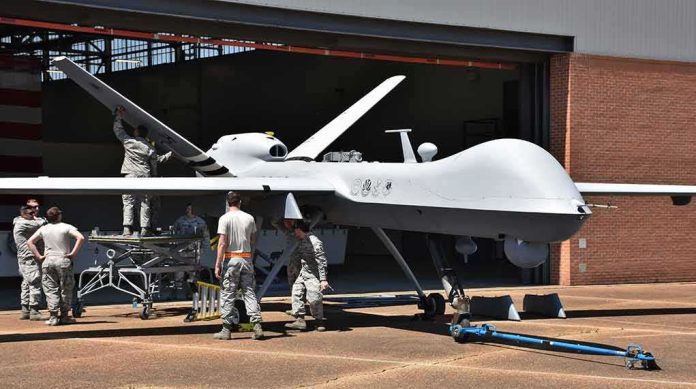
Wars are measured in more than territory and timelines; they are counted in inventories. In Operation Epic Fury, the United States has absorbed a material toll that is specific, itemized, and operationally consequential: at least 81 U.S. aircraft—crewed and uncrewed—were reported lost or damaged, a replacement bill the Congressional Budget Office (CBO) pegs as high as $3.3 billion depending on what is actually bought to backfill the fleet.
The Short Version
- Congress’s research arm cataloged 81 U.S. aircraft lost or damaged during operations against Iran since late February, across fighters, tankers, ISR aircraft, helicopters, and drones.
- CBO estimated the replacement cost of war losses at $1.9–$3.3 billion, a range driven by whether DoD replaces like-for-like or with currently available platforms.
- The Pentagon Inspector General separately documented “dozens” of aircraft hit, corroborating substantial airframe damage and losses in the same period.
- Named platforms in public summaries include F-15Es, an F-35A, A-10s, KC-135s, an E-3 Sentry, MQ-9 Reapers, and other UAS—evidence of a widespread cross-fleet impact.
What the records actually say: a concrete, cross-validated loss picture
The center of gravity is a Congressional Research Service (CRS) product—CRS is nonpartisan, written for lawmakers—that aggregates official statements, watchdog findings, and credible reporting into an itemized table of 81 fixed- and rotary-wing aircraft, including uncrewed systems, “reportedly lost or damaged” during U.S. operations against Iran beginning February 28. The figure is not a headline flourish; it is built as a list of discrete aircraft and categories across services and missions. That list aligns with contemporaneous accounts that named specific platforms—from F-15E Strike Eagles and an F-35A to A-10s, KC-135 tankers, an E-3 Sentry, and MQ-9 Reapers—indicating the burden is not confined to expendable drones or peripheral fleets.
A separate lane of official oversight corroborates the pattern. The Department of Defense Inspector General (DoD IG) reported substantial airframe damage and destruction in the same window, enumerating losses and hits to major fleet elements—fighters, tankers, and intelligence/surveillance aircraft—while documenting broader war costs and readiness frictions. Multiple mainstream outlets independently drew on the IG’s release to report “dozens” of affected aircraft, which converges with the CRS total as later synthesis rather than contradiction.
Cost mechanics: why the same losses price out differently
Counting airframes is only half the ledger; how you price them matters. CRS cites a CBO estimate that replacement of equipment losses as of August 1 could run from $1.9 billion—if DoD only replaces items it already planned to backfill—to $3.3 billion when substituting with what is available to buy now. That spread is not creative accounting; it reflects procurement reality. A retired KC-135 mission loss priced at the marginal cost of accelerating a planned KC-46 buy is a different number than acquiring an additional airframe outside of the plan. Likewise, replacing a destroyed MQ-9 with a current-configuration Reaper—or with a next-in-line UAS—carries distinct unit costs, support packages, and lead times.
For readers accustomed to neat “program cost” figures, this can feel slippery. It isn’t. Defense economists have long modeled fleet sustainment as a function of timing, configuration, and industrial base capacity—one reason CBO’s broader aviation analyses show replacement bills rising and falling over decades as programs transition and lines open or close. In short: the $3.3 billion is a plausible upper bound under present-market substitutions; the $1.9 billion reflects a narrower, plans-based replenishment. Both are valid views of the same events, framed for different budgeting choices.
What “lost or damaged” means in a war zone, and why definitions matter
Militaries slice aircraft outcomes along several axes: physical damage, functional damage (the mission capability hit), and system-level effect; they then record whether a platform is a total loss, economically repairable, or temporarily mission-killed pending depot work. Those categories are standard across U.S. doctrine and battle damage assessment practice and drive how events are logged, how long airframes are out of action, and what funding lines pay to restore the capability.
The CRS phrasing—“lost or damaged”—intentionally nests that full spectrum. Some entries on the 81-aircraft roll-up will have been total write-offs; others likely returned to service after repair. From an operational perspective, both outcomes matter. A mission-kill that grounds a tanker wing during a critical surge window can ripple through strike packages just as decisively as a hull-loss, even if the jet flies again six months later. From a budget perspective, the distinction affects whether CBO books a replacement or a repair line—but the headline story remains: the fleet absorbed significant combat attrition across multiple mission sets.
Which fleets were hit, and why that mix is strategically important
The public summaries of the CRS and watchdog material emphasize a cross-section that reads like a miniature order of battle: fourth- and fifth-generation fighters (F-15E, F-35A), close air support (A-10), airborne early warning and control (E-3 Sentry), aerial refueling (KC-135), attack and utility helicopters, and medium- and high-altitude UAS such as MQ-9 and MQ-4C. Each carries asymmetric value. Tankers are connective tissue for every long-range sortie; AWACS extends radar horizons and air battle management; Reapers provide persistent ISR and strike at cost points that make them workhorses. Damage across that mix signals a campaign that stressed U.S. air operations at multiple layers—base defense, en-route survivability, and on-station persistence—rather than a narrow problem confined to one vulnerable platform class.
That pattern also tracks with the operational setting. Epic Fury unfolded under sustained missile, drone, and rocket pressure against regional bases, forcing aircraft to operate from exposed ramps and predictable launch corridors. DoD IG reporting on base damage and aircraft hits—paired with routine press imagery of sandbagged revetments and ad hoc dispersal—reflects a theater where adversary stand-off fires reached the flight line with some regularity.
https://twitter.com/PresstvExtra/status/2107625489460572381
How this shapes readiness, procurement, and basing practice
Material loss is only the first-order effect. Second-order consequences land in readiness metrics and industrial schedules. Dozens of damaged aircraft translate into maintenance backlogs, parts cannibalization, and depot queues—hidden costs that do not show up as “replacement” but erode sortie-generation capacity for months. When the affected fleets include tankers and AWACS, even modest attrition strains campaign tempo disproportionally, because those low-density, high-demand assets lack slack inventory and require specialized crews and support.
Procurement planners face a different bind. Replacing uncrewed systems can be fast if lines are hot and configurations stable; replacing legacy tankers or surveillance aircraft embedded in transition plans forces trade-offs among modernization, recapitalization, and immediate operational need. CBO’s range captures that policy dilemma cleanly: whether to accept capability gaps while repairing and modernizing, or to buy additional near-term inventory at the cost of long-term program coherence.
What to watch next
Three indicators will reveal how deep the scar tissue runs. First, fleet availability rates across tankers, ISR platforms, and Reapers—if mission capable percentages lag for consecutive quarters, the repair burden is biting. Second, budget reprogramming actions and supplementals—if Congress moves funds into aircraft procurement or depot maintenance mid-year, planners are privileging replacement or accelerated repairs. Third, basing hardening and dispersal—more shelters, rapid ramp protection, and distributed operating locations would signal a doctrinal response to stand-off fires rather than a one-off patch.
Bottom line
The record is clear and consistent across credible channels: U.S. airpower absorbed meaningful combat attrition in the Iran war, with at least 81 aircraft reported lost or damaged and a replacement cost envelope between $1.9 and $3.3 billion, depending on policy choices. Arguing over exact counts misses the strategic point. The inventory has been blooded across the very fleets that underwrite modern joint operations—refueling, airborne command and control, persistent ISR, and tactical strike. Recovering that capacity is not just a matter of money; it is a matter of time, industrial throughput, and smarter protection for the next fight.
Sources:
nypost.com, aerotime.aero, bostonglobe.com, nbcnews.com, timesofindia.indiatimes.com, ground.news, x.com, migflug.com