
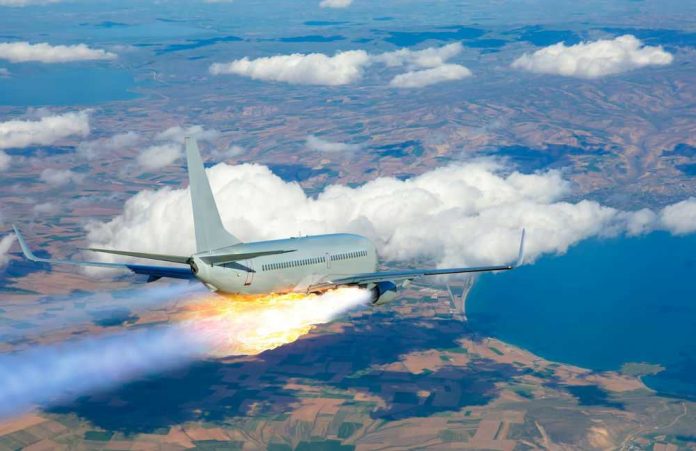
An oil rig worker standing on a platform off the Vietnamese coast watched flames streak across the night sky on March 8, 2014, documented what he saw in a formal email to his employers, and then watched investigators search for Malaysia Airlines Flight MH370 in the wrong ocean for over a decade.
Story Snapshot
- Mike McKay witnessed what he believes was MH370 engulfed in flames over the South China Sea, providing specific compass bearings and timing details in an official report to his employer
- The search eventually shifted to the Indian Ocean, 1,200 miles off Perth, Australia, contradicting McKay’s South China Sea sighting location
- McKay’s email was leaked publicly, leading him to feel discredited despite his professional credibility and technical specificity
- Ocean Infinity resumed search operations in December 2025, over 11 years after the Boeing 777 vanished with 239 people aboard
- The case remains aviation’s greatest unsolved mystery, with no confirmed wreckage discovered despite extensive deep-ocean search efforts
The Witness Nobody Wanted to Hear
Mike McKay stepped outside the Songa Mercur oil platform for a cigarette break on the night of March 8, 2014. The New Zealand oil rig worker stationed off Vietnam’s coast saw something that should have redirected the entire MH370 investigation. Flames burned at high altitude, visible for 10 to 15 seconds, tracking along compass bearings between 265 and 275 degrees. McKay did not rush to social media or call reporters. He documented his observations in a formal email to his employers, providing technical details that demonstrated professional observation rather than sensational speculation.
When the Search Went the Wrong Direction
Initial search efforts concentrated on the South China Sea near Vietnam, exactly where McKay reported his sighting. Then something shifted. The search moved away from the South China Sea entirely, eventually focusing on the Indian Ocean approximately 1,200 miles off the coast of Perth, Australia. McKay attempted to contact Malaysian and Vietnamese officials about his observations in the days following March 8. His email subsequently leaked to the public. Rather than receiving serious investigative attention, McKay reports feeling discredited, his detailed account sidelined as the search moved thousands of miles from where he watched flames burn across the night sky.
The Boeing 777 departed Kuala Lumpur International Airport bound for Beijing with 227 passengers and 12 crew members. Approximately one hour after takeoff, the aircraft deviated sharply westward from its planned course, heading out over the Andaman Sea before vanishing from all radar systems. This represented the beginning of aviation history’s biggest unsolved mystery, now stretching across nearly 4,300 days without definitive answers. The aircraft’s deviation and complete communication system loss suggest either deliberate human intervention or catastrophic technical failure, but the lack of wreckage discovery prevents conclusive determination.
The Credibility Problem with Inconvenient Witnesses
McKay possessed no apparent motive to fabricate his account. He was not seeking media attention or financial gain. His immediate documentation through official employer channels rather than public forums supports genuine observation. The technical specificity of his report, including precise compass bearings, altitude observations, and timing duration, distinguishes his account from vague speculation. Yet when his testimony contradicted the eventual search trajectory, his credibility suffered rather than prompting serious investigation into why the search direction changed so dramatically from his reported sighting location.
This raises uncomfortable questions about how large-scale investigations handle eyewitness testimony that does not fit evolving official narratives. McKay has continued questioning the investigation’s direction and methodology over subsequent years, his persistence suggesting genuine conviction rather than attention-seeking behavior. The discrepancy between his South China Sea observation and the Indian Ocean search focus represents a significant unresolved question that investigators have never adequately explained to the public or to the families of 239 victims still seeking answers.
The Search That Never Ends
Ocean Infinity abruptly halted search efforts in April 2025. Malaysia’s Transport Minister Anthony Loke indicated plans to resume searching at year’s end. On December 31, 2025, a new search operation officially commenced, representing renewed governmental commitment after years of limited activity. The Armada 8605 vessel, equipped with two underwater drones, reached its designated search area and began operations with Malaysia approving an intermittent 55-day search window. The 2026 search employed wider search strips than previous operations, raising questions about search efficiency and coverage patterns among observers analyzing the methodology.
Early February 2026 brought operational challenges. The Armada 8605 paused operations after encountering rough seas, returning to Fremantle for port operations. However, the search continued through additional phases rather than concluding entirely, demonstrating the multi-phase nature of deep-ocean aircraft recovery operations. As of early 2026, no public breakthroughs or confirmed wreckage discoveries have been announced. The search pattern itself has generated analytical interest, suggesting the methodology may contain strategic elements not immediately apparent in public reporting, possibly representing intentional first-phase filtering requiring subsequent verification rather than inefficiency.
What Air France Flight 447 Teaches About Ocean Searches
Deep-ocean aircraft recovery requires sustained, methodical investigation across multiple phases. Air France Flight 447, an Airbus A330 that vanished on a flight from Rio de Janeiro to Paris, eventually yielded wreckage in the Atlantic Ocean only after extensive operations. Investigators conducted initial sonar runs to establish broad search areas, followed by close-range sonar verification, and finally optical imaging with cameras to confirm findings before recovery of critical components like flight recorders. This precedent demonstrates why the MH370 search continues across multiple phases, with wider initial strips potentially representing strategic filtering approaches rather than compromised coverage.
The prolonged MH370 investigation has advanced underwater robotics and sonar technology development while influencing future deep-ocean aircraft recovery protocols. The incident drove development of improved real-time aircraft monitoring systems and prompted international aviation bodies to implement enhanced communication and tracking requirements for commercial aircraft. These technological and regulatory responses represent the investigation’s practical legacy, even as the mystery itself remains unsolved. Victim families continue seeking closure after over 11 years of uncertainty, their moral authority sustaining public pressure for continued search efforts despite operational challenges and enormous costs.
The Unanswered Question That Haunts the Investigation
Mike McKay saw something burn across the night sky over the South China Sea on March 8, 2014. He documented it professionally and immediately. Investigators searched the South China Sea initially, then redirected their efforts to the Indian Ocean thousands of miles away. No credible public explanation has addressed this fundamental discrepancy. Did McKay witness MH370’s final moments, or did he observe a separate aircraft while MH370 flew in an entirely different direction? The investigation’s failure to adequately address this question represents either investigative incompetence or a deliberate decision to discount eyewitness testimony that contradicted emerging technical analysis.
Sources:
Oil Rig Worker Claims to Have Seen Missing Flight MH370 Engulfed in Flames – Motor Biscuit
MH370 Search Update: Malaysia Airlines Government Investigation – UNILAD