While Washington argues over talking points, Moscow just declared a battlefield victory next door—and the facts on the ground remain murky enough to let propaganda flourish on both sides.
Story Snapshot
- Russia’s top general told President Vladimir Putin that the last settlement in the Kursk region, Gornal, was “liberated,” and Putin claimed all of Kursk was retaken [3][1].
- Ukraine’s General Staff and President Volodymyr Zelenskyy said operations continue in Kursk and that Ukrainian units still hold positions [1].
- Russian statements credited North Korean soldiers with helping push Ukrainian forces out of the region [2][3].
- Independent mapping or satellite confirmation of full Russian control has not surfaced; major outlets describe the claims as disputed [1][4].
Competing Claims About Control of the Kursk Region
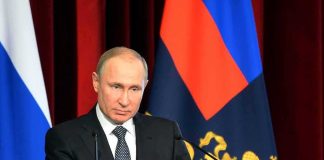
Russian Chief of the General Staff Valery Gerasimov told President Vladimir Putin that the village of Gornal, described as the last settlement in the Kursk region under Ukrainian control, was “liberated,” and Putin said Russian forces had retaken the entire region [3][1]. Ukraine’s General Staff immediately disputed that assertion, saying operations in “certain areas” of the Kursk region continue and calling the announcement a propaganda ploy [1]. The dueling claims underline an information war accompanying real fighting.
President Volodymyr Zelenskyy reinforced Kyiv’s denial in an evening address, stating that Ukrainian forces “continue to operate in the Kursk and Belgorod regions” and maintain a presence inside Russia [1]. The Associated Press likewise reported that Ukraine says it is still fighting in the area despite Moscow’s declaration of success [4]. Without independent confirmation, the result is a narrative stalemate: Russia touts a clean victory; Ukraine insists the battlefield remains active and contested.
Verification Gaps And Why They Matter
Major Western outlets noted the absence of independent verification or third-party mapping to confirm full Russian control of the region following Moscow’s announcement [1][4]. Analysts and observers often rely on satellite imagery, geolocated video, or reputable battlefield maps to validate such claims, and those products can lag fast-moving events by days. That lag enables governments to define “victory” before facts are verified, fueling cynicism among Americans who already believe officials spin reality to suit political needs.
Gerasimov’s statement singled out Gornal as the final settlement retaken, but Ukrainian officials did not provide specific geospatial counter-evidence, instead offering broader assertions of continued operations [3][1]. This asymmetry—precise naming from Russia, general denial from Ukraine—does not prove either side correct; it shows how selectively presented details can shape perception. For citizens trying to separate fact from theater, the lack of transparent, verifiable data remains the core problem.
Foreign Fighters And Expanding Stakes
Russian briefings credited North Korean soldiers with assisting in pushing Ukrainian forces out of the Kursk region, a claim repeated in broadcast segments covering Moscow’s announcement [2][3]. If accurate, that participation signals deeper internationalization of the conflict, raising questions about where the limits of involvement lie and how quickly a border fight can widen. For Americans worried about drawn-out wars and mission creep, the suggestion of North Korean ground support near Russia’s frontier is a flashing red light.
The Kremlin framed the purported victory as creating “conditions for further successes” along the frontline, implying momentum for future operations beyond Kursk [3]. Ukraine’s leadership rejected that framing, asserting that their continued presence undercuts any claim of decisive Russian control [1]. This tension—Moscow projecting inevitability, Kyiv stressing resilience—sets expectations for the next phase and keeps pressure on outside backers to keep money, weapons, and political capital flowing.
Costs, Consequences, And The Public’s Patience
Reporting on the Kursk fight highlighted significant human and economic costs inside Russia stemming from the months-long incursion and counteroffensive, including displacement and infrastructure damage, complicating the narrative of a clean strategic win [1]. Those burdens, along with allegations of local government failures, have surfaced alongside battlefield claims, reinforcing a broader concern shared by many Americans: leaders sell victories while ordinary people pay the price.
"Around 14,000 servicemen from Pyongyang have been dispatched to fight for Russia in its Kursk region, with 6,000 of them believed to have been killed."
— Georgeanne Matranga ☮️🟧 (@DTPORGE) May 10, 2026
For readers in the United States, the bigger takeaway is not just who holds which village this week. It is the pattern. Governments worldwide rush to declare success while independent confirmation lags; media ecosystems amplify the side they trust; and citizens are left sorting spin from substance. Until reliable mapping and imagery verify control of every settlement in Kursk, skepticism is warranted—and so is vigilance about how quickly contested claims become policy talking points at home.
Sources:
[1] Ukraine denies Putin’s claim that Russian forces regained Kursk
[2] Russia claims it has regained full control of Kursk from Ukraine
[3] Ukrainian troops forced out of Kursk region, Russia claims – CBS News
[4] Russia says it has fully reclaimed the Kursk region. Ukraine says it is …