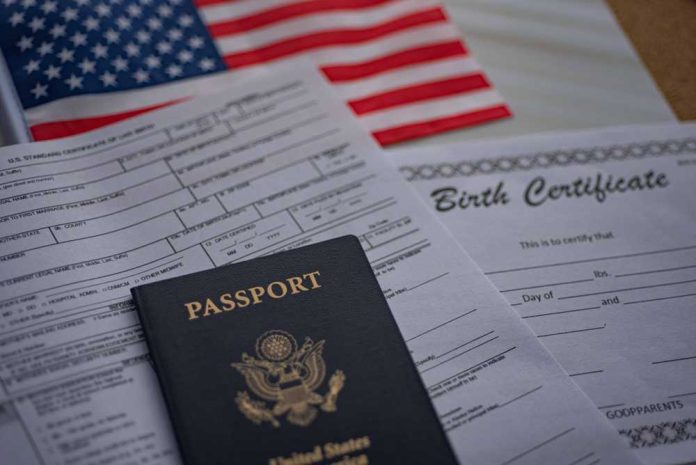
At the center of the current fight over birthright citizenship is not just a disputed reading of fourteen words in the Constitution, but a strategic gamble: Republican leaders have tethered themselves to President Trump’s executive order while doing remarkably little to prepare for the near‑probable event that the Supreme Court strikes it down.
Key Points
- President Trump’s Executive Order 14160 attempts to end birthright citizenship for children of undocumented immigrants and many temporary visitors, in tension with more than a century of law and practice.[3][6]
- Senate Republicans have introduced the Birthright Citizenship Act of 2025 to mirror the order in statute, but it has not passed either chamber and cannot serve as an immediate fallback if the order is invalidated.[1][2]
- Every federal court to consider the order has blocked it, and oral argument at the Supreme Court suggests a strong likelihood that the justices will rule against Trump’s position.[3]
- For now, there is no detailed, enacted GOP Plan B; their strategy leans on continued litigation, a long‑shot statutory fix, and a contested re‑reading of the 14th Amendment’s phrase “subject to the jurisdiction thereof.”[1][3]
What Trump’s executive order actually does
Executive Order 14160, titled “Protecting the Meaning and Value of American Citizenship,” was signed on January 20, 2025, the first day of Donald Trump’s second term.[6] It directs federal agencies to deny automatic U.S. citizenship at birth to children born in the United States to parents who are either unlawfully present or only lawfully present on a temporary basis, such as on student or work visas.[3][6] The order does not disturb citizenship for children whose parents are U.S. citizens or lawful permanent residents; instead, it redraws the boundary of who counts as “subject to the jurisdiction” of the United States under the 14th Amendment. In operational terms, the order goes further than a mere constitutional pronouncement. It tells agencies not to treat a birth certificate as sufficient proof of citizenship for certain categories of newborns and instructs them to adjust their document‑issuance practices accordingly.[3] It applies only prospectively to people born more than thirty days after its issuance, an explicit attempt to avoid retroactively stripping citizenship from those who already possess it.[6]
The legal problem is straightforward. Since 1898, in United States v. Wong Kim Ark, the Supreme Court has understood the Citizenship Clause to guarantee citizenship to nearly everyone born on U.S. soil, with narrow exceptions for children of foreign diplomats, enemy occupation forces, and similar categories.[3] The order attempts to carve out a new, much larger exception for the children of undocumented or temporary migrants, directly contradicting that settled reading. Civil‑rights groups and many constitutional scholars argue that a president cannot accomplish such a reversal by executive fiat; only a constitutional amendment, or a fundamental shift in Supreme Court doctrine, could lawfully narrow birthright citizenship on this scale.[3][4][5]
The Birthright Citizenship Act of 2025: a legislative mirror, not a backup
Recognizing the fragility of relying solely on an executive order, Republican senators moved in parallel on the legislative front. In January 2025, Senators Lindsey Graham, Ted Cruz, and Katie Britt introduced the Birthright Citizenship Act of 2025 (S. 304).[1] The bill would limit citizenship at birth to children with at least one parent who is a U.S. citizen or a lawful permanent resident, thereby excluding children of non‑immigrants (such as temporary visa holders) and those here unlawfully.[1][2] In substance, the bill is designed to codify the same policy the executive order attempts to impose by directive; Cruz has said explicitly that the legislation “codifies President Trump’s stance” and reflects what he sees as the original meaning of the Citizenship Clause.[1]
From a constitutional perspective, however, the bill faces the same core obstacle as the order. Congress cannot legislate around the 14th Amendment’s text; it can only legislate within it. If the Supreme Court reaffirms Wong Kim Ark and holds that the Amendment mandates birthright citizenship for almost everyone born here, then a statute denying citizenship to those children would be unconstitutional for exactly the same reason the executive order would be.[3] That is why, despite giving Republicans a talking point that they are “backing up” the president with legislation, S. 304 is not a true contingency plan. It is another vehicle to test the same theory in court, not an alternative that survives if the Court rejects that theory.
Equally important, S. 304 has not passed. The bill was introduced, publicized, and discussed in hearings, but it has neither cleared both chambers nor been signed into law.[1][2] In other words, even if Congress had the constitutional power to narrow birthright citizenship by statute—which existing precedent strongly denies—Republicans have not yet secured the votes to do it. If the Supreme Court strikes down EO 14160 in the coming decision, there will be no operative statute waiting in the wings to accomplish the same substantive change.
What the courts have already said
The judicial response to EO 14160 has been uniformly negative so far. Every federal court that has examined the order has blocked it, issuing injunctions that prevent it from taking effect while the litigation proceeds.[3] Those decisions have leaned heavily on Wong Kim Ark and on a century of administrative and statutory practice treating U.S.‑born children of noncitizens as citizens at birth.[3] By the time the Supreme Court heard oral argument in Trump v. Barbara on April 1, the picture was clear: lower courts saw the order as incompatible with the 14th Amendment and beyond presidential power.
Coverage of the arguments, including detailed summaries by legal reporters and advocacy groups, suggests that a majority of justices are skeptical of Trump’s position.[3] Questions from the bench pressed the administration’s lawyers on how their reading of “subject to the jurisdiction” could be squared with Wong Kim Ark, what limiting principle would prevent future erosions of citizenship, and how agencies would practically verify parents’ immigration status at the moment of birth.[2] One of the central practical complaints is administrative chaos: birth certificates have long functioned as the baseline proof of citizenship. If those documents no longer suffice for a substantial category of U.S.‑born people, agencies will face a morass of determinations that hospitals are neither staffed nor trained to make.[3]
Advocacy organizations opposing the order, including the Brennan Center for Justice, Asian Law Caucus, and ACLU, portray the legal question as almost straightforward: the 14th Amendment guarantees citizenship to children born in the United States, with narrow, historically recognized exceptions, and no president or ordinary statute can rewrite that rule.[3][4][5] They frame the case as a test of whether constitutional guarantees yield to presidential preference. Within that frame, EO 14160’s chances are slim; the Supreme Court does not lightly overturn long‑standing constitutional doctrine that countless people have relied on in structuring their lives and legal status.
This week from Seen, Heard & Whispered:
➡️ Republican senators apparently have no Plan B if the Supreme Court sides against President Trump’s order to end birthright citizenship this month.
➡️ GOP senators predicted this week that Blll Pulte, whom President Trump made acting…
— The Washington Times (@WashTimes) June 11, 2026
GOP strategy: originalist reinterpretation without contingency
So why have Republican senators not developed a more robust Plan B? Part of the answer lies in the legal theory they have embraced. Conservative scholars and institutions such as the Center for Immigration Studies argue that the prevailing understanding of the Citizenship Clause is historically mistaken. Drawing on the 1866 Civil Rights Act and debates in Congress at the time, they contend that “subject to the jurisdiction” meant full, undivided allegiance to the United States—not mere physical presence—and that Congress never intended to include the children of illegal entrants or transient visitors. In this view, Wong Kim Ark is either read narrowly, confined to a lawful permanent resident of Chinese nationality, or criticized as wrongly decided; the current Court is invited to revisit or sharply limit it.
Graham, Cruz, and their allies have chosen to put their weight behind this originalist reinterpretation, using both executive action and companion legislation as test vehicles. The political bet is that by aligning tightly with Trump’s order and presenting a unified theory of constitutional meaning, they may persuade at least five justices to narrow birthright citizenship without the impossible hurdle of a formal amendment.[1][6] From that perspective, devising a moderated Plan B—say, a narrower statute targeting specific abuses or focusing on administrative reforms—could be seen as undermining their core argument that the Constitution itself never guaranteed birthright citizenship to these children at all.
The result is a strategically all‑or‑nothing posture. If the Court accepts their theory, they achieve a generational shift in citizenship law. If it rejects it, there is no carefully groomed fallback that preserves some of their objectives while respecting the Court’s ruling. That is what observers mean when they say Senate Republicans have “no Plan B” if Trump loses this case.[1][3]
Why amending the Constitution is not on the table
One might ask why Republicans do not simply pursue a constitutional amendment to override Wong Kim Ark and make explicit their narrower definition of birthright citizenship. The answer is arithmetic as much as ideology. Amending the Constitution requires approval by two‑thirds of both the House and Senate and ratification by three‑quarters of state legislatures. In the current political environment, where public opinion polls show majority disapproval of Trump’s order and broad support for birthright citizenship as a principle, the chances of assembling that coalition are essentially nil. Even conservative legal advocates who oppose birthright citizenship acknowledge that an amendment campaign would be a long‑shot, multi‑decade project at best.
Given that reality, GOP lawmakers have chosen the more immediate path of executive and statutory re‑interpretation. But that path comes with its own risks. If the Court issues a clear, strong opinion reaffirming the broad reading of the Citizenship Clause, it will not only kill EO 14160; it will also narrow the space for future statutory experiments like S. 304 and make it easier for lower courts to strike similar efforts quickly. In attempting to win everything at once, Republicans may end up entrenching the very doctrine they hoped to dislodge.
The stakes for families and for constitutional governance
Behind the legal abstractions are real people and institutions. Civil‑rights organizations estimate that millions of children could be denied citizenship over the coming decades if EO 14160 or equivalent policies survive.[4] Those children would be born and raised in the United States, yet lack the security and rights that citizenship confers, risking the creation of a hereditary underclass of U.S.‑born noncitizens. Hospitals, schools, and state agencies would be dragged into disputes over immigration status that they are ill‑equipped to resolve. Families would confront the bewildering reality that siblings born in the same U.S. town could have different legal statuses solely because of their parents’ paperwork at the time of birth.
On the other side, advocates of restricting birthright citizenship point to what they see as incentives for unlawful migration and “birth tourism,” arguing that automatic citizenship for any child born on U.S. soil erodes the meaning of national membership and strains social‑service systems.[1] For them, the absence of a Plan B is not a bug but a feature: it underscores their conviction that the status quo is untenable and that only a decisive break—judicial or constitutional—will suffice.
What is clear, though, is that the governing party has chosen to stake an enormous policy shift on a fragile legal theory without building a realistic fallback. If the Supreme Court, as expected by many observers, rules against Trump’s order, Republican senators will emerge from this fight with their central objective thwarted, their flagship bill inert, and no ready alternative beyond returning to the amendment debate they have so far treated as a nonstarter.[3] For a question as foundational as who is an American at birth, that is a remarkably thin margin for error.
Sources:
[1] Web – GOP senators have no backup plan if Supreme Court kills Trump’s …
[2] Web – Graham, Cruz and Britt Introduce Bill to Restrict Birthright …
[3] Web – Birthright Citizenship Act of 2025: Bill Summary
[4] Web – Birthright Citizenship Under the U.S. Constitution
[5] Web – Know Your Rights: Trump’s Birthright Citizenship Executive Order
[6] Web – Trump’s Birthright Citizenship Executive Order: What Happens Next