
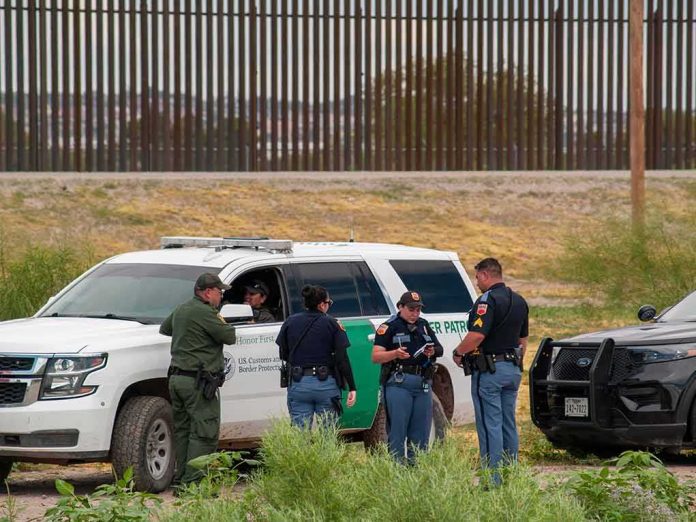
Walk up to a U.S. border crossing with a smartphone in your pocket, and you carry something no customs officer a generation ago could have imagined: a device holding years of private correspondence, medical records, financial details, location history, and photographs, all accessible to a federal agent without a warrant, without probable cause, and in most of the country without even reasonable suspicion. That gap between Fourth Amendment protections everywhere else in American life and the border’s much looser rules is now squarely in front of the Supreme Court, and how it resolves will determine whether digital privacy survives international travel.
Key Points
- Seven federal appeals courts hold that border agents may search a traveler’s phone without a warrant, probable cause, or suspicion of any kind; only the Fourth and Ninth Circuits require more in certain circumstances.
- CBP searched a record 55,318 electronic devices in fiscal year 2025, up 17.6 percent from 2024 and nearly a third higher than 2023, even though device searches still touch a tiny fraction of international travelers.
- The Supreme Court has asked the government to respond to Anibowei v. Blanche, a petition from a Dallas immigration attorney whose phone has been searched five times since 2016, raising the warrant question directly.
- Courts applying the border-search exception distinguish Riley v. California, the 2014 ruling requiring warrants for phone searches incident to arrest, by arguing border searches serve sovereignty interests rather than evidence-gathering during arrest.
- The strongest recent appellate rulings cover only manual searches; whether forensic extraction of a phone’s full contents requires suspicion remains legally unsettled.
The Legal Foundation: What the Border-Search Exception Actually Permits
The border-search exception is one of the oldest carve-outs in American search-and-seizure law, dating to the first Congress’s customs statutes and resting on a simple premise: a sovereign nation has inherent authority to inspect what and who crosses its threshold, authority broader than what police enjoy investigating crime on domestic soil. For two centuries that meant luggage, cargo holds, and pockets. CBP and the courts that have blessed its practices now extend the same logic to laptops and phones, treating a manual scroll through a device’s contents as the digital equivalent of unzipping a suitcase.
The U.S. Court of Appeals for the Seventh Circuit put the consensus plainly in a 2026 opinion, stating that a border search of a cell phone or other electronic device requires neither a warrant nor probable cause, and noting this tracked every other circuit that had addressed the question. CBP’s own published guidance distinguishes “basic” manual searches, which require no suspicion, from “advanced” forensic examinations using specialized tools, which the agency says require reasonable suspicion of a legal violation or a national-security concern and supervisory approval.
How We Got Here: From Suitcases to Smartphones
Device search volume tells its own story of institutional momentum. CBP reported roughly 8,500 electronic-device searches in fiscal year 2015; that climbed past 30,000 by 2017, reached 33,295 in 2018, and hit a record 55,318 in 2025. The agency maintains that fewer than 0.01 percent of arriving international travelers experience a device search in any given year, framing the practice as narrow despite its growth in absolute terms. Courts confronting this issue in the early 2000s mostly extended physical-search rules to early computers without much friction, but as storage capacity and the sheer intimacy of phone data exploded, that uniformity began to crack, producing the circuit split now before the justices.
The Circuit Split and the Case Testing It
Most recently, the Second Circuit’s September 2026 decisions in United States v. Aigbogun and a companion case upheld warrantless manual phone searches at JFK Airport, rejecting arguments that Riley’s warrant requirement should carry over from arrests to border crossings and dismissing First Amendment objections to scanning expressive material stored on a device. Judge Eunice Lee concurred in the outcome but dissented from the majority’s broader holding, warning it handed the government sweeping access to deeply personal digital information without meaningful safeguards. That internal disagreement within a single panel mirrors the national split: seven circuits require no suspicion at all, while the Fourth and Ninth require it in at least some circumstances.
The case the Supreme Court is weighing, Anibowei v. Blanche, centers on George Anibowei, a Dallas immigration lawyer whose phone has been searched five times since 2016 upon returning from international travel. The Constitutional Accountability Center and Pacific Legal Foundation have filed amicus support, with PLF attorney Amy Peikoff arguing that “Americans don’t surrender their Fourth Amendment rights at the border” and that a cellphone “holds the sum of a person’s private life.” The American Bar Association separately flagged that warrantless searches threaten attorney-client privilege for lawyers like Anibowei, since agents cannot easily distinguish privileged files from ordinary ones during a manual scroll.
Why Riley Looms Over Every Ruling
The government’s entire doctrinal defense depends on keeping Riley v. California boxed into its original context. That 2014 decision held police generally need a warrant to search an arrestee’s phone, reasoning that phones are qualitatively different from wallets or cigarette packs because they aggregate, as Chief Justice Roberts wrote, “the privacies of life.” Appellate courts upholding border searches insist Riley addressed a different exception, one concerned with officer safety and evidence destruction during an arrest, not the sovereign interest in controlling entry. That distinction is doctrinally coherent, but it does not answer the deeper question Riley raised: whether the sheer volume and intimacy of phone data changes the constitutional calculus regardless of which exception the government invokes. Privacy advocates, including the Electronic Frontier Foundation and the ACLU, argue it must, and a federal district court in United States v. Smith held in 2023 that a warrant is required absent exigent circumstances, the first ruling of its kind.
What the Evidence Doesn’t Show
Notably absent from the government’s public case is data demonstrating that warrantless phone searches actually produce results commensurate with their intrusiveness. CBP’s statistics quantify how often searches happen, not what they find, how many led to prosecutions, or how many simply photographed a traveler’s bank account and contact list before returning the device. Nor is there a clear public accounting of compliance with CBP’s own stated limits on advanced searches and cloud access, retention periods, or information-sharing with other agencies. That evidentiary vacuum matters: a power justified by sovereign necessity ought to be measurable, and right now it largely isn’t.
What Travelers Should Expect Going Forward
Until the Supreme Court acts, the rules a traveler faces depend entirely on geography. Land at JFK or LAX and agents need no suspicion for a manual search; land in parts of the Ninth Circuit’s territory and a more thorough forensic exam may require it. U.S. citizens cannot be denied entry for refusing to unlock a device, though refusal can mean seizure of the phone and weeks or months without it while agents pursue other means. Visa holders and some lawful permanent residents face steeper consequences, including possible denial of entry. Whatever the Court eventually decides, the stakes extend well past one Dallas attorney’s five searches: it will decide whether the Constitution treats a smartphone crossing an international border the same as a suitcase, or finally recognizes it as something else entirely.
Sources:
reason.com, media.ca7.uscourts.gov, supremecourt.gov, theusconstitution.org, cbp.gov