
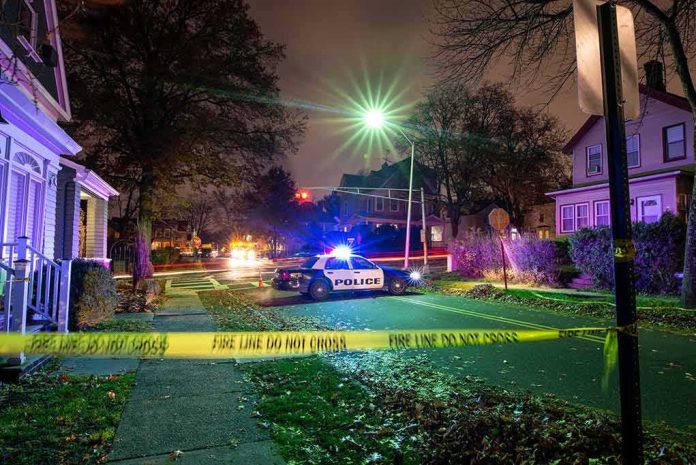
When authorities publicly classify a household’s four deaths as three homicides followed by the gun suicide of a fourth family member, they are not guessing; they are anchoring that conclusion in injury patterns, scene context, and the investigative posture that follows. That is the case in West Lafayette, Indiana, where coroner findings and the initial investigative record support the determination that the Tkach family deaths were a murder-suicide.
At a Glance
- Tippecanoe County’s coroner identified Thomas, Julie, Katharyn, and Lauren Tkach and preliminarily ruled three homicides and one suicide.
- Autopsy reports describe multiple gunshot wounds for the three victims and a self-inflicted gunshot wound for Thomas, a pattern consistent with a murder-suicide framework.
- A daughter’s 911 call preceded discovery of the bodies and reported that Thomas had a gun, shaping the emergency response and initial assessment.
- Indiana State Police assumed the lead investigation because Thomas worked for the county sheriff’s office, adding investigative independence.
What Investigators Have Established So Far
Authorities identified the deceased as four members of one household: Thomas and Julie Tkach and their daughters, Katharyn and Lauren. The Tippecanoe County Coroner’s Office issued preliminary manners of death that are decisive on the central question: Thomas died by suicide, and Julie, Katharyn, and Lauren were homicide victims. The injury descriptions align with that classification—Thomas with a gunshot wound to the head and each of the other family members with multiple gunshot wounds—an injury pattern that, taken together, points to a single household actor killing others and then himself.
The police response began with a 911 call reportedly made by a daughter around 8:30 p.m. stating that Thomas had a gun. Dispatch audio and reporting indicate that the call provided contemporaneous information before officers entered the residence, discovered the victims, and secured the scene. The combination of a live-in family constellation, the reported presence of a gun in the father’s hands, and the manner-of-death determinations coheres into the working conclusion investigators announced publicly: a murder-suicide within the home.
Why Indiana State Police Are Leading the Case
Jurisdictional alignment in sensitive cases is as much about public confidence as it is about capability. Because Thomas was employed by the Tippecanoe County Sheriff’s Office, investigators handed primary responsibility to the Indiana State Police Lafayette Post. That structure reduces real and perceived conflicts by separating the investigative team from the decedent’s employing agency; it follows widely endorsed best practices for independence when cases involve law enforcement personnel or connected households. This choice matters: it insulates evidence-gathering, witness interviews, and forensic decisions from organizational loyalties that might otherwise invite skepticism.
Practically, state police leadership brings specialized resources—ballistics, crime-scene reconstruction, and digital forensics—under a command not embedded in the local sheriff’s chain. It also signals to the public that findings will be based on demonstrable evidence and standard homicide-suicide protocols rather than departmental convenience.
How the Forensic Pattern Supports the Murder-Suicide Finding
In multi-victim household shootings, manner-of-death classifications do significant analytical work. Multiple gunshot wounds to victims combined with a single, self-inflicted gunshot wound to the alleged perpetrator describes a canonical pattern: the shooter directs sustained fire at others, then completes the act with a single terminal shot. While full reconstruction ultimately integrates ballistics, trajectory, gunshot residue, and digital timelines, coroners’ preliminary findings are not cosmetic—they encode core scene realities that seldom invert in final reports absent extraordinary contrary evidence.
The 911 call functions as near-real-time context. A daughter’s report that Thomas possessed a firearm, broadcast on dispatch channels and followed by the discovery of four bodies, narrows plausible interpretations. In domestic settings, proximity, access, and firearm control are determinative factors; taken together with the coroner’s determinations, they support law enforcement’s stated conclusion.
Where This Case Sits in the Homicide-Suicide Landscape
The Tkach case is tragic, but not anomalous within the subcategory of homicide-suicide and familicide. Across jurisdictions and decades, the overwhelming majority of identified perpetrators in family annihilation or filicide-suicide cases are men, and the predominant weapon is a firearm. A National Institute of Justice review found that 91% of homicide-suicide perpetrators were men and 88% used a gun; prior intimate-partner violence appeared in 70% of cases across a 12-city study. Comparative research in Canada and England-Wales similarly shows male predominance and frequent suicide completion by perpetrators after the killings. These patterns do not prove who fired the shots in any single case, but they make the classification authorities announced in Indiana recognizable within established criminological profiles.
The single-household context also aligns with familicide mechanics—clustering of victims in a residence, rapid temporal sequence, and an absence of indicators pointing to an external assailant. In such events, investigative attention typically turns to firearm provenance, shell-casing distribution, bloodstain patterning, and room-by-room timelines to map the sequence. Those technical products tend to corroborate the coroner’s preliminary framework rather than overturn it when injury patterns already segregate a suicide from homicides.
Institutional Roles, Evidence Development, and Public Clarity
Once the immediate threat is neutralized and the residence secured, homicide-suicide investigations progress along three lanes. First, scene forensics and autopsies lock down manner, cause, and likely sequence: wound ballistics, muzzle-to-target distances, stippling or soot, and trajectory through walls and fixtures. Second, the firearm’s chain of custody and ballistics match casings and projectiles to the recovered weapon. Third, digital forensics reconstructs intent and timeline—messages, searches, location pings—that may never become public but often resolve unanswered questions for investigators and next of kin.
In this case, the independence of the lead agency is not a footnote but a structural safeguard. Indiana State Police stewardship means outside detectives are responsible for evidence integrity and reporting; that separation is particularly relevant given Thomas’s employment with the sheriff’s office. It also helps local institutions—law enforcement and Purdue University—navigate communication with their communities without appearing to referee their own tragedy.
A Note on Responsible Interpretation
Media accounts have variably reported an age discrepancy for Julie Tkach, a common artifact of early reporting that does not alter the core finding of three homicides and one suicide within a single family. As the investigation completes and official records finalize, such inconsistencies typically resolve. The central facts that define this case—the identities of the deceased, the injury patterns, the daughter’s report of a gun, and the independent state-led investigation—remain consistent across credible outlets and official statements.
Sources:
foxnews.com, sacbee.com, fox5ny.com, wlky.com, newsnationnow.com, wrtv.com, wishtv.com, purdueexponent.org