
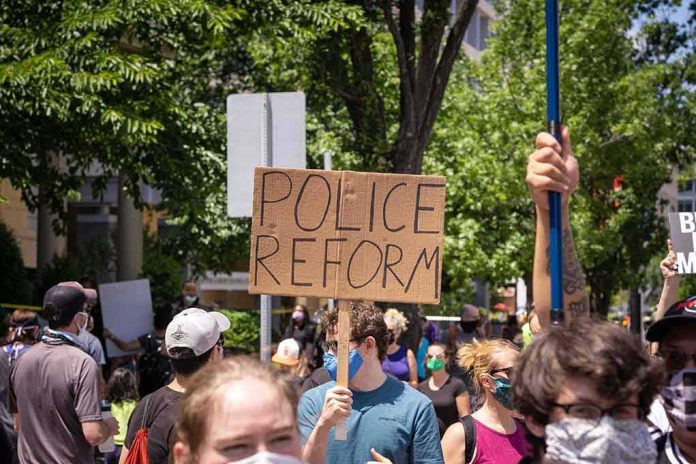
When a police killing ignites street protests that spill into restaurants, sidewalks, and traffic, what you are seeing is not chaos for its own sake but a collision between two forms of public life: everyday commerce and an extraordinary demand for accountability that refuses to stay politely out of view.
Key Points
- The Madison police shooting of Corey Ruiz is under active state homicide investigation, with key facts and legal conclusions still unresolved.
- Protest activity has rapidly escalated, including confrontations with sidewalk diners and motorists, reflecting a strategy of disruptive civil resistance rather than quiet mourning.
- Official accounts emphasize a knife, an injured officer, and prior Taser use; activists stress delayed transparency, video questions, and a broader pattern of racialized policing.
- Madison’s history of protest and past Black Lives Matter mobilizations shapes both the scale of current demonstrations and the community’s polarized response.
From Police Killing to Street Confrontation: What Is Actually Happening in Madison
The starting point in Madison is stark: a police officer shot and killed 38‑year‑old Corey Ruiz after a brief, chaotic encounter on a city street just yards from a popular neighborhood food co‑op. According to multiple news organizations, officers were responding to reports of a man checking parked cars or stealing bicycles when the situation escalated into a struggle, a knife appeared, an officer was injured, and gunfire followed. All four officers involved were placed on administrative leave, and state authorities classified the case as an active homicide investigation led by the Wisconsin Department of Justice’s Division of Criminal Investigation. That classification matters: it signals that, for the moment, the state itself is acknowledging this as a death potentially caused by criminal conduct, not a closed case of routine justified force.
What has grabbed attention beyond the shooting itself is how quickly protest moved from courthouse steps and organized marches into direct disruptions of daily life. Hundreds of people have taken to Madison’s streets in the days after the killing, with at least one march captured on video blocking a woman’s car and confronting diners seated outside as protesters passed by. An Associated Press account describes city officials cancelling or curtailing signature summer events and concert series because demonstrations and tensions made business‑as‑usual untenable. In that sense, the phrase “BLM is back in force” is less a slogan than a description of tactics: activists are willing to intrude on the comfort of motorists and restaurant patrons to insist that the state’s use of lethal force against Ruiz is everyone’s problem, not just a matter for lawyers and internal affairs.
The Official Narrative: Knife, Injured Officer, and Escalating Force
To understand why this particular killing drew such rapid and intense reaction, you have to lay out the police narrative in detail. Reports summarized by AP, NBC, NPR, and local outlets present a consistent sequence. Officers respond to a suspect allegedly checking parked vehicles or involved in bike theft. They attempt to detain him; he resists and flees. A struggle follows involving several officers. During that struggle, Ruiz produces a knife and injures at least one officer. Officers deploy a Taser, but it fails to subdue him. The same officer who was injured by the knife then fires his service weapon, fatally wounding Ruiz, who later dies at the hospital.
Legally, that narrative is tailored to the familiar “immediate threat” frame that often underpins self‑defense or justified‑force findings. A suspect armed with a knife inside grappling distance of officers, one of whom is already injured, fits the training scenarios in which lethal force is authorized when less‑lethal options fail. State investigative protocols reinforce this framing; the officers are placed on leave while DCI gathers evidence, video, and forensic material, and the department signals that it will defer to that process rather than adjudicate guilt or innocence in public.
Still, two notable gaps remain. First, the knife’s precise use—distance, angle, duration, whether disengagement was possible—is not yet documented in public forensic detail. Media reports repeat that an officer was injured but do not provide wound analysis or frame‑by‑frame video reconstruction sufficient to demonstrate that no alternative existed at the moment shots were fired. Second, the underlying suspicion that brought officers to the scene is described but not independently substantiated in the public record; the 911 calls, dispatch logs, and initial incident reports have not been broadly released. For a skeptical public, those gaps matter.
The Activist Account: Homicide, Video Questions, and Pattern Recognition
On the other side of the street, activists and community members are not contesting every detail of the police account; they are contesting its sufficiency and credibility. From their perspective, the key fact is that Madison’s police chief has publicly described the case as an “open and active homicide investigation,” with state authorities in charge and all involved officers off duty pending review. That language affirms their core claim: this was not simply “a justified shooting” completed at the moment bullets were fired; it is a killing the state itself has not yet cleared.
Several additional elements feed protester anger. Bystander video exists and has been aired by national outlets, but not in comprehensive, publicly released form that settles the sequence of events. Activists and Ruiz’s associates have described the shooting in terms like “execution,” asking why lethal force was necessary after multiple officers had physical control during parts of the struggle. The firing officer’s name has not been immediately disclosed, which in Madison carries the weight of history: the city still remembers previous controversial shootings, including the killing of unarmed teenager Tony Robinson in 2015 by a veteran officer whose name and prior record became central to the debate over disproportionate force. When you layer this new killing onto that history, many residents see a pattern of deadly escalation against suspects of color near the city’s Capitol and liberal neighborhoods, with accountability arriving slowly if at all.
From this vantage point, disruptive protest is not a breakdown of civic norms; it is a deliberate strategy to force a full evidentiary reckoning. Demonstrators have interrupted official press conferences, confronted city leaders, and filled downtown streets, insisting on rapid release of video, officer identification, and an independent assessment of whether lethal force was truly the last resort. Their claim is straightforward: without pressure, institutional processes will drift toward quiet exoneration, as they have in many past cases across the country.
Disruption, Harassment, and the Boundary of Legitimate Protest
The research record does confirm that protest in Madison has, at times, crossed into significant disruption. AP and other outlets report that a major summer concert series and other signature events were cancelled or curtailed as demonstrations and tensions grew around the shooting. Video shows at least one incident in which protesters blocked a woman’s car at an intersection and confronted diners eating outside as the march passed by. This is not Madison’s first experience of protest spilling into private comfort: during earlier Black Lives Matter mobilizations, the city saw marches, curfews, property damage, and occasional violence, even as most demonstrations remained peaceful.
Whether these tactics amount to “harassment” depends heavily on one’s priors. For residents and business owners, having a peaceful meal or a drive home interrupted by chanting crowds, raised fists, and blocked traffic can feel coercive and hostile. Nationally, similar episodes during the 2020 cycle—BLM protesters confronting diners in Washington, D.C., and demanding they raise their fists in solidarity—were widely circulated and criticized as intimidation. For activists, however, that discomfort is the point. A protest that leaves daily routines untouched, they argue, rarely shifts power or forces serious institutional change. Disruptions send a signal: lives have been lost, and the city does not get to glide past that reality with jazz on the square and patio cocktails.
Crucially, the available public record does not yet parse which protesters are engaging in confrontational tactics versus those marching peacefully, nor does it quantify the number or severity of direct interpersonal incidents with diners or passersby. We have documentation of interruptions, confrontations, and cancellations, but not a systematic incident ledger that would support sweeping claims that “BLM activists” as a collective are harassing residents in some sustained, organized campaign. The evidence supports a narrower, more precise description: some protesters have embraced disruptive, face‑to‑face tactics that many residents experience as harassment; others have participated in largely peaceful marches and vigils calling for accountability.
Madison’s Long History of Protest and Policing Controversy
To understand why Madison became a flashpoint again, you have to situate these events in the city’s longer arc. Madison has, for decades, prided itself on political activism—a progressive capital with regular marches, rallies, and demonstrations on its downtown isthmus. The city’s own guidelines explicitly support the right to assemble and express views in public spaces, while acknowledging that certain actions—blocking streets, using amplified sound, occupying parks—can trigger permit requirements and traffic management. In practice, this means protest is part of the city’s normal operating environment.
At the same time, Madison’s experience with racialized policing controversies runs deep. The Tony Robinson case in 2015, involving an unarmed Black teenager shot by a veteran officer, triggered intense Black Lives Matter protests, national scrutiny, and long‑term debates over use of force and officer discipline. Subsequent officer‑involved shootings have been investigated by the same state Division of Criminal Investigation now handling the Ruiz case, with patterns of delayed transparency and eventual findings that often favor officers. Residents inclined toward skepticism look at this history and see a familiar script replaying: a young man of color, disputed threat level, lethal force used, officer identity initially withheld, and institutionally framed as “under review.”
It is also important to note that Madison has seen both disciplined protest and serious misconduct by individuals claiming activist mantel. In one 2020 case, a local Black Lives Matter activist was charged with federal extortion after allegedly harassing and threatening a woman praying the rosary and demanding money, food, and beverages from downtown businesses under threat of “force, violence and fear.” That episode illustrates how, in any protest wave, a small subset may engage in criminal conduct that opponents then use to paint the entire movement as lawless. The current Madison mobilization is unfolding under the shadow of both those precedents.
Where the Evidence Stands and What Comes Next
As of now, the evidence supports several firm conclusions and leaves critical questions open. It is clear that Ruiz was killed by police gunfire during a struggle following reports of property crime; that he had a knife and an officer was injured; that a Taser was used unsuccessfully before the shots; and that the incident is officially classified and investigated as a homicide by state authorities. It is equally clear that protest has disrupted ordinary civic life, from concerts to traffic to outdoor dining, and that some confrontational tactics have targeted bystanders directly.
What remains unsettled is the core proportionality question: whether, in the specific physical and temporal circumstances of that struggle, lethal force was necessary under law and training, or whether alternative tactics could reasonably have prevented Ruiz’s death. Answering that requires full release and independent analysis of body‑camera, dash‑camera, and bystander footage; forensic mapping of wounds, shell casings, officer positions, and timing; and public disclosure of the 911 calls and dispatch logs that framed the initial response. Until that record is complete, both the police narrative of justified self‑defense and the activist narrative of unjustified “execution” rest on partial evidence and prior experience.
For Madison—and for any city watching—this moment is a test of whether a community can hold two truths at once. First, that residents have a right to go about their lives without being menaced or obstructed by anyone, including protesters. Second, that when the state kills someone under contested circumstances, normal routines sometimes have to yield to collective insistence that the facts be fully exposed and accountability, if warranted, be real. How Madison navigates that tension in the weeks ahead will say as much about the city’s democratic health as any eventual investigative report.
Sources:
twitchy.com, apnews.com, nbcnews.com, npr.org, youtube.com, washingtonexaminer.com, cnn.com, wpr.org, nytimes.com, facebook.com, jsonline.com, abcnews.go.com, fox6now.com, wisdoj.gov