When a long-starved fan base finally gets its championship moment, the line between euphoric celebration and public disorder can disappear in minutes—and how that blur is framed by police and media often matters as much as what actually happened on the street.
Key Points
- Video and police statements leave little doubt that some Knicks fans climbed on NYPD vehicles and damaged at least four of them, including shattered windshields.[3]
- Those clashes unfolded within much larger crowds—often 7,000 to 10,000 people—who mostly watched peacefully and dispersed without incident, a distinction acknowledged by both police and city officials.[2][3]
- Media and social clips that focus on “crazed” fans and smashed cars capture real misconduct but also incentivize a crime-drama narrative that can overshadow the base rate: rare pockets of violence inside mass celebrations.[7][3]
- The contest over whether this was “unprovoked violence” or “celebration that got out of hand” reflects a broader, recurring pattern in sports riots where law enforcement, fans, and news outlets compete to define what the night “really” was.
What We Actually Know About the Knicks Celebrations and the Smashed Cop Car
The most concrete layer of this story is factual: public statements from the NYPD, reporting from mainstream outlets, and widely shared videos all describe a similar pattern across multiple Finals games. After Game 2, police said 17 people were arrested near Madison Square Garden, including one fan accused of punching an officer after entering a restricted area and refusing to leave; the department also reported fans stopping traffic and climbing poles and subway entrances.[1] That same night, social video shows crowds climbing onto an NYPD vehicle near the Garden and a windshield clearly shattered under people jumping on the hood.[2][4][6]
By Game 3, the city had shifted the main viewing hub to Bryant Park. Roughly 7,000 people gathered there, according to police and ESPN. The watch party itself, by multiple accounts, stayed largely orderly, but pockets of fans in surrounding streets fought, ripped signs out of the ground, and threw glass objects—leading to eight arrests and injuries to five officers.[2] Police described the crowd as growing “incredibly reckless” and “increasingly rowdy, violent, and destructive.”[2]
Game 4: From Unruly Street Party to Smashed Windshields
The most dramatic numbers and images came after the Knicks’ dramatic Game 4 comeback win. The NYPD estimated about 10,000 people filled the streets surrounding Madison Square Garden, outside the arena’s security perimeter.[3] Over the course of the night, 56 people were taken into custody for behavior that ranged from blocking streets to more serious charges such as assault on a police officer, criminal mischief, and weapons possession.[3][6]
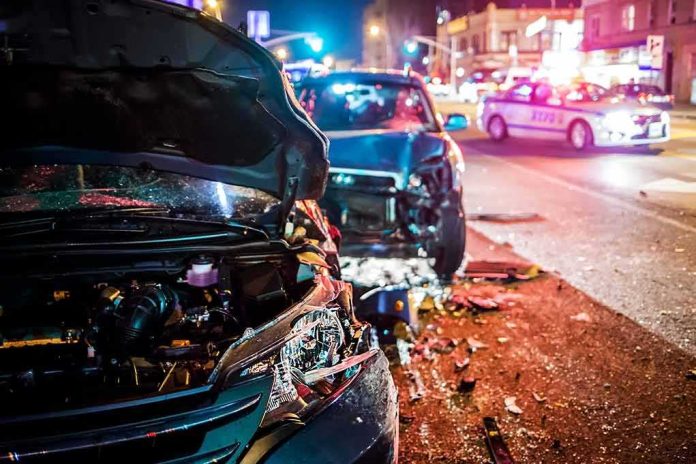
Here the official incident list is telling. Police said fans shut down major avenues, climbed scaffolding, light poles, and buildings, tried to flip a taxi, and ignited fireworks in dense crowds.[3] They also reported fans “climbing on top of NYPD vehicles, resulting in significant damage to four department cars, shattering front and back windshields.”[3] Ten officers were injured, including one struck in the head with a glass bottle. Reuters and local TV segments echoed this framing, describing “reckless and dangerous” behavior while noting that only a subset of fans were involved.[7][6]
How Sensational Headlines and Viral Clips Shape the Story
Against that factual backdrop, the now-familiar New York Post Sports headline—“Crazed Knicks fans smash cop car as NBA Finals ecstasy immediately turns violent”—lands squarely in the modern tabloid tradition. It captures a real piece of the night: there is video of fans on the roof and hood of an NYPD car, the windshield spider-webbed, while people around them chant and film.[2][4][6][7] But the headline also performs work: it collapses a complex, citywide celebration into a single, lurid image of “crazed” fans and “immediate” violence.
Political commentators amplified that frame, sharing the same clips and presenting them as emblematic of a lawless crowd that “overran” police. The videos themselves are short and tightly edited—impactful as evidence that the damage occurred, far less useful for understanding how the situation built over time or how representative those moments were within tens of thousands of people on the streets.[2][5][6] This is typical of sports-riot coverage: the most dramatic thirty seconds become the night.
Fans’ Counter-Narrative: Celebration with Bad Actors at the Edges
There is, however, a meaningful counterpoint coming from within the same ecosystem. On-air interviews and some social posts from fans stress that most people were there to celebrate, not to fight police or destroy property. ABC7’s coverage of the Bryant Park watch party emphasized an orderly viewing area with isolated flare-ups outside its bounds, and a spokesperson for the mayor underscored that the “overwhelming majority” of fans watched peacefully.[2] NBC’s recap of Game 4 made a similar point: 56 people were taken into custody, but only about 15 faced more serious charges, and “the vast majority” of New Yorkers celebrated in “euphoric fashion.”[6]
That pattern—thousands behaving lawfully, dozens behaving badly—is the base rate in large-scale sports celebrations across cities and decades. The Knicks case fits it closely. What fans object to is less the acknowledgement of misconduct, which is hard to dispute on the available footage, and more the implication that smashing a cop car or swinging a bus-stop sign defines the night for everyone in blue and orange.[3][5] In their telling, this was a rare championship moment for a long-suffering franchise, with a few people crossing clear lines in a compressed space full of alcohol, adrenaline, and cameras.
Gaps in the Record: What We Don’t Know Yet
Even with multiple independent videos and detailed NYPD summaries, some specific questions remain open. Public reporting so far does not identify by name who broke which windshield or whether particular individuals seen on social clips were among those arrested. Police statements list categories of charges—assault on an officer, criminal mischief, weapons counts—but do not map those counts to specific pieces of high-visibility damage like the now-iconic smashed cruiser.[1][3]
Likewise, the mechanism is visually clear (people jumping or stomping on vehicles) but not forensically parsed in public documents. From the standpoint of criminal law, distinguishing between, say, a thrown object and a person’s body weight might matter; in the headlines, both collapse into “smash.” That does not make the damage any less real, but it does mean that the evidentiary chain from viral clip to courtroom charge has not been laid out in the material currently available to the public.[1][3]
New York City — Knicks title celebration turns violent near MSG
Crowd Control / Championship Celebration / Property Damage / Police Response
Event date/time: Late Saturday, June 13 into early Sunday, June 14, 2026
Madison Square Garden / Midtown Manhattan
Status: Developing pic.twitter.com/0yPlWdgUVv— WilluChill United States News. (@Will466513) June 14, 2026
The Broader Pattern: Sports, Policing, and the Economics of Sensation
Stepping back, the Knicks celebrations are not an anomaly; they are a local instance of a recurring pattern in modern cities. High-stakes games—NBA Finals, Stanley Cup, World Series—regularly produce post-game unrest: cars flipped in Montreal, fires in Boston, street brawls in Detroit. Criminologists and the National Institute of Justice have long noted that these “sports riots” emerge from a mix of dense crowds, alcohol, perceived anonymity, and a policing posture that oscillates between facilitation and control.[1]
In that environment, three institutional logics collide. Law enforcement has incentives to emphasize risk and disorder, both to justify heavy deployments and to argue for future resources and tighter controls. Media outlets, especially tabloids and social-driven brands, benefit from images of chaos that drive clicks and advertising revenue; a calm watch party is dull footage, a shattered windshield is a viral asset.[7] Fans and teams, by contrast, often seek to highlight civic unity and joyous release, minimizing or individualizing the bad behavior at the margins. The Knicks’ relative silence on the specifics of the unrest effectively cedes the narrative field to police and media, which then define the perception of the night.
Why This Matters for Cities and Fans Going Forward
For New York, the Game 2–4 experience will almost certainly shape how future large-scale celebrations are policed and permitted. After earlier melees, the NYPD had already curtailed outdoor watch parties near the Garden; the city’s decision to push viewing to Bryant Park and other locations was an attempt to balance fan experience with control.[1][2][3] The reported injuries to 10 officers, shattered windshields on multiple department vehicles, and dozens of arrests will give ample fodder to those inside the department and police unions who want stricter perimeters, more barriers, and quicker dispersal orders.[3][7]
For fans, the lesson is more cultural than legal. A championship run in a dense, media-saturated city will always be documented at its worst angles. When even a small fraction of a massive crowd climbs on cars or swings street furniture, the images produced will stand in for everyone—especially when newsrooms and algorithm-driven feeds are rewarded for foregrounding conflict. That does not excuse the conduct captured on those Game 4 clips; it explains why, years from now, “crazed Knicks fans smash cop car” may be the phrase that survives in popular memory while the thousands who simply celebrated in the streets fade into the background.
Sources:
[1] Web – Crazed Knicks fans smash cop car as NBA Finals ecstasy immediately …
[2] Web – NYPD arrests 17 at Knicks NBA Finals watch party outside MSG
[3] Web – NYPD car windshield SMASHED UP as crowds Jump on top near …
[4] YouTube – Knicks fans clash with NYPD as fights break out near Bryant Park …
[5] YouTube – NYPD car windshield SMASHED UP as crowds Jump on …
[6] Web – Knicks fans are out of control! Smashing cars and wrestling cops.
[7] Web – NYPD car windshield SMASHED UP as crowds Jump on top near …