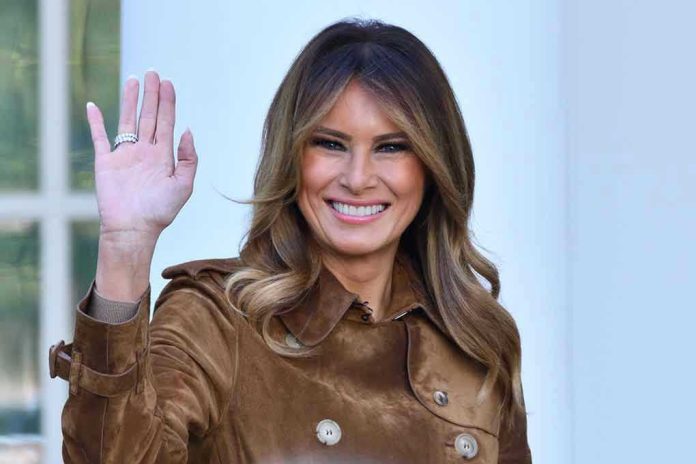
When a late-night comedian’s joke about the First Lady suddenly collides with real-world violence, the line between satire and recklessness becomes impossible to ignore.
Quick Take
- Jimmy Kimmel called Melania Trump an “expectant widow” in an April 23 White House Correspondents’ Dinner parody, days before a shooting disrupted the actual event
- Melania Trump responded on April 27 via X, labeling Kimmel a “coward” and demanding ABC “take a stand” against his “hateful and violent rhetoric”
- The controversy exposes the dangerous intersection of political satire and real-world threats in an increasingly polarized media landscape
- Critics argue Kimmel’s timing was dangerously insensitive; supporters contend it was standard political humor taken out of context
The Joke That Wouldn’t Stay Buried
On April 23, late-night host Jimmy Kimmel delivered what he likely thought was edgy political comedy. During a White House Correspondents’ Dinner parody on his ABC show, Kimmel looked at the First Lady and remarked that Melania had “a glow like an expectant widow.” The line was designed to mock her marriage to President Trump, part of a broader satirical monologue about the presidential couple. In the insular world of late-night television, where Trump family mockery has become routine since 2017, this joke barely registered as noteworthy.
But timing, as they say, is everything. Two days later, on April 25-26, the actual White House Correspondents’ Dinner at the Washington Hilton erupted into chaos. An active shooter, identified as Cole Allen, disrupted the event. President Trump and Melania were escorted out amid gunfire. Suddenly, Kimmel’s pre-recorded joke about an “expectant widow”—implying anticipation of Trump’s death—was no longer just offensive comedy. It was a punchline that had aged catastrophically in forty-eight hours.
When the First Lady Speaks
Melania Trump rarely engages in public disputes. Her communications are typically formal, measured, and infrequent. On April 27, she broke that pattern. Via X, the First Lady issued a statement that was notably direct: she called Kimmel a “coward,” accused him of spreading “hateful and violent rhetoric,” and demanded that ABC “take a stand.” Her words framed the joke not as mere comedy but as corrosive speech that divides the nation during a moment of genuine danger.
The distinction matters. Melania wasn’t simply objecting to being mocked—that’s part of public life. She was objecting to the specific nature of the mockery and its timing relative to an actual assassination attempt. By positioning herself as a defender of national unity rather than personal dignity, she elevated the complaint beyond typical celebrity pushback into a broader indictment of media irresponsibility.
The Precedent Problem
This isn’t Kimmel’s first brush with controversy over poorly timed jokes. Months earlier, he faced suspension after making comments about the fatal shooting of Turning Point activist Charlie Kirk. He apologized, was reinstated, and the incident faded. That precedent now haunts him. If he received consequences for insensitive remarks about one shooting, why not this one? The difference, critics argue, is that his Kirk comments came after the tragedy; his Melania joke came before—making it arguably worse.
Conservative media personalities and Trump allies seized on the hypocrisy. Sky News host Rita Panahi called Kimmel “dangerously unfunny” and “perpetually miserable.” Right-wing commentators demanded ABC issue an apology or face calls for license revocation. The social media firestorm grew predictably, with Trump supporters citing the incident as evidence of mainstream media’s contempt for the president and his family.
The Satire Defense Crumbles
Defenders of Kimmel argue this is standard political satire—the kind that has defined late-night television for decades. They note that comedians have mocked presidential couples relentlessly, and that Kimmel couldn’t have predicted the shooting. His joke wasn’t a threat; it was humor, however dark. In a functioning democracy, they contend, we don’t punish comedians for the coincidental timing of real-world violence.
That argument carries weight in theory. In practice, it collapses under the weight of context. The “widow” reference wasn’t abstract political commentary—it was a specific, visceral jab at Melania’s marriage, implying her husband might die. Made days before someone actually attempted to kill him, the joke transformed from satire into something that felt like prophecy or, worse, incitement. The question isn’t whether Kimmel predicted the shooting. It’s whether he bears any responsibility for contributing to a media environment where violence against political figures is normalized through “humor.”
What Comes Next
As of April 27, ABC has made no public statement. Kimmel has not apologized. The clip continues circulating on social media, each share amplifying the controversy. The network faces a genuine dilemma: defend free speech and artistic expression, or capitulate to pressure from a sitting First Lady and her political allies. Either choice carries consequences in today’s polarized landscape.
The broader implication is chilling for comedy itself. If late-night hosts begin self-censoring on sensitive topics due to fear of backlash or accusations of incitement, the medium loses its edge. Yet if they continue making jokes that blur the line between satire and inflammatory rhetoric in an environment where assassination attempts are real, they risk contributing to the very violence they claim to critique. The Kimmel controversy exposes a fundamental tension in contemporary American media: we’ve created a system where satire and danger have become dangerously entangled.
Sources:
Kimmel Calls Melania Trump ‘Expectant Widow’ Days Before White House Correspondents’ Dinner Shooting
Jimmy Kimmel’s Shocking ‘Widow’ Melania Trump Joke Timing Raises Questions Amid WHCD Shooting Chaos