As rescuers dig through crushed adobe homes in Peru’s Andes, a small 5.5 quake is exposing big gaps in how the world’s poorest communities are protected when the ground moves.
Story Snapshot
- A 5.5 magnitude earthquake near Sicaya in Peru’s Andes killed at least six people and injured more than 30.
- Rescue teams are searching collapsed homes, while officials still do not know how many people are missing.
- Hundreds of residents are displaced, highlighting how fragile adobe housing is in many mountain villages.
- The disaster shows how poorer regions worldwide often face the worst danger from even “moderate” quakes.
Deadly quake hits highland communities
Late Saturday night, a 5.5 magnitude earthquake shook Peru’s central Andes, striking near the town of Sicaya in Huancayo province. The United States Geological Survey said the quake hit at 9:24 p.m. local time at a shallow depth of about 10 kilometers, which makes shaking at the surface more intense. Authorities reported at least six people dead, more than 30 injured, and about 300 residents forced from their homes, with the full number of missing still unknown.
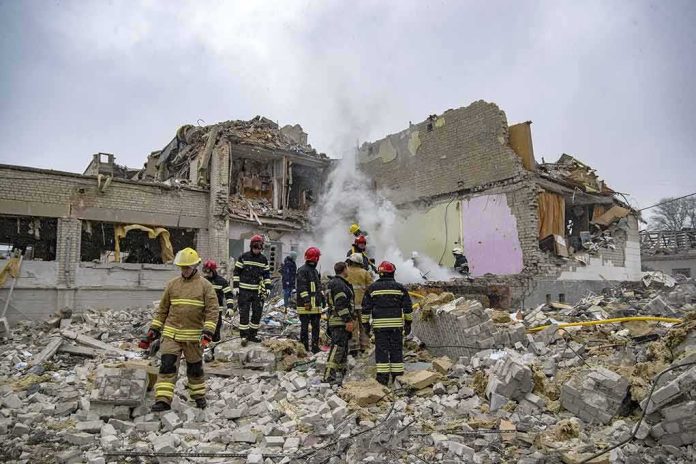
Most of the victims lived in small Andean communities where many homes are made of unreinforced adobe bricks. Local reports describe houses collapsing in minutes as walls crumbled under the shaking, trapping families inside. Rescue workers and neighbors rushed out overnight to search the rubble by hand and with simple tools, trying to pull survivors from broken buildings before aftershocks or rain made conditions worse. For families, the damage means not only loss of loved ones but also loss of shelter, savings, and food stores.
Rescue efforts and limits of emergency response
Peru’s National Civil Defense Institute said rescuers are “attending to the emergency and continuing search and rescue operations,” confirming that official teams are still combing debris for the missing. Emergency crews worked through the night in the thin Andean air, moving from one collapsed structure to another while doctors treated the injured in nearby clinics and hospitals. Local authorities set up temporary shelters for the roughly 300 displaced people, using schools, tents, and community centers to give families basic protection from the cold highland weather.
Despite these efforts, early disaster responses in Peru’s mountains often face serious limits. Many villages sit hours away from major cities by narrow mountain roads, which can be blocked by landslides after a quake or heavy rain. That slows down arrival of heavy equipment, doctors, and outside aid. Civil defense officials must rely first on local volunteers and simple gear, meaning rescues are slower and more dangerous than in richer, better-connected areas. These delays increase fear that the real toll may rise as search teams reach more remote hamlets around Sicaya and Huancayo.
Why a “moderate” quake caused such heavy damage
Some Americans might wonder how a 5.5 magnitude earthquake, much smaller than the giant quakes that hit Peru in past decades, could kill and injure so many people. Seismologists who study the Andes note that shallow quakes under mountain towns can be deadly when most homes are built from adobe or simple brick without steel reinforcement. These traditional materials are cheap and familiar but brittle under shaking. Even moderate ground motion can cause walls to crack and roofs to fall, especially when buildings are crowded together on steep slopes.
A 5.5-magnitude earthquake shook the Andes region of Peru, killing at least five people, local authorities say on Sunday. More than 20 people were injured, and 300 have been displaced so far. https://t.co/BXJyGbdMBz
— NBC News (@NBCNews) July 20, 2026
Scientists have warned for years that central Peru’s highlands face serious seismic risk because of active faults running beneath the eastern cordillera and nearby valleys. A study of past earthquakes in the region shows that similar events below magnitude 6.0 have still produced severe local damage when they hit vulnerable towns. Yet many rural families cannot afford modern construction or strict building codes. The result is a pattern people across the political spectrum recognize at home: those with the least money live in the most dangerous places and pay the highest price when disaster strikes.
Shared concerns about forgotten communities
Watching images from Peru, many Americans see echoes of their own worries about how governments treat ordinary people. In the Andes, residents say help often arrives late and rebuilding funds seldom reach those most in need. That frustration sounds familiar to conservatives who feel global elites focus on climate conferences and foreign deals while basic safety in working towns is ignored, and to liberals who see once again how the poorest and rural minorities end up in the most fragile housing and face the steepest climb back after a shock.
This small but deadly quake is a reminder that numbers on a seismic scale do not tell the whole story. What matters is who lives above the fault, what their homes are made of, and how seriously leaders take their duty to protect them before the next tremor. As rescuers in Peru keep digging through rubble, the scene raises a broader question that reaches far beyond one Andean valley: when disaster hits, are systems built to shield regular families, or mainly to preserve the comfort and control of those already on top?
Sources:
youtube.com, en.wikipedia.org, abc30.com, app.ingemmet.gob.pe