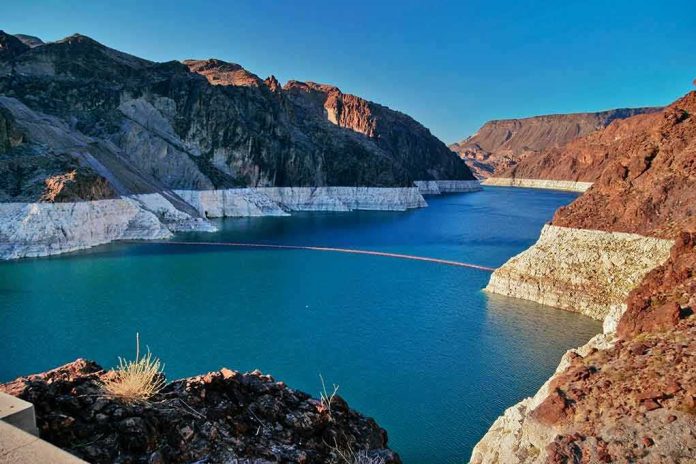
The Lower Basin’s fight over Colorado River cuts is not a temporary spat but the latest turn in a century-long cycle: legal promises that exceed the river’s reliable yield colliding with hydrology that no longer forgives overuse. Voluntary conservation can buy time; it has never, by itself, erased the basin’s structural deficit.
The Short Version
- Arizona, California, and Nevada have advanced voluntary conservation, but federal modeling now contemplates far deeper, mandatory reductions to keep Lake Mead and Lake Powell above crisis thresholds.
- Arizona’s Central Arizona Project (CAP) already absorbs large shortage cuts under current rules; tiered reductions have fallen first and hardest on agriculture.
- The core conflict is structural: allocations outstrip dependable inflows, and priority rights shield California longer than Arizona, amplifying Lower Basin tensions.
- Post-2026 operating rules will determine whether the basin continues ad hoc triage or finally aligns delivery obligations with a drier climate and real reservoir losses.
Why the cuts keep coming: the structural deficit made visible
The Colorado River’s accounting problem is older than this drought. The Law of the River—compacts, decrees, treaties, and guidelines layered since 1922—divided a hydrologic pie that was overestimated at the outset and has shrunk under warming temperatures. The result is a structural deficit: promised deliveries from Lake Mead routinely exceed what flows in. When storage was full, paper surpluses masked the imbalance; as Mead and Powell fell, the deficit surfaced, and shortage tiers began to bite. That is why, despite rounds of voluntary conservation and binational agreements, federal authorities have repeatedly triggered mandatory reductions to prevent storage from plunging toward dead pool, the point at which releases or power generation become physically impossible.
This history matters because it clarifies today’s friction. Voluntary cuts can slow the descent, but they cannot close a deficit embedded in the operating rules. As negotiators hash out post-2026 operations, any durable plan must explicitly reconcile annual deliveries, evaporation and system losses, and realistic inflows—rather than hoping intermittent wet years or ad hoc conservation will backstop the math.
What voluntary conservation has (and hasn’t) achieved
The Lower Basin states have not been idle. Arizona, California, and Nevada have offered and implemented voluntary reductions, and Arizona in particular has taken substantial hits under current shortage tiers. For 2025, Arizona is operating under Tier 1 reductions of about 512,000 acre-feet—approximately 30% of CAP’s normal supply and roughly 18% of Arizona’s Colorado River apportionment—with most cuts borne by CAP users, primarily agriculture in central Arizona. These near-term sacrifices extend earlier Lower Basin and U.S.–Mexico conservation programs designed to prop up Lake Mead.
Still, the Bureau of Reclamation’s planning horizon now runs to 2036, and its analysis points to the need for much deeper annual reductions—on the order of up to 3 million acre-feet across the Lower Basin—if the two big reservoirs are to avoid the most dangerous levels in dry sequences. That federal ceiling is roughly double the million acre-feet voluntary concept the states put forward in earlier negotiations. The gap between what the hydrology requires and what politics can accept is the crux of the stalemate.
Priority, not sentiment: how the Law of the River allocates pain
Shortage sharing in the Lower Basin is governed by priority. California’s large historic rights are senior to Arizona’s CAP supplies; under the current guidelines and related agreements, CAP deliveries are curtailed earlier and more severely than major California users. In practice, that has meant Arizona agriculture has been the first and hardest hit, while California’s biggest users—both agricultural and urban—retain allocations longer during shortages. News stories that tally percentage cuts without explaining priority inadvertently mislead; it is the legal seniority structure, not day-to-day federal discretion, that determines who is curtailed first.
This asymmetry fuels political friction. Arizona officials argue they have already contributed outsized volumes to stabilize Mead in recent years and question why further deep cuts should again fall predominantly on CAP users while Upper Basin states face looser expectations. California counters that senior rights are the foundation of the compact-era bargains that built the system and financed infrastructure; upending that priority would undermine the legal certainty on which the West was developed. Both positions have internal logic. The hydrology, however, is indifferent to priority. If the math doesn’t pencil, the reservoir surface falls regardless of who has paper rights.
How we got here: a brief history of rules and renegotiations
Every decade or so, stress in the hydrology forces a governance reset. The 2007 Shortage Guidelines created the first formal step-downs. The 2012–2017 binational Minutes with Mexico added conservation and sharing mechanisms. The 2019 Drought Contingency Plans layered additional reductions. Then the 2021–2023 dry years accelerated declines at Mead and Powell, triggering mandatory tiers that deeply cut Arizona’s CAP pool and forced emergency releases and conservation buys to keep Glen Canyon Dam and Hoover Dam operating. Each of these interventions was negotiated to avoid litigation and preserve flexibility, but each was also a patch: none eliminated the underlying structural deficit.
We are again at an inflection. The current guidelines expire in 2026. Reclamation has launched the Post-2026 environmental review to set new operating rules for Powell and Mead; the process is designed to incorporate alternatives from states, tribes, Mexico, and stakeholders, and to account for climate-affected inflows. Absent consensus, Interior has authority to select and implement a federal alternative—one reason rhetoric has sharpened as parties position for leverage.
What the federal planning signals—and why it alarms Arizona
Federal materials and public reporting describe a planning envelope that contemplates much steeper Lower Basin reductions than the states’ prior voluntary concept. Reuters reported a 10-year federal framework that could require up to 3 million acre-feet per year from Arizona, California, and Nevada combined, with reassessments every two years—a scale intended to keep Mead and Powell out of critical zones in dry sequences. Within Arizona, CAP has warned constituents that draft federal options modeled extremely severe outcomes for CAP deliveries in stressed hydrology, reflecting CAP’s junior status in the priority hierarchy rather than a new doctrine.
For Arizona, these scenarios translate to real sectoral risk. CAP water is the backbone not only for agricultural districts in Pinal and Maricopa counties but also for banking groundwater and supporting municipal growth strategies in Phoenix and Tucson. Tiered cuts have already shifted burdens to farmers; deeper, longer cuts would push more acreage out of production, complicate groundwater management, and increase the transaction value of senior agricultural rights elsewhere in the system.
Upper Basin, Lower Basin, and the fairness argument
Much of the political heat centers on perceived inequity between basins. Lower Basin deliveries come from Lake Mead, where evaporation and system losses have historically been charged to storage rather than debited against state allocations—one driver of the structural deficit. The Upper Basin operates under a different constraint: a compact obligation to deliver a ten-year rolling average at Lee Ferry, calibrated to 7.5 million acre-feet per year, without allocations spelled out by state in the same way as the Lower Basin. In wet periods, this arrangement felt arcane; in prolonged drought, it feels consequential.
Arizona officials often argue that Upper Basin conservation has lagged while Lower Basin users have already shouldered visible, quantifiable cuts. Upper Basin leaders respond that their consumptive uses are smaller, their hydrology is colder and snowmelt-driven, and their obligation is the Lee Ferry delivery—not participation in Lower Basin accounting reforms. There is no technical solution to this political disagreement. The only workable path is a basin-wide package that: explicitly budgets evaporation and transit losses, normalizes conservation accounting across reservoirs, and creates predictable shortage triggers that are both hydrologically grounded and legally durable.
Mechanics that matter: evaporation, system losses, and accounting
Two unglamorous mechanics drive outcomes more than speeches: how the system accounts for evaporation and how it prices conservation. For decades, the Lower Basin treated evaporation at Mead as a cost absorbed by storage rather than a charge to users; doing so inflated effective deliveries relative to inflows. Correcting that convention—debiting evaporation and other system losses to accounts—shrinks the apparent pool of water available for delivery and forces more honest planning. Likewise, conservation that is credited, stored, and recoverable in future years (Intentionally Created Surplus, system conservation programs) can stabilize reservoirs only if credits are not overdrawn at the first sign of a wet winter. Durable rules must tighten both: count every loss and bind conservation credits to reservoir targets, not political cycles.
Where the real disagreements lie
Genuine disputes are narrow but profound: whether to allocate future cuts by legal priority or pro rata percentages, how to quantify and charge evaporation, how to integrate tribal water settlements and Mexico’s treaty deliveries into shortage accounting, and whether the Upper Basin will accept symmetrical obligations beyond Lee Ferry delivery in exceptionally dry sequences. Each choice creates winners and losers. Priority-based regimes protect senior rights but can all but zero out junior pools such as CAP in severe shortages. Pro rata regimes spread pain but disrupt settled investments and could trigger litigation from senior-rights holders. Hybrid approaches exist—priority until a threshold, then proportional sharing—but they require an explicit political bargain and clear triggers to avoid endless relitigation.
None of these choices can be outsourced to hydrology alone. Reservoir modeling can show what is required to keep Mead above, say, 1,020 feet and Powell above minimum power pool across plausible climate futures. It cannot decide whether a senior irrigation district in the Imperial Valley or a fast-growing municipality in central Arizona should absorb the next marginal cut. That is governance—painfully specific, value-laden, and unavoidable.
WATER WARS! I live in Arizona so we follow it closely.
It was actually 1922. Arizona sued California over it, but the judge ruled in CA favor giving them 7.5 million acre-feet (maf) of water annually.
1944 Mexican Water Treaty: Committed 1.5 maf of the river's annual flow to…— USA Guild (@Guild_1775) July 3, 2026
The path to a durable settlement
A workable post-2026 framework will share four traits. First, hydrologic realism: delivery caps that match median-to-dry climate projections and explicitly budget evaporation and transit losses at both reservoirs. Second, enforceable triggers: shortage tiers and recovery rules tied to transparent reservoir elevations, with automatic adjustments that reduce the need for emergency diplomacy. Third, basin-wide symmetry: mechanisms that enlist both Upper and Lower Basins in extraordinary drought response beyond Lee Ferry delivery when modeled risks to dead pool cross agreed thresholds. Fourth, a credible conservation market: standardized metrics and pricing for conserved water, protected from immediate reallocation, and inclusive of tribal water rights as active partners rather than afterthoughts.
Voluntary cuts will remain part of the toolkit; they build trust and move water fast. But the evidence from the last two decades is unambiguous: voluntary measures cannot, on their own, resolve a structural deficit baked into rules that overpromise. The next operating plan must do what earlier patches avoided—right-size legal allocations to a smaller river—so that the reservoirs can stabilize without constant crisis management. The alternative is familiar: deeper, faster federal interventions when the hydrology runs ahead of the politics.
Sources:
feedpress.me, apnews.com, reuters.com, youtube.com, scholar.law.colorado.edu, pmc.ncbi.nlm.nih.gov, narf.org