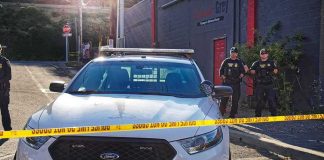
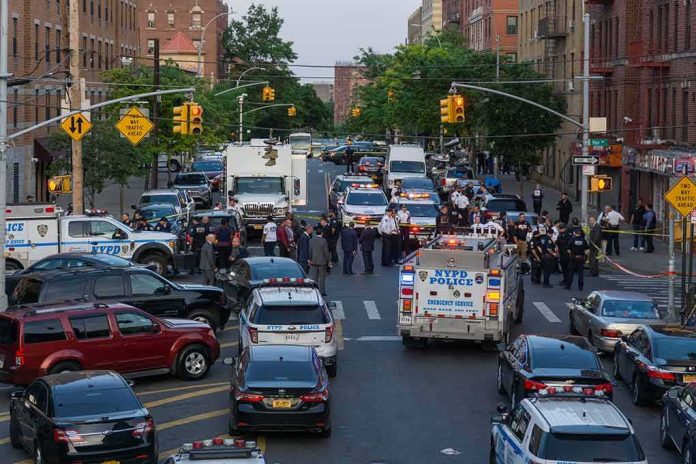
The corner of 153rd Street and Jamaica Avenue, at the edge of Rufus King Park in Queens, has become one of those unfortunate patches of pavement that keeps reappearing in the police blotter — not because the neighborhood is uniquely lawless, but because a small number of locations absorb a disproportionate share of a city’s gun violence, and this one has taken more than its share over the past year.
Key Points
- A 14-year-old boy was shot in the leg near 153rd Street and Jamaica Avenue, just outside Rufus King Park, shortly before 5 p.m. on Sunday, September 6, 2026, according to the NYPD.
- The shooter, described as dressed head-to-toe in black, fled on foot; no arrest had been made as of the initial reporting.
- The victim was taken to Jamaica Hospital and was listed in stable condition.
- Police have not confirmed a motive or said whether the teenager was specifically targeted.
- This is at least the third violent incident tied to the same Rufus King Park corridor in roughly a year, a pattern that outlasts any single headline.
What the NYPD Has Confirmed
According to police accounts relayed in contemporaneous reporting, the shooting occurred shortly before 5 p.m. on Sunday, September 6, 2026, at the intersection of 153rd Street and Jamaica Avenue, just outside Rufus King Park in the Jamaica section of Queens. Officers responded to the scene around 4:52 p.m. and found the 14-year-old suffering from a gunshot wound to the leg. EMS transported him to Jamaica Hospital, where he was reported in stable condition — the kind of update that, in NYPD parlance, signals a wound serious enough for hospitalization but not judged life-threatening.
The gunman was described as wearing an all-black ensemble and fled the scene on foot, direction unspecified, before officers arrived in force. No arrest had been announced as the investigation continued, and police have not said whether the teenager was deliberately targeted or caught in something incidental to him. That distinction — targeted versus random — is often the single most consequential unresolved question in an early-stage shooting investigation, because it shapes everything from the urgency of a manhunt to the safety calculus of everyone else who uses that corner.
A Corner With a Troubling Track Record
This was not the first shooting connected to Rufus King Park, nor even the first involving a 14-year-old boy. In September 2025, the NYPD searched for two suspects after a teenager was shot inside the park itself on a Friday morning, an investigation that remained open with no arrests reported at the time. Days earlier that same September, a 14-year-old was shot in a separate, daylight incident on a Queens street and made his way roughly a mile to a park before police found him. And in April 2026, a 13-year-old was stabbed with a large knife near the same park, at 89th Avenue and 153rd Street, in what police described as a dispute. Three separate weapons, three separate ages, one recurring backdrop.
That repetition matters more than any single incident’s details. Crime clusters at specific intersections and green spaces for identifiable reasons — foot traffic, transit access, informal gathering spots that double as flashpoints for disputes — and Rufus King Park’s surrounding blocks appear to fit that profile. A single shooting is a data point; a pattern across a year, at the same corner, involving the same age bracket, is a signal that something structural is at work, whether that’s a persistent conflict among local youth, a supply line for illegal firearms, or simply a public space that has outgrown the informal social controls that once kept disputes from escalating to gunfire.
Why the Early Picture Stays Narrow
Readers often wonder why breaking crime coverage feels thin on motive and thick on physical description — the all-black outfit, the direction of flight, the exact minute of the 911 call. That’s a structural feature of how this kind of news gets made, not a flaw specific to this case. Police departments control the “raw materials” of an active investigation — scene access, witness statements, surveillance footage — and journalists rely on them as the accredited first source, which means the earliest public account is necessarily provisional. Academic research on crime reporting has found law-enforcement sources cited in roughly a third of crime and justice coverage, far outpacing courts, victims, or witnesses combined. That’s not evidence of concealment; it’s simply how the information pipeline is built in the first hours after a shooting, before ballistics, canvassing, and video review have run their course.
The practical upshot for a case like this one: the confirmed facts — location, wound, hospital status, flight on foot, no arrest — are solid because they come directly from police accounts given to multiple outlets independently. What remains open — motive, whether the boy was targeted, the sequence of events before the shot was fired — remains open because investigators themselves haven’t closed it, not because reporters withheld it.
Sunday 7:40 p.m.:
• Strong-arm — 3 males, black BMW, ~7:28 p.m. • Fight — West 8th St, Brooklyn • Robbery earlier — Bay 40th & 86th, fled toward Stillwell • Shooting — Rufus King Park, Jamaica, ~5:00 p.m.#NYC #Brooklyn #Queens #LaborDayWeekend— Howard Weiss (@youfoundhowie) September 6, 2026
The Wider Queens Pattern, and What Follows
Set against the borough’s recent run of youth gun violence, this shooting reads less like an isolated tragedy and more like one entry in a ledger. Roy Wilkins Park in St. Albans lost 15-year-old Jaden Pierre to a chest wound during a basketball-court melee that same season, prompting Queens Borough President Donovan Richards to call the loss “indescribable” and community members to demand expanded after-school programming as a counterweight to idle time and easy access to firearms. A separate Ozone Park subway shooting left another 15-year-old wounded with the same gun used in a February incident involving him — evidence, however narrow, that some of these disputes don’t resolve after one confrontation; they recur, sometimes with the same weapon, sometimes with the same participants.
For Jamaica residents, the practical implication is straightforward even if the investigative details aren’t: a specific, identifiable stretch of blocks around Rufus King Park has produced multiple shootings and one stabbing involving minors within about a year. Whether the NYPD’s ongoing investigation into the September 6 shooting yields an arrest, a named suspect, or a confirmed motive will matter far less to the neighborhood’s long-term safety than whether the underlying dispute — or disputes — driving repeat violence at that corner get addressed at all.
Sources:
qns.com, nypost.com, fox5ny.com, youtube.com, nbcnewyork.com